Ask ten people whether Turkish is hard and you will get ten answers, most of them shaped by the first long word they saw on a shop sign. Here is a more useful answer: Turkish is different from English in a few big ways and surprisingly easy in several others. Knowing which is which saves you months of frustration.
This article gives you an honest breakdown for English speakers: what the official difficulty ranking says, what is genuinely easy, what is genuinely hard, and how to handle the hard parts. You can test your ear on the sounds learners find hardest and try building sentences in Turkish word order.
What the official difficulty ranking says
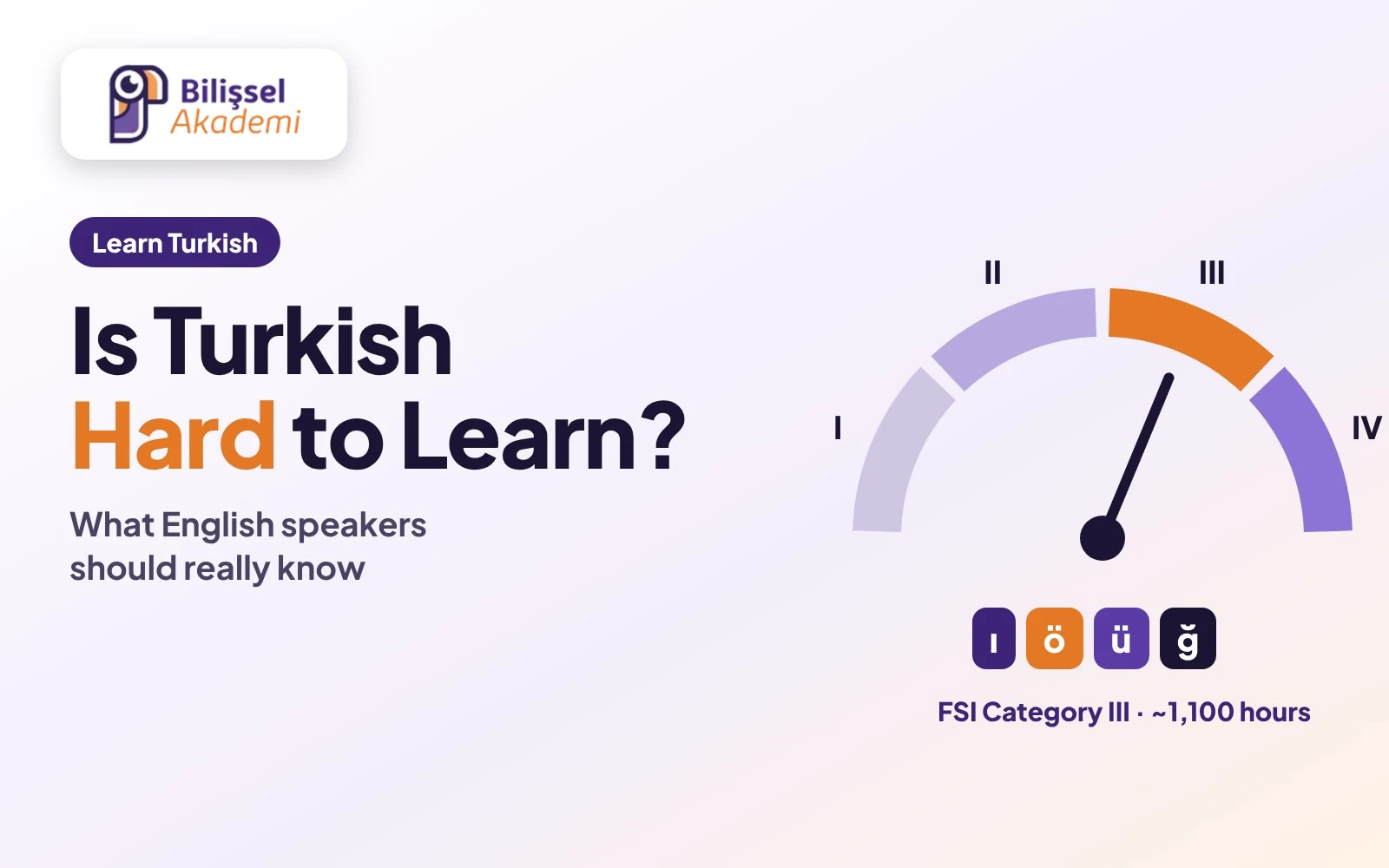
The US Foreign Service Institute groups languages by how long English-speaking diplomats need to reach professional working proficiency. Turkish sits in Category III, “hard languages” with significant linguistic or cultural differences from English, with an estimate of about 44 weeks or 1,100 class hours. That is more than Spanish or French (Category I) but half of Category IV languages such as Arabic, Japanese or Chinese.
Category I · ~24–30 weeks
- Spanish, French, Italian, Portuguese, Dutch
- Close to English in vocabulary and grammar
Category III · ~44 weeks
- Turkish, Russian, Greek, Hindi and many more
- Real differences, but a learnable system
The ranking measures time to a high professional level, not to everyday conversation. It also assumes classroom study. If you live in Turkey and hear Turkish all day, your “hours” grow much faster than a classroom timetable suggests.
What is easy about Turkish
Latin alphabet
29 letters, mostly familiar. Six new ones (ç, ğ, ı, ö, ş, ü) and three missing (q, w, x). You can read a street sign on day one.
Spelled as spoken
Each letter has one sound. Once you know the letters, you can pronounce any word you read, which English cannot promise.
No gender, no articles
No he/she distinction in the pronoun (o means he, she and it) and no “the”. Fewer things to memorise for every noun.
Very regular grammar
Suffixes follow clear patterns and there are very few irregular verbs. Learn a pattern once and it works almost everywhere.
Familiar loanwords
otobüs, taksi, istasyon, televizyon, kuaför: many everyday words come from French or English.
What is hard about Turkish
1Suffix chains
Turkish builds meaning by adding endings: ev (house) → evler (houses) → evlerimiz (our houses) → evlerimizde (in our houses). One word can carry a whole English phrase.
2Vowel harmony
Suffixes change their vowel to match the word:
evler but
kitaplar. It feels strange for a week and automatic after a few months. See
vowel harmony explained simply.
3Verb-final word order
“I tea drink.” The verb comes last, so you have to wait for the end of the sentence to know what is happening.
5Listening speed
Native speakers run words together, and the important information sits in the endings. Your ear needs daily exposure to catch them.
Test your ear: the hard sounds
PCFET0NUWVBFIGh0bWw+PGh0bWwgbGFuZz0idHIiPjxoZWFkPjxtZXRhIGNoYXJzZXQ9InV0Zi04Ij48bWV0YSBuYW1lPSJ2aWV3cG9ydCIgY29udGVudD0id2lkdGg9ZGV2aWNlLXdpZHRoLGluaXRpYWwtc2NhbGU9MSI+PHRpdGxlPlR1cmtpc2ggaGFyZCBzb3VuZHMgbGlzdGVuaW5nIHRlc3Q8L3RpdGxlPjxzdHlsZT4qe2JveC1zaXppbmc6Ym9yZGVyLWJveH1odG1sLGJvZHl7bWFyZ2luOjA7YmFja2dyb3VuZDp0cmFuc3BhcmVudH1odG1sLmVtYmVkLGh0bWwuZW1iZWQgYm9keXtvdmVyZmxvdzpoaWRkZW59Cjpyb290ey0tYTojM0MyNDc4Oy0tYTI6IzVCM0JBNjstLWI6I0U0NzgyNDstLWIyOiNGMjlBNEU7LS1zb2Z0OiNGM0VFRkI7LS1vc29mdDojRkZGMUU1Oy0tbGluZTojRTdFMUYyOy0taW5rOiMxQjE0MzM7LS1tdXQ6IzVDNTQ3NDstLW9rOiMxNjgzNEE7LS1va2JnOiNFOUY4RUY7LS1ubzojQzYyODI4Oy0tbm9iZzojRkRFQ0VDOy0td2FybjojOUE1QTAwOy0td2FybmJnOiNGRkY0RTI7LS1wYWxlOiNGQUY4RkR9CmJvZHl7Zm9udC1mYW1pbHk6IlBsdXMgSmFrYXJ0YSBTYW5zIixzeXN0ZW0tdWksLWFwcGxlLXN5c3RlbSwiU2Vnb2UgVUkiLFJvYm90byxBcmlhbCxzYW5zLXNlcmlmO2NvbG9yOnZhcigtLWluayk7Zm9udC1zaXplOjE2cHg7bGluZS1oZWlnaHQ6MS41Oy13ZWJraXQtdGV4dC1zaXplLWFkanVzdDoxMDAlfQojYXBwe3BhZGRpbmc6MnB4fWh0bWw6bm90KC5lbWJlZCkgI2FwcHttYXgtd2lkdGg6NzgwcHg7bWFyZ2luOjAgYXV0bztwYWRkaW5nOjIwcHggMTZweH0KLmJveHtiYWNrZ3JvdW5kOiNmZmY7Ym9yZGVyOjJweCBzb2xpZCB2YXIoLS1saW5lKTtib3JkZXItcmFkaXVzOjIycHg7b3ZlcmZsb3c6aGlkZGVufS5ib3grLmJveHttYXJnaW4tdG9wOjE2cHh9Ci5oZWFke2JhY2tncm91bmQ6bGluZWFyLWdyYWRpZW50KDEyMGRlZyx2YXIoLS1hKSx2YXIoLS1hMikpO2NvbG9yOiNmZmY7cGFkZGluZzoxNHB4IDE4cHg7ZGlzcGxheTpmbGV4O2p1c3RpZnktY29udGVudDpzcGFjZS1iZXR3ZWVuO2FsaWduLWl0ZW1zOmNlbnRlcjtnYXA6NnB4IDEycHg7ZmxleC13cmFwOndyYXA7Ym9yZGVyLWJvdHRvbTo0cHggc29saWQgdmFyKC0tYil9Ci5oZWFkIGJ7Zm9udC1zaXplOjE4cHg7bGluZS1oZWlnaHQ6MS4yNX0uaGVhZCBzcGFue2ZvbnQtc2l6ZToxMy41cHg7Y29sb3I6cmdiYSgyNTUsMjU1LDI1NSwuODYpfQouYm9keXtwYWRkaW5nOjE2cHggMThweCAxOHB4fQouaW50cm97Y29sb3I6dmFyKC0tbXV0KTtmb250LXNpemU6MTQuNXB4O21hcmdpbjowIDAgMTRweH0KYnV0dG9ue2ZvbnQ6aW5oZXJpdDtjb2xvcjppbmhlcml0O2N1cnNvcjpwb2ludGVyOy13ZWJraXQtdGFwLWhpZ2hsaWdodC1jb2xvcjp0cmFuc3BhcmVudH0KaW5wdXQsc2VsZWN0e2ZvbnQ6aW5oZXJpdDtjb2xvcjppbmhlcml0fQouYnRue2JvcmRlcjowO2JvcmRlci1yYWRpdXM6MTJweDtwYWRkaW5nOjEwcHggMTZweDtmb250LXdlaWdodDo4MDA7Zm9udC1zaXplOjE1cHg7YmFja2dyb3VuZDp2YXIoLS1hKTtjb2xvcjojZmZmO21pbi1oZWlnaHQ6NDRweH0KLmJ0bi5ve2JhY2tncm91bmQ6dmFyKC0tYil9LmJ0bi5naG9zdHtiYWNrZ3JvdW5kOiNGMkVGRjg7Y29sb3I6dmFyKC0taW5rKX0uYnRuOmRpc2FibGVke29wYWNpdHk6LjQ1O2N1cnNvcjpkZWZhdWx0fQouYnRuc3tkaXNwbGF5OmZsZXg7ZmxleC13cmFwOndyYXA7Z2FwOjhweDttYXJnaW4tdG9wOjEwcHh9Ci5zcGt7ZGlzcGxheTppbmxpbmUtZmxleDthbGlnbi1pdGVtczpjZW50ZXI7anVzdGlmeS1jb250ZW50OmNlbnRlcjtnYXA6NnB4O2JvcmRlcjoxLjVweCBzb2xpZCB2YXIoLS1saW5lKTtiYWNrZ3JvdW5kOiNmZmY7Ym9yZGVyLXJhZGl1czo5OTlweDttaW4td2lkdGg6NDBweDtoZWlnaHQ6NDBweDtwYWRkaW5nOjAgMTJweDtjb2xvcjp2YXIoLS1hKTtmb250LXdlaWdodDo4MDA7Zm9udC1zaXplOjEzLjVweDt2ZXJ0aWNhbC1hbGlnbjptaWRkbGU7ZmxleDpub25lO2xpbmUtaGVpZ2h0OjF9Ci5zcGsgc3Zne3dpZHRoOjE4cHg7aGVpZ2h0OjE4cHg7ZmxleDpub25lfS5zcGs6aG92ZXJ7Ym9yZGVyLWNvbG9yOnZhcigtLWIpfQouc3BrLm9ue2JhY2tncm91bmQ6dmFyKC0tb3NvZnQpO2JvcmRlci1jb2xvcjp2YXIoLS1iKTthbmltYXRpb246YmEtcHVsc2UgMXMgaW5maW5pdGV9Ci5zcGsuYmlne2hlaWdodDo0NnB4O3BhZGRpbmc6MCAxOHB4O2ZvbnQtc2l6ZToxNXB4O2JhY2tncm91bmQ6dmFyKC0tYik7Y29sb3I6I2ZmZjtib3JkZXItY29sb3I6dmFyKC0tYil9LnNway5iaWcub257YmFja2dyb3VuZDp2YXIoLS1hKTtib3JkZXItY29sb3I6dmFyKC0tYSk7Y29sb3I6I2ZmZn0KQGtleWZyYW1lcyBiYS1wdWxzZXs1MCV7Ym94LXNoYWRvdzowIDAgMCA2cHggcmdiYSgyMjgsMTIwLDM2LC4xOCl9fQoudHJ7Y29sb3I6dmFyKC0tbXV0KTtmb250LXNpemU6MTRweH0KLnRvcGxpbmV7ZGlzcGxheTpmbGV4O2p1c3RpZnktY29udGVudDpzcGFjZS1iZXR3ZWVuO2FsaWduLWl0ZW1zOmNlbnRlcjtnYXA6OHB4O2ZsZXgtd3JhcDp3cmFwfQouY250e2ZvbnQtc2l6ZToxM3B4O2NvbG9yOnZhcigtLW11dCk7Zm9udC13ZWlnaHQ6ODAwfQoucHJvZ3toZWlnaHQ6OHB4O2JhY2tncm91bmQ6I0VGRUFGNztib3JkZXItcmFkaXVzOjk5cHg7b3ZlcmZsb3c6aGlkZGVuO21hcmdpbjo2cHggMCAxNHB4fS5wcm9nIGl7ZGlzcGxheTpibG9jaztoZWlnaHQ6MTAwJTt3aWR0aDowO2JhY2tncm91bmQ6bGluZWFyLWdyYWRpZW50KDkwZGVnLHZhcigtLWEpLHZhcigtLWIpKTt0cmFuc2l0aW9uOndpZHRoIC4zc30KLnF7Ym9yZGVyOjEuNXB4IHNvbGlkIHZhcigtLWxpbmUpO2JvcmRlci1yYWRpdXM6MTZweDtwYWRkaW5nOjE0cHg7bWFyZ2luLWJvdHRvbToxMnB4fQoucW57Zm9udC1zaXplOjEycHg7Zm9udC13ZWlnaHQ6ODAwO2NvbG9yOnZhcigtLWIpO2xldHRlci1zcGFjaW5nOi4wNWVtO3RleHQtdHJhbnNmb3JtOnVwcGVyY2FzZX0KLnF0e2ZvbnQtd2VpZ2h0OjcwMDttYXJnaW46NHB4IDAgMTBweDtkaXNwbGF5OmZsZXg7Z2FwOjEwcHg7YWxpZ24taXRlbXM6ZmxleC1zdGFydDtqdXN0aWZ5LWNvbnRlbnQ6c3BhY2UtYmV0d2Vlbn0KLmN0eHtiYWNrZ3JvdW5kOnZhcigtLXBhbGUpO2JvcmRlci1yYWRpdXM6MTBweDtwYWRkaW5nOjlweCAxMnB4O21hcmdpbjowIDAgMTBweDtmb250LXNpemU6MTUuNXB4fQoubGlzdGVue2Rpc3BsYXk6ZmxleDtnYXA6OHB4O2ZsZXgtd3JhcDp3cmFwO21hcmdpbjoycHggMCAxMnB4fQoub3B0c3tkaXNwbGF5OmdyaWQ7Z2FwOjhweH0ub3B0cy5yb3d7Z3JpZC10ZW1wbGF0ZS1jb2x1bW5zOnJlcGVhdChhdXRvLWZpbGwsbWlubWF4KDExOHB4LDFmcikpfQoub3B0e2JvcmRlcjoxLjVweCBzb2xpZCB2YXIoLS1saW5lKTtiYWNrZ3JvdW5kOiNmZmY7Ym9yZGVyLXJhZGl1czoxMnB4O3BhZGRpbmc6MTBweCAxMnB4O3RleHQtYWxpZ246bGVmdDtmb250LXdlaWdodDo2MDA7bWluLWhlaWdodDo0NHB4fQoub3B0OmhvdmVyOm5vdCg6ZGlzYWJsZWQpe2JvcmRlci1jb2xvcjp2YXIoLS1iKX0ub3B0OmRpc2FibGVke2N1cnNvcjpkZWZhdWx0fQoub2t7Ym9yZGVyLWNvbG9yOnZhcigtLW9rKSFpbXBvcnRhbnQ7YmFja2dyb3VuZDp2YXIoLS1va2JnKSFpbXBvcnRhbnQ7Y29sb3I6IzBFNUEzMSFpbXBvcnRhbnR9Ci5ub3tib3JkZXItY29sb3I6dmFyKC0tbm8pIWltcG9ydGFudDtiYWNrZ3JvdW5kOnZhcigtLW5vYmcpIWltcG9ydGFudDtjb2xvcjojOEUxQjFCIWltcG9ydGFudH0KLndoeXtkaXNwbGF5Om5vbmU7bWFyZ2luLXRvcDoxMHB4O2ZvbnQtc2l6ZToxNC41cHg7cGFkZGluZzoxMHB4IDEycHg7Ym9yZGVyLXJhZGl1czoxMnB4O2JhY2tncm91bmQ6dmFyKC0tcGFsZSl9LndoeS5zaG93e2Rpc3BsYXk6YmxvY2t9Ci5yZXN7ZGlzcGxheTpub25lO2JvcmRlci1yYWRpdXM6MTZweDtwYWRkaW5nOjE2cHg7YmFja2dyb3VuZDp2YXIoLS1zb2Z0KTttYXJnaW4tdG9wOjZweH0ucmVzLnNob3d7ZGlzcGxheTpibG9ja30KLnJlcyAuYmlne2ZvbnQtc2l6ZTozMHB4O2ZvbnQtd2VpZ2h0OjgwMDtjb2xvcjp2YXIoLS1hKTtsaW5lLWhlaWdodDoxLjF9LnJlcyBoNHttYXJnaW46NHB4IDAgNHB4O2ZvbnQtc2l6ZToxOHB4fS5yZXMgcHttYXJnaW46MH0KLmN0YXtkaXNwbGF5OmZsZXg7ZmxleC13cmFwOndyYXA7Z2FwOjhweDttYXJnaW4tdG9wOjEycHh9Ci5jdGEgYXtmbGV4OjEgMSAxNzBweDt0ZXh0LWFsaWduOmNlbnRlcjtib3JkZXItcmFkaXVzOjEycHg7cGFkZGluZzoxMXB4IDE0cHg7Zm9udC13ZWlnaHQ6ODAwO3RleHQtZGVjb3JhdGlvbjpub25lO2ZvbnQtc2l6ZToxNXB4fQouY3RhIC5we2JhY2tncm91bmQ6dmFyKC0tYik7Y29sb3I6I2ZmZn0uY3RhIC53e2JhY2tncm91bmQ6I0U3RjhFRTtjb2xvcjojMTI2QjM1fS5jdGEgLmd7YmFja2dyb3VuZDojRjJFRkY4O2NvbG9yOnZhcigtLWluayl9Ci5ub3Rle2ZvbnQtc2l6ZToxMi41cHg7Y29sb3I6dmFyKC0tbXV0KTttYXJnaW4tdG9wOjEwcHh9Ci50b2FzdHtkaXNwbGF5Om5vbmU7bWFyZ2luLXRvcDoxMHB4O2ZvbnQtc2l6ZToxMy41cHg7YmFja2dyb3VuZDp2YXIoLS13YXJuYmcpO2JvcmRlcjoxcHggc29saWQgI0Y1RDlBNjtjb2xvcjojN0E0QTAwO2JvcmRlci1yYWRpdXM6MTBweDtwYWRkaW5nOjhweCAxMHB4fS50b2FzdC5zaG93e2Rpc3BsYXk6YmxvY2t9Ci5jaGlwe2Rpc3BsYXk6aW5saW5lLWZsZXg7YWxpZ24taXRlbXM6Y2VudGVyO2dhcDo2cHg7Ym9yZGVyOjEuNXB4IHNvbGlkIHZhcigtLWxpbmUpO2JhY2tncm91bmQ6I2ZmZjtib3JkZXItcmFkaXVzOjEycHg7cGFkZGluZzo4cHggMTJweDtmb250LXdlaWdodDo3MDA7bWFyZ2luOjRweDtmb250LXNpemU6MTVweDttaW4taGVpZ2h0OjQ0cHh9Ci5jaGlwLnNlbHtib3JkZXItY29sb3I6dmFyKC0tYSk7YmFja2dyb3VuZDp2YXIoLS1zb2Z0KTtjb2xvcjp2YXIoLS1hKX0KLmlucHttaW4td2lkdGg6MDtib3JkZXI6MS41cHggc29saWQgdmFyKC0tbGluZSk7Ym9yZGVyLXJhZGl1czoxMHB4O3BhZGRpbmc6OHB4IDEwcHg7Zm9udC1zaXplOjE2cHg7YmFja2dyb3VuZDojZmZmO3dpZHRoOjEwMCV9Ci5pbnA6Zm9jdXN7b3V0bGluZTpub25lO2JvcmRlci1jb2xvcjp2YXIoLS1iKX0KLnRhZ3tkaXNwbGF5OmlubGluZS1ibG9jaztmb250LXNpemU6MTEuNXB4O2ZvbnQtd2VpZ2h0OjgwMDtib3JkZXItcmFkaXVzOjk5OXB4O3BhZGRpbmc6M3B4IDlweDtiYWNrZ3JvdW5kOnZhcigtLXNvZnQpO2NvbG9yOnZhcigtLWEpfQoubXV0ZWR7Y29sb3I6dmFyKC0tbXV0KX0KLmJhZGdle2Rpc3BsYXk6aW5saW5lLWZsZXg7YWxpZ24taXRlbXM6Y2VudGVyO2dhcDo2cHg7Ym9yZGVyLXJhZGl1czo5OTlweDtwYWRkaW5nOjVweCAxMnB4O2ZvbnQtd2VpZ2h0OjgwMDtmb250LXNpemU6MTRweH0KLmItb2t7YmFja2dyb3VuZDp2YXIoLS1va2JnKTtjb2xvcjojMEU1QTMxfS5iLW5ve2JhY2tncm91bmQ6dmFyKC0tbm9iZyk7Y29sb3I6IzhFMUIxQn0uYi13YXJue2JhY2tncm91bmQ6dmFyKC0td2FybmJnKTtjb2xvcjp2YXIoLS13YXJuKX0uYi1pbmZve2JhY2tncm91bmQ6dmFyKC0tc29mdCk7Y29sb3I6dmFyKC0tYSl9Ci5wYW5lbHtib3JkZXItcmFkaXVzOjE2cHg7cGFkZGluZzoxNHB4IDE2cHg7bWFyZ2luLXRvcDoxMnB4O2JhY2tncm91bmQ6dmFyKC0tcGFsZSk7Ym9yZGVyOjEuNXB4IHNvbGlkIHZhcigtLWxpbmUpfQoucGFuZWwgaDR7bWFyZ2luOjAgMCA2cHg7Zm9udC1zaXplOjE3cHh9LnBhbmVsIHB7bWFyZ2luOjRweCAwfQouc3RhdHtkaXNwbGF5OmdyaWQ7Z3JpZC10ZW1wbGF0ZS1jb2x1bW5zOnJlcGVhdChhdXRvLWZpdCxtaW5tYXgoMTMwcHgsMWZyKSk7Z2FwOjhweDttYXJnaW46MTBweCAwfQouc3RhdCBkaXZ7YmFja2dyb3VuZDojZmZmO2JvcmRlcjoxLjVweCBzb2xpZCB2YXIoLS1saW5lKTtib3JkZXItcmFkaXVzOjE0cHg7cGFkZGluZzoxMHB4IDEycHh9Ci5zdGF0IHNtYWxse2Rpc3BsYXk6YmxvY2s7Zm9udC1zaXplOjEycHg7Zm9udC13ZWlnaHQ6ODAwO2NvbG9yOnZhcigtLW11dCk7dGV4dC10cmFuc2Zvcm06dXBwZXJjYXNlO2xldHRlci1zcGFjaW5nOi4wNGVtfS5zdGF0IGJ7Zm9udC1zaXplOjIycHg7Y29sb3I6dmFyKC0tYSl9Ci5zZWd7ZGlzcGxheTpmbGV4O2ZsZXgtd3JhcDp3cmFwO2dhcDo2cHh9LnNlZyBidXR0b257Ym9yZGVyOjEuNXB4IHNvbGlkIHZhcigtLWxpbmUpO2JhY2tncm91bmQ6I2ZmZjtib3JkZXItcmFkaXVzOjk5OXB4O3BhZGRpbmc6OHB4IDE0cHg7Zm9udC13ZWlnaHQ6NzAwO21pbi1oZWlnaHQ6NDJweH0uc2VnIGJ1dHRvbi5zZWx7YmFja2dyb3VuZDp2YXIoLS1hKTtib3JkZXItY29sb3I6dmFyKC0tYSk7Y29sb3I6I2ZmZn0KLnJhbmdle3dpZHRoOjEwMCU7YWNjZW50LWNvbG9yOnZhcigtLWIpO2hlaWdodDoyOHB4fQpAbWVkaWEgKG1heC13aWR0aDo0ODBweCl7LmJvZHl7cGFkZGluZzoxNHB4IDEycHggMTZweH0uaGVhZHtwYWRkaW5nOjEycHggMTRweH0uaGVhZCBie2ZvbnQtc2l6ZToxNi41cHh9LnN0YXQgYntmb250LXNpemU6MTlweH19CgpbbGFuZz1hcl0sLmFye2ZvbnQtZmFtaWx5OiJOb3RvIE5hc2toIEFyYWJpYyIsIkFtaXJpIiwiR2VlemEgUHJvIiwiVHJhZGl0aW9uYWwgQXJhYmljIiwiU2Vnb2UgVUkiLCJUYWhvbWEiLEFyaWFsLHNhbnMtc2VyaWY7ZGlyZWN0aW9uOnJ0bDt1bmljb2RlLWJpZGk6aXNvbGF0ZTtmb250LXNpemU6MS4yOGVtO2xpbmUtaGVpZ2h0OjEuNzU7Zm9udC13ZWlnaHQ6NjAwfQoudHJse2ZvbnQtc3R5bGU6aXRhbGljO2NvbG9yOnZhcigtLW11dCk7Zm9udC1zaXplOjE0cHh9Cjwvc3R5bGU+PC9oZWFkPjxib2R5PjxkaXYgaWQ9ImFwcCI+PC9kaXY+PHNjcmlwdD4oZnVuY3Rpb24oKXsidXNlIHN0cmljdCI7CnZhciBEPWRvY3VtZW50LFc9d2luZG93LEJBPVcuQkE9e2M6e30sbGFuZzoidHItVFIifTsKZnVuY3Rpb24gZXNjKHMpe3JldHVybiBTdHJpbmcocz09bnVsbD8iIjpzKS5yZXBsYWNlKC9bJjw+Il0vZyxmdW5jdGlvbihjKXtyZXR1cm57IiYiOiImYW1wOyIsIjwiOiImbHQ7IiwiPiI6IiZndDsiLCciJzoiJnF1b3Q7In1bY119KTt9CkJBLmVzYz1lc2M7CkJBLmZtdD1mdW5jdGlvbih4LGQpe2lmKHg9PW51bGx8fGlzTmFOKHgpKXJldHVybiLigJMiO3ZhciBzPSgreCkudG9GaXhlZChkPT1udWxsPzI6ZCk7cmV0dXJuIHMucmVwbGFjZSgiLiIsIiwiKTt9Owp2YXIgSUNPTj0nPHN2ZyB2aWV3Qm94PSIwIDAgMjQgMjQiIGFyaWEtaGlkZGVuPSJ0cnVlIj48cGF0aCBmaWxsPSJjdXJyZW50Q29sb3IiIGQ9Ik0zIDkuNXY1aDMuNkwxMSAxOC41di0xM0w2LjYgOS41SDN6bTEyLjMgMi41YTMuNiAzLjYgMCAwIDAtMi4xLTMuM3Y2LjZhMy42IDMuNiAwIDAgMCAyLjEtMy4zek0xMy4yIDQuM3YyYTYgNiAwIDAgMSAwIDExLjR2MmE4IDggMCAwIDAgMC0xNS40eiIvPjwvc3ZnPic7CkJBLmljb249SUNPTjsKQkEuc3BrPWZ1bmN0aW9uKHQsbGFiZWwsY2xzLHJhdGUsbGFuZyl7cmV0dXJuICc8YnV0dG9uIHR5cGU9ImJ1dHRvbiIgY2xhc3M9InNwaycrKGNscz8iICIrY2xzOiIiKSsnIiBkYXRhLXNheT0iJytlc2ModCkrJyInKyhyYXRlPycgZGF0YS1yYXRlPSInK3JhdGUrJyInOiIiKSsobGFuZz8nIGRhdGEtbGFuZz0iJytsYW5nKyciJzoiIikrJyBhcmlhLWxhYmVsPSJEaW5sZScrKGxhYmVsPyIgKCIrZXNjKGxhYmVsKSsiKSI6IiIpKyciPicrSUNPTisobGFiZWw/IjxzcGFuPiIrbGFiZWwrIjwvc3Bhbj4iOiIiKSsiPC9idXR0b24+Ijt9OwpCQS5zaHVmZmxlPWZ1bmN0aW9uKGEpe3ZhciBiPWEuc2xpY2UoKSxrPTA7ZG97Zm9yKHZhciBpPWIubGVuZ3RoLTE7aT4wO2ktLSl7dmFyIGo9TWF0aC5mbG9vcihNYXRoLnJhbmRvbSgpKihpKzEpKSx0PWJbaV07YltpXT1iW2pdO2Jbal09dDt9aysrO313aGlsZShiLmxlbmd0aD4xJiZrPDgmJmIuam9pbigiXHUwMDAxIik9PT1hLmpvaW4oIlx1MDAwMSIpKTtyZXR1cm4gYjt9OwpCQS5ub1ZvaWNlPWZ1bmN0aW9uKExOKXtpZihCQS51aT09PSJlbiIpe3ZhciB1YTA9bmF2aWdhdG9yLnVzZXJBZ2VudHx8IiIsdzA9L1dpbmRvd3MvLnRlc3QodWEwKSxlMD0vRWRnXC8vLnRlc3QodWEwKSxtMD0vQW5kcm9pZHxpUGhvbmV8aVBhZHxNb2JpbGUvLnRlc3QodWEwKSx0MD0iTm8gVHVya2lzaCB2b2ljZSB3YXMgZm91bmQgb24gdGhpcyBkZXZpY2UsIHNvIHlvdSBtYXkgbm90IGhlYXIgdGhlIGF1ZGlvLiAiO2lmKHcwJiYhZTApdDArPSJPbiBXaW5kb3dzIHRoZSBlYXNpZXN0IGZpeCBpcyB0byBvcGVuIHRoaXMgcGFnZSBpbiBNaWNyb3NvZnQgRWRnZS4gVG8gc3RheSBpbiBDaHJvbWUsIGFkZCBhIFR1cmtpc2ggdm9pY2UgaW4gV2luZG93cyBTZXR0aW5ncyA+IFRpbWUgJiBsYW5ndWFnZSA+IFNwZWVjaCBhbmQgcmVzdGFydCBDaHJvbWUuIjtlbHNlIGlmKHcwKXQwKz0iQWRkIGEgVHVya2lzaCB2b2ljZSBpbiBXaW5kb3dzIFNldHRpbmdzID4gVGltZSAmIGxhbmd1YWdlID4gU3BlZWNoIGFuZCByZXN0YXJ0IHRoZSBicm93c2VyLiI7ZWxzZSBpZihtMCl0MCs9IllvdSBjYW4gYWRkIGEgVHVya2lzaCB2b2ljZSBpbiB5b3VyIHBob25lJ3MgdGV4dC10by1zcGVlY2ggc2V0dGluZ3MuIjtlbHNlIHQwKz0iQWRkIGEgVHVya2lzaCB0ZXh0LXRvLXNwZWVjaCB2b2ljZSBpbiB5b3VyIGRldmljZSBzZXR0aW5ncyBhbmQgcmVzdGFydCB0aGUgYnJvd3Nlci4iO3JldHVybiB0MDt9dmFyIHVhPW5hdmlnYXRvci51c2VyQWdlbnR8fCIiLHdpbj0vV2luZG93cy8udGVzdCh1YSksZWRnZT0vRWRnXC8vLnRlc3QodWEpLG1vYj0vQW5kcm9pZHxpUGhvbmV8aVBhZHxNb2JpbGUvLnRlc3QodWEpLG09IkJ1IGNpaGF6ZGEgIitMTisiIHNlcyBidWx1bmFtYWTEsSwgYnUgecO8emRlbiBva3VudcWfIGR1eXVsbWF5YWJpbGlyLiAiO2lmKHdpbiYmIWVkZ2UpbSs9IldpbmRvd3MndGEgZW4ga29sYXkgw6fDtnrDvG0gc2F5ZmF5xLEgTWljcm9zb2Z0IEVkZ2UgaWxlIGHDp21hay4gQ2hyb21lJ2RhIGthbG1hayBpc3RlcnNlbml6IFdpbmRvd3MgQXlhcmxhciA+IFNhYXQgdmUgZGlsID4gS29udcWfbWEgYsO2bMO8bcO8bmRlbiAiK0xOKyIgc2VzIGVrbGV5aXAgQ2hyb21lJ3UgeWVuaWRlbiBiYcWfbGF0xLFuLiI7ZWxzZSBpZih3aW4pbSs9IldpbmRvd3MgQXlhcmxhciA+IFNhYXQgdmUgZGlsID4gS29udcWfbWEgYsO2bMO8bcO8bmRlbiAiK0xOKyIgc2VzIGVrbGV5aXAgdGFyYXnEsWPEsXnEsSB5ZW5pZGVuIGJhxZ9sYXTEsW4uIjtlbHNlIGlmKG1vYiltKz0iVGVsZWZvbiBheWFybGFyxLFuZGFraSBtZXRpbiBva3VtYSAoeWF6xLFkYW4ga29udcWfbWF5YSkgYsO2bMO8bcO8bmRlbiAiK0xOKyIgc2VzaSBla2xleWViaWxpcnNpbml6LiI7ZWxzZSBtKz0iQ2loYXrEsW4gYXlhcmxhcsSxbmRhbiAiK0xOKyIgbWV0aW4gb2t1bWEgc2VzaSBla2xleWlwIHRhcmF5xLFjxLF5xLEgeWVuaWRlbiBiYcWfbGF0xLFuLiI7cmV0dXJuIG07fTsKLyogLS0tLS0tLS0tLSBzcGVlY2ggKGxhbmd1YWdlLWF3YXJlKSAtLS0tLS0tLS0tICovCnZhciBUVFM9QkEudHRzPXt2Om51bGwsCnBpY2s6ZnVuY3Rpb24oKXtpZighKCJzcGVlY2hTeW50aGVzaXMiIGluIFcpKXJldHVybjt2YXIgTD1CQS5sYW5nLGJhc2U9TC5zcGxpdCgiLSIpWzBdLnRvTG93ZXJDYXNlKCksdnM9Vy5zcGVlY2hTeW50aGVzaXMuZ2V0Vm9pY2VzKCl8fFtdLAptPXZzLmZpbHRlcihmdW5jdGlvbih2KXtyZXR1cm4gdi5sYW5nJiZ2LmxhbmcucmVwbGFjZSgiXyIsIi0iKS50b0xvd2VyQ2FzZSgpLmluZGV4T2YoYmFzZSk9PT0wO30pOwp2YXIgZXg9bS5maWx0ZXIoZnVuY3Rpb24odil7cmV0dXJuIHYubGFuZy5yZXBsYWNlKCJfIiwiLSIpLnRvTG93ZXJDYXNlKCk9PT1MLnRvTG93ZXJDYXNlKCk7fSk7dGhpcy52PWV4LmZpbHRlcihmdW5jdGlvbih2KXtyZXR1cm4gL2dvb2dsZS9pLnRlc3Qodi5uYW1lKTt9KVswXXx8bS5maWx0ZXIoZnVuY3Rpb24odil7cmV0dXJuIC9nb29nbGUvaS50ZXN0KHYubmFtZSk7fSlbMF18fGV4LmZpbHRlcihmdW5jdGlvbih2KXtyZXR1cm4gL25hdHVyYWx8b25saW5lfG5ldXJhbC9pLnRlc3Qodi5uYW1lKTt9KVswXXx8bS5maWx0ZXIoZnVuY3Rpb24odil7cmV0dXJuIC9uYXR1cmFsfG9ubGluZXxuZXVyYWwvaS50ZXN0KHYubmFtZSk7fSlbMF18fG0uZmlsdGVyKGZ1bmN0aW9uKHYpe3JldHVybiB2LmxhbmcucmVwbGFjZSgiXyIsIi0iKS50b0xvd2VyQ2FzZSgpPT09TC50b0xvd2VyQ2FzZSgpO30pWzBdfHxtWzBdfHxudWxsO30sCnZvaWNlRm9yOmZ1bmN0aW9uKEwpe2lmKCEoInNwZWVjaFN5bnRoZXNpcyIgaW4gVykpcmV0dXJuIG51bGw7dmFyIHZzPVcuc3BlZWNoU3ludGhlc2lzLmdldFZvaWNlcygpfHxbXSxsPUwudG9Mb3dlckNhc2UoKSxiYXNlPWwuc3BsaXQoIi0iKVswXSxubT1mdW5jdGlvbih2KXtyZXR1cm4gKHYubGFuZ3x8IiIpLnJlcGxhY2UoIl8iLCItIikudG9Mb3dlckNhc2UoKTt9Owp2YXIgZXg9dnMuZmlsdGVyKGZ1bmN0aW9uKHYpe3JldHVybiBubSh2KT09PWw7fSksbT12cy5maWx0ZXIoZnVuY3Rpb24odil7cmV0dXJuIG5tKHYpLmluZGV4T2YoYmFzZSk9PT0wO30pO3ZhciBwcmVmPWZ1bmN0aW9uKGEpe3JldHVybiBhLmZpbHRlcihmdW5jdGlvbih2KXtyZXR1cm4gL2dvb2dsZS9pLnRlc3Qodi5uYW1lKTt9KVswXXx8YS5maWx0ZXIoZnVuY3Rpb24odil7cmV0dXJuIC9uYXR1cmFsfG9ubGluZXxuZXVyYWwvaS50ZXN0KHYubmFtZSk7fSlbMF18fGFbMF18fG51bGw7fTsKcmV0dXJuIHt2OnByZWYoZXgpfHxwcmVmKG0pLGV4YWN0OmV4Lmxlbmd0aD4wfTt9LApzYXk6ZnVuY3Rpb24odCxyYXRlLGJ0bixsYW5nKXtpZighKCJzcGVlY2hTeW50aGVzaXMiIGluIFcpfHwhVy5TcGVlY2hTeW50aGVzaXNVdHRlcmFuY2Upe0JBLnRvYXN0KEJBLnVpPT09ImVuIj8iWW91ciBicm93c2VyIGRvZXMgbm90IHN1cHBvcnQgc3BlZWNoLiBUcnkgQ2hyb21lLCBFZGdlIG9yIFNhZmFyaS4iOiJUYXJhecSxY8SxbsSxeiBzZXNsaSBva3VtYXnEsSBkZXN0ZWtsZW1peW9yLiBDaHJvbWUsIEVkZ2UgdmV5YSBTYWZhcmkgaWxlIGRlbmV5aW4uIik7cmV0dXJuO30KdmFyIFM9Vy5zcGVlY2hTeW50aGVzaXM7Uy5jYW5jZWwoKTtpZighdGhpcy52KXRoaXMucGljaygpOwp2YXIgdT1uZXcgVy5TcGVlY2hTeW50aGVzaXNVdHRlcmFuY2UodCk7dS5sYW5nPUJBLmxhbmc7aWYodGhpcy52KXUudm9pY2U9dGhpcy52O2lmKGxhbmcmJmxhbmchPT1CQS5sYW5nKXt1Lmxhbmc9bGFuZzt2YXIgdmY9dGhpcy52b2ljZUZvcihsYW5nKTtpZih2ZiYmdmYudil1LnZvaWNlPXZmLnY7fXUucmF0ZT1yYXRlfHwwLjk1O3UucGl0Y2g9MTsKRC5xdWVyeVNlbGVjdG9yQWxsKCIuc3BrLm9uIikuZm9yRWFjaChmdW5jdGlvbihiKXtiLmNsYXNzTGlzdC5yZW1vdmUoIm9uIik7fSk7CmlmKGJ0bil7YnRuLmNsYXNzTGlzdC5hZGQoIm9uIik7dmFyIG9mZj1mdW5jdGlvbigpe2J0bi5jbGFzc0xpc3QucmVtb3ZlKCJvbiIpO307dS5vbmVuZD1vZmY7dS5vbmVycm9yPW9mZjtzZXRUaW1lb3V0KG9mZixNYXRoLm1heCgyNTAwLHQubGVuZ3RoKjEyMC8ocmF0ZXx8MC45NSkpKTt9ClMuc3BlYWsodSk7CmlmKCF0aGlzLnYmJiF0aGlzLndhcm5lZCl7dmFyIHNlbGY9dGhpcztzZXRUaW1lb3V0KGZ1bmN0aW9uKCl7c2VsZi5waWNrKCk7aWYoIXNlbGYudil7c2VsZi53YXJuZWQ9MTt2YXIgTE49e3RyOiJUw7xya8OnZSIsZGU6IkFsbWFuY2EgKERldXRzY2gpIixlbjoixLBuZ2lsaXpjZSIsZnI6IkZyYW5zxLF6Y2EiLGl0OiLEsHRhbHlhbmNhIixhcjoiQXJhcMOnYSJ9W0JBLmxhbmcuc3BsaXQoIi0iKVswXV18fCJidSBkaWwiO0JBLnRvYXN0KEJBLm5vVm9pY2UoTE4pKTt9fSw3MDApO30KfX07CmlmKCJzcGVlY2hTeW50aGVzaXMiIGluIFcpe1RUUy5waWNrKCk7dHJ5e1cuc3BlZWNoU3ludGhlc2lzLmFkZEV2ZW50TGlzdGVuZXIoInZvaWNlc2NoYW5nZWQiLGZ1bmN0aW9uKCl7VFRTLnBpY2soKTt9KTt9Y2F0Y2goZSl7Vy5zcGVlY2hTeW50aGVzaXMub252b2ljZXNjaGFuZ2VkPWZ1bmN0aW9uKCl7VFRTLnBpY2soKTt9O319CkQuYWRkRXZlbnRMaXN0ZW5lcigiY2xpY2siLGZ1bmN0aW9uKGUpe3ZhciBiPWUudGFyZ2V0LmNsb3Nlc3QmJmUudGFyZ2V0LmNsb3Nlc3QoIltkYXRhLXNheV0iKTtpZighYilyZXR1cm47ZS5wcmV2ZW50RGVmYXVsdCgpO1RUUy5zYXkoYi5nZXRBdHRyaWJ1dGUoImRhdGEtc2F5IiksYi5nZXRBdHRyaWJ1dGUoImRhdGEtcmF0ZSIpPytiLmdldEF0dHJpYnV0ZSgiZGF0YS1yYXRlIik6MCxiLGIuZ2V0QXR0cmlidXRlKCJkYXRhLWxhbmciKSk7fSk7Ci8qIC0tLS0tLS0tLS0gbGF5b3V0IGhlbHBlcnMgLS0tLS0tLS0tLSAqLwpCQS50b2FzdD1mdW5jdGlvbihtc2cpe3ZhciB0PUQucXVlcnlTZWxlY3RvcigiI2JhLXRvYXN0Iik7aWYoIXQpcmV0dXJuO3QudGV4dENvbnRlbnQ9bXNnO3QuY2xhc3NMaXN0LmFkZCgic2hvdyIpO0JBLnBvc3QoKTt9OwpCQS5ib3g9ZnVuY3Rpb24oYil7dmFyIHM9RC5jcmVhdGVFbGVtZW50KCJzZWN0aW9uIik7cy5jbGFzc05hbWU9ImJveCI7cy5pbm5lckhUTUw9JzxkaXYgY2xhc3M9ImhlYWQiPjxiPicrKGIudGl0bGV8fCIiKSsiPC9iPiIrKGIuc3ViPyI8c3Bhbj4iK2Iuc3ViKyI8L3NwYW4+IjoiIikrJzwvZGl2PjxkaXYgY2xhc3M9ImJvZHkiPicrKGIuaW50cm8/JzxwIGNsYXNzPSJpbnRybyI+JytiLmludHJvKyI8L3A+IjoiIikrJzxkaXYgY2xhc3M9ImlubmVyIj48L2Rpdj48L2Rpdj4nO3JldHVybiBzO307CkJBLmNvdW50ZXI9ZnVuY3Rpb24ocm9vdCxuLGxhYmVsKXt2YXIgdz1ELmNyZWF0ZUVsZW1lbnQoImRpdiIpO3cuaW5uZXJIVE1MPSc8ZGl2IGNsYXNzPSJ0b3BsaW5lIj48c3BhbiBjbGFzcz0iY250Ij4wIC8gJytuKyIgIisobGFiZWx8fCJ5YW7EsXQiKSsnPC9zcGFuPjxzcGFuIGNsYXNzPSJjbnQgc2MiPjwvc3Bhbj48L2Rpdj48ZGl2IGNsYXNzPSJwcm9nIj48aT48L2k+PC9kaXY+Jztyb290LmFwcGVuZENoaWxkKHcpOwpyZXR1cm57c2V0OmZ1bmN0aW9uKGQscyl7dy5xdWVyeVNlbGVjdG9yKCIuY250IikudGV4dENvbnRlbnQ9ZCsiIC8gIituKyIgIisobGFiZWx8fCJ5YW7EsXQiKTt3LnF1ZXJ5U2VsZWN0b3IoIi5wcm9nIGkiKS5zdHlsZS53aWR0aD0oMTAwKmQvbikrIiUiO3cucXVlcnlTZWxlY3RvcigiLnNjIikudGV4dENvbnRlbnQ9ZD8oIkRvxJ9ydTogIitzKToiIjt9fTt9OwpCQS5jdGFIdG1sPWZ1bmN0aW9uKGMpe2lmKCFjKXJldHVybiIiO3JldHVybiAoYy50ZXh0Pyc8cCBzdHlsZT0ibWFyZ2luLXRvcDoxMHB4Ij4nK2MudGV4dCsiPC9wPiI6IiIpKyc8ZGl2IGNsYXNzPSJjdGEiPicrYy5saW5rcy5tYXAoZnVuY3Rpb24obCl7cmV0dXJuICc8YSBjbGFzcz0iJysobC5jfHwicCIpKyciIGhyZWY9IicrZXNjKGwuaHJlZikrJyIgdGFyZ2V0PSJfdG9wIiByZWw9Im5vb3BlbmVyIj4nK2wubCsiPC9hPiI7fSkuam9pbigiIikrIjwvZGl2PiI7fTsKQkEucmVzdWx0PWZ1bmN0aW9uKGNmZyxzY29yZSxuKXt2YXIgYmFuZHM9Y2ZnLmJhbmRzfHxbe21pbjoxLHQ6Ikt1c3Vyc3V6ISIsZDoiQnUga29udXl1IG90dXJ0bXXFn3N1bi4gQmlyIHNvbnJha2kga29udXlhIGdlw6dlYmlsaXJzaW4uIn0se21pbjowLjYsdDoiw4dvayBpeWkgZ2lkaXlvcnN1biIsZDoiWWFubMSxxZ8geWFwdMSxxJ/EsW4gc29ydWxhcsSxbiBhw6fEsWtsYW1hbGFyxLFuxLEgYmlyIGtleiBkYWhhIG9rdS4ifSx7bWluOjAsdDoiVGVrcmFyIHphbWFuxLEiLGQ6Ill1a2FyxLFkYWtpIGFubGF0xLFtYSBkw7Zuw7xwIMO2cm5la2xlcmkgeWVuaWRlbiDDp8O2eiwgc29ucmEgdGVzdGkgYmHFn3RhbiBkZW5lLiJ9XTsKdmFyIHI9c2NvcmUvbixiPWJhbmRzW2JhbmRzLmxlbmd0aC0xXTtmb3IodmFyIGk9MDtpPGJhbmRzLmxlbmd0aDtpKyspe2lmKHI+PWJhbmRzW2ldLm1pbil7Yj1iYW5kc1tpXTticmVhazt9fQpyZXR1cm4gJzxkaXYgY2xhc3M9ImJpZyI+JytzY29yZSsiIC8gIituKyI8L2Rpdj48aDQ+IitiLnQrIjwvaDQ+PHA+IitiLmQrIjwvcD4iK0JBLmN0YUh0bWwoY2ZnLmN0YSkrJzxkaXYgY2xhc3M9ImJ0bnMiPjxidXR0b24gdHlwZT0iYnV0dG9uIiBjbGFzcz0iYnRuIGdob3N0IHJlZG8iPkJhxZ90YW4gw6fDtno8L2J1dHRvbj48L2Rpdj4nO307Ci8qIC0tLS0tLS0tLS0gaGVpZ2h0IG1lc3NhZ2luZyBmb3IgdGhlIHNpdGUncyBiYS1lbWJlZCBsb2FkZXIgLS0tLS0tLS0tLSAqLwp2YXIgaW5GcmFtZT1mYWxzZTt0cnl7aW5GcmFtZT1XLnNlbGYhPT1XLnRvcDt9Y2F0Y2goZSl7aW5GcmFtZT10cnVlO30KaWYoaW5GcmFtZSlELmRvY3VtZW50RWxlbWVudC5jbGFzc0xpc3QuYWRkKCJlbWJlZCIpOwp2YXIgbGFzdEg9MCx0bT0wOwpCQS5wb3N0PWZ1bmN0aW9uKCl7Y2xlYXJUaW1lb3V0KHRtKTt0bT1zZXRUaW1lb3V0KGZ1bmN0aW9uKCl7dmFyIGE9RC5nZXRFbGVtZW50QnlJZCgiYXBwIik7aWYoIWEpcmV0dXJuO3ZhciBoPU1hdGguY2VpbChhLmdldEJvdW5kaW5nQ2xpZW50UmVjdCgpLmhlaWdodCkrNjtpZihNYXRoLmFicyhoLWxhc3RIKT4xKXtsYXN0SD1oO3RyeXtXLnBhcmVudC5wb3N0TWVzc2FnZSh7YmFFbWJlZEhlaWdodDpofSwiKiIpO31jYXRjaChlKXt9fX0sMzApO307Ci8qIC0tLS0tLS0tLS0gVUkgbGFuZ3VhZ2UgKGNmZy51aT0iZW4iKSAtLS0tLS0tLS0tICovCkJBLkVOPVtbIkRpbmxlIHZlIGRvxJ9ydSBjZXZhYsSxIHNlw6cuIiwiTGlzdGVuIGFuZCBjaG9vc2UgdGhlIHJpZ2h0IGFuc3dlci4iXSxbIsOHw7Z6w7xtw7wgZGlubGUiLCJMaXN0ZW4gdG8gdGhlIGV4cGxhbmF0aW9uIl0sWyLinJMgRG/En3J1LiIsIuKckyBDb3JyZWN0LiJdLFsi4pyXIERvxJ9ydSBjZXZhcDogIiwi4pyXIEFuc3dlcjogIl0sWyJCYcWfdGFuIMOnw7Z6IiwiVHJ5IGFnYWluIl0sWyJIYXRhc8SxeiBlxZ9sZcWfdGlyZGluISIsIk5vIG1pc3Rha2VzISJdLFsiIGhhdGFsxLEgZGVuZW1lbiBvbGR1LiAiLCIgd3JvbmcgdHJpZXMuICJdLFsiSGF0YWzEsSBkZW5lbWU6ICIsIldyb25nIHRyaWVzOiAiXSxbIkthcsSxxZ90xLFyLCB5ZW5pZGVuIG95bmEiLCJTaHVmZmxlIGFuZCBwbGF5IGFnYWluIl0sWyJUYW1hbWxhbmTEsSIsIkRvbmUiXSxbIiBlxZ9sZcWfbWUiLCIgbWF0Y2hlZCJdLFsiRG/En3J1OiAiLCJDb3JyZWN0OiAiXSxbIiB5YW7EsXQiLCIgYW5zd2VyZWQiXSxbIlNvcnUgIiwiUXVlc3Rpb24gIl0sWyJZYXZhxZ8iLCJTbG93Il0sWyJTZXNpbmkga2F5ZGV0IiwiUmVjb3JkIHlvdXJzZWxmIl0sWyJLYXlkxLEgZHVyZHVyIiwiU3RvcCByZWNvcmRpbmciXSxbIk1pa3JvZm9uIGl6bmkgdmVyaWxtZWRpLiBBZHJlcyDDp3VidcSfdW5kYWtpIG1pa3JvZm9uIHNpbWdlc2luZGVuIGl6aW4gdmVyZWJpbGlyc2luLiIsIk1pY3JvcGhvbmUgcGVybWlzc2lvbiB3YXMgbm90IGdpdmVuLiBZb3UgY2FuIGFsbG93IGl0IGZyb20gdGhlIG1pY3JvcGhvbmUgaWNvbiBpbiB0aGUgYWRkcmVzcyBiYXIuIl0sWyJUYXJhecSxY8SxbiBzZXMga2F5ZMSxbsSxIGRlc3Rla2xlbWl5b3IuIFRlbGVmb251bnVuIHNlcyBrYXlkZWRpY2lzaXlsZSBkZSDDp2FsxLHFn2FiaWxpcnNpbi4iLCJZb3VyIGJyb3dzZXIgY2Fubm90IHJlY29yZCBhdWRpby4gWW91IGNhbiB1c2UgeW91ciBwaG9uZSdzIHZvaWNlIHJlY29yZGVyIGluc3RlYWQuIl0sWyJEaW5sZSIsIkxpc3RlbiJdXTsKQkEuaTE4bj1mdW5jdGlvbihyb290KXtmdW5jdGlvbiBmaXgobil7dmFyIHA9bi5wYXJlbnROb2RlO3doaWxlKHAmJnAhPT1yb290KXtpZihwLmdldEF0dHJpYnV0ZSYmcC5nZXRBdHRyaWJ1dGUoImxhbmciKT09PSJ0ciIpcmV0dXJuO3A9cC5wYXJlbnROb2RlO312YXIgdD1uLm5vZGVWYWx1ZSxvPXQ7QkEuRU4uZm9yRWFjaChmdW5jdGlvbihyKXtpZih0LmluZGV4T2YoclswXSk+LTEpdD10LnNwbGl0KHJbMF0pLmpvaW4oclsxXSk7fSk7aWYodCE9PW8pbi5ub2RlVmFsdWU9dDt9CmZ1bmN0aW9uIHdhbGsoZWwpe2lmKGVsLm5vZGVUeXBlPT09Myl7Zml4KGVsKTtyZXR1cm47fWlmKGVsLm5vZGVUeXBlIT09MXx8ZWwudGFnTmFtZT09PSJTQ1JJUFQifHxlbC50YWdOYW1lPT09IlNUWUxFIilyZXR1cm47aWYoZWwuZ2V0QXR0cmlidXRlKCJsYW5nIik9PT0idHIiKXJldHVybjtmb3IodmFyIGM9ZWwuZmlyc3RDaGlsZDtjO2M9Yy5uZXh0U2libGluZyl3YWxrKGMpO30Kd2Fsayhyb290KTtpZihXLk11dGF0aW9uT2JzZXJ2ZXIpe25ldyBNdXRhdGlvbk9ic2VydmVyKGZ1bmN0aW9uKG1zKXttcy5mb3JFYWNoKGZ1bmN0aW9uKG0pe2lmKG0udHlwZT09PSJjaGFyYWN0ZXJEYXRhIilmaXgobS50YXJnZXQpO2Vsc2UgbS5hZGRlZE5vZGVzLmZvckVhY2god2Fsayk7fSk7fSkub2JzZXJ2ZShyb290LHtjaGlsZExpc3Q6dHJ1ZSxzdWJ0cmVlOnRydWUsY2hhcmFjdGVyRGF0YTp0cnVlfSk7fX07Ci8qIC0tLS0tLS0tLS0gcnVubmVyIC0tLS0tLS0tLS0gKi8KQkEucnVuPWZ1bmN0aW9uKGNmZyl7dmFyIGFwcD1ELmdldEVsZW1lbnRCeUlkKCJhcHAiKTtpZihjZmcubGFuZylCQS5sYW5nPWNmZy5sYW5nO2lmKGNmZy51aSl7QkEudWk9Y2ZnLnVpO0QuZG9jdW1lbnRFbGVtZW50Lmxhbmc9Y2ZnLnVpO31pZihjZmcudGhlbWUpe2Zvcih2YXIgayBpbiBjZmcudGhlbWUpRC5kb2N1bWVudEVsZW1lbnQuc3R5bGUuc2V0UHJvcGVydHkoIi0tIitrLGNmZy50aGVtZVtrXSk7fQp2YXIgYmxvY2tzPWNmZy5ibG9ja3N8fFtjZmddO2Jsb2Nrcy5mb3JFYWNoKGZ1bmN0aW9uKGIpe3ZhciBib3g9QkEuYm94KGIpO2FwcC5hcHBlbmRDaGlsZChib3gpO3ZhciBpbm5lcj1ib3gucXVlcnlTZWxlY3RvcigiLmlubmVyIik7dHJ5e0JBLmNbYi50eXBlXShiLGlubmVyKTt9Y2F0Y2goZXJyKXtpbm5lci5pbm5lckhUTUw9JzxwIGNsYXNzPSJtdXRlZCI+QnUgZXRraW5saWsgecO8a2xlbmVtZWRpLjwvcD4nO2lmKFcuY29uc29sZSljb25zb2xlLmVycm9yKGVycik7fX0pOwppZihjZmcuZm9vdCl7dmFyIGY9RC5jcmVhdGVFbGVtZW50KCJwIik7Zi5jbGFzc05hbWU9Im5vdGUiO2YuaW5uZXJIVE1MPWNmZy5mb290O2FwcC5hcHBlbmRDaGlsZChmKTt9CmlmKEJBLnVpPT09ImVuIilCQS5pMThuKGFwcCk7dmFyIHQ9RC5jcmVhdGVFbGVtZW50KCJkaXYiKTt0LmlkPSJiYS10b2FzdCI7dC5jbGFzc05hbWU9InRvYXN0Ijt0LnNldEF0dHJpYnV0ZSgicm9sZSIsInN0YXR1cyIpO2FwcC5hcHBlbmRDaGlsZCh0KTsKaWYoVy5SZXNpemVPYnNlcnZlcil7bmV3IFJlc2l6ZU9ic2VydmVyKEJBLnBvc3QpLm9ic2VydmUoYXBwKTt9Vy5hZGRFdmVudExpc3RlbmVyKCJsb2FkIixCQS5wb3N0KTtXLmFkZEV2ZW50TGlzdGVuZXIoInJlc2l6ZSIsQkEucG9zdCk7QkEucG9zdCgpO3NldFRpbWVvdXQoQkEucG9zdCw0MDApO3NldFRpbWVvdXQoQkEucG9zdCwxNTAwKTt9Owp9KSgpOwovKiBtaW5pbWFsLXBhaXIgbGlzdGVuaW5nIHRlc3QgKEVuZ2xpc2ggVUkpOiBjZmcucGFpcnMgW1t3MSxlbjEsdzIsZW4yLGZvY3VzXV0sIGNmZy5yb3VuZHMgKi8KQkEuYy5zZXM9ZnVuY3Rpb24oY2ZnLHJvb3Qpewp2YXIgc3Q9ZG9jdW1lbnQuY3JlYXRlRWxlbWVudCgic3R5bGUiKTtzdC50ZXh0Q29udGVudD0iLnNzLXF7dGV4dC1hbGlnbjpjZW50ZXJ9LnNzLXB7ZGlzcGxheTpncmlkO2dyaWQtdGVtcGxhdGUtY29sdW1uczoxZnIgMWZyO2dhcDoxMHB4O21hcmdpbi10b3A6MTRweH0uc3MtcCBidXR0b257Ym9yZGVyOjJweCBzb2xpZCB2YXIoLS1saW5lKTtiYWNrZ3JvdW5kOiNmZmY7Ym9yZGVyLXJhZGl1czoxNnB4O3BhZGRpbmc6MTRweCAxMHB4O21pbi1oZWlnaHQ6ODZweH0uc3MtcCBidXR0b24gYntkaXNwbGF5OmJsb2NrO2ZvbnQtc2l6ZToyNnB4O2NvbG9yOnZhcigtLWEpfS5zcy1wIGJ1dHRvbiBzcGFue2ZvbnQtc2l6ZToxMy41cHg7Y29sb3I6dmFyKC0tbXV0KX0uc3MtcCBidXR0b24ub2t7Ym9yZGVyLWNvbG9yOnZhcigtLW9rKTtiYWNrZ3JvdW5kOnZhcigtLW9rYmcpfS5zcy1wIGJ1dHRvbi5ub3tib3JkZXItY29sb3I6dmFyKC0tbm8pO2JhY2tncm91bmQ6dmFyKC0tbm9iZyl9LnNzLWZ7ZGlzcGxheTppbmxpbmUtYmxvY2s7Zm9udC1zaXplOjEyLjVweDtmb250LXdlaWdodDo4MDA7YmFja2dyb3VuZDp2YXIoLS1zb2Z0KTtjb2xvcjp2YXIoLS1hKTtib3JkZXItcmFkaXVzOjk5OXB4O3BhZGRpbmc6M3B4IDEwcHg7bWFyZ2luLXRvcDo2cHh9LnNzLWNtcHtkaXNwbGF5OmZsZXg7Z2FwOjhweDtqdXN0aWZ5LWNvbnRlbnQ6Y2VudGVyO2ZsZXgtd3JhcDp3cmFwO21hcmdpbi10b3A6OHB4fSI7cm9vdC5hcHBlbmRDaGlsZChzdCk7CnZhciBQPWNmZy5wYWlycyxOPU1hdGgubWluKGNmZy5yb3VuZHN8fDgsUC5sZW5ndGgpLFM9e2k6MCxzYzowLEw6W10sbG9jazpmYWxzZSxjdXI6bnVsbCxwaWNrOjB9Owpyb290Lmluc2VydEFkamFjZW50SFRNTCgiYmVmb3JlZW5kIiwnPGRpdiBjbGFzcz0ic3MtbyI+PC9kaXY+Jyk7dmFyIE89cm9vdC5xdWVyeVNlbGVjdG9yKCIuc3MtbyIpOwpmdW5jdGlvbiBUKHQpe3JldHVybic8c3BhbiBsYW5nPSJ0ciI+JytCQS5lc2ModCkrIjwvc3Bhbj4iO30KZnVuY3Rpb24gc3RhcnQoKXtTLmk9MDtTLnNjPTA7Uy5MPUJBLnNodWZmbGUoUCkuc2xpY2UoMCxOKTthc2soKTt9CmZ1bmN0aW9uIGFzaygpe1MubG9jaz1mYWxzZTtpZihTLmk+PVMuTC5sZW5ndGgpe08uaW5uZXJIVE1MPSc8ZGl2IGNsYXNzPSJyZXMgc2hvdyBzcy1xIj48ZGl2IGNsYXNzPSJiaWciPicrUy5zYysiIC8gIitTLkwubGVuZ3RoKyI8L2Rpdj48aDQ+IisoUy5zYz09PVMuTC5sZW5ndGg/IkdyZWF0IGVhciEiOlMuc2M+PVMuTC5sZW5ndGgqMC42PyJOZWFybHkgdGhlcmUiOiJUaGVzZSBzb3VuZHMgbmVlZCBwcmFjdGljZSIpKyI8L2g0PjxwPiIrKFMuc2M9PT1TLkwubGVuZ3RoPyJZb3UgY2FuIGhlYXIgdGhlIGRpZmZlcmVuY2UgYmV0d2VlbiB0aGVzZSBUdXJraXNoIHNvdW5kcy4gTm93IHRyeSBzYXlpbmcgYm90aCB3b3JkcyBvdXQgbG91ZC4iOiJSZXBsYXkgdGhlIHBhaXJzIHlvdSBtaXNzZWQgYXQgc2xvdyBzcGVlZCBhbmQgc2F5IHRoZW0geW91cnNlbGYuIE1vc3QgbGVhcm5lcnMgbmVlZCBhIGZldyBkYXlzIGJlZm9yZSDEsS9pIGFuZCDDti9vIHNvdW5kIGNsZWFybHkgZGlmZmVyZW50LiIpKyc8L3A+PGRpdiBjbGFzcz0iYnRucyIgc3R5bGU9Imp1c3RpZnktY29udGVudDpjZW50ZXIiPjxidXR0b24gdHlwZT0iYnV0dG9uIiBjbGFzcz0iYnRuIHNzbiI+TmV3IHJvdW5kPC9idXR0b24+PC9kaXY+PC9kaXY+JztCQS5wb3N0KCk7cmV0dXJuO30KdmFyIHA9Uy5MW1MuaV07Uy5waWNrPU1hdGgucmFuZG9tKCk8MC41PzA6MjtTLmN1cj1wO3ZhciB3PXBbUy5waWNrXTsKTy5pbm5lckhUTUw9JzxkaXYgY2xhc3M9InNzLXEiPjxkaXYgY2xhc3M9InRvcGxpbmUiPjxzcGFuIGNsYXNzPSJjbnQiPlBhaXIgJysoUy5pKzEpKyIgLyAiK1MuTC5sZW5ndGgrJzwvc3Bhbj48c3BhbiBjbGFzcz0iY250Ij5Db3JyZWN0OiAnK1Muc2MrJzwvc3Bhbj48L2Rpdj48ZGl2IGNsYXNzPSJwcm9nIj48aSBzdHlsZT0id2lkdGg6JysoMTAwKlMuaS9TLkwubGVuZ3RoKSsnJSI+PC9pPjwvZGl2PjxwIHN0eWxlPSJmb250LXdlaWdodDo3MDA7bWFyZ2luOjEycHggMCA2cHgiPldoaWNoIHdvcmQgZG8geW91IGhlYXI/PC9wPjxkaXYgY2xhc3M9Imxpc3RlbiIgc3R5bGU9Imp1c3RpZnktY29udGVudDpjZW50ZXIiPicrQkEuc3BrKHcsIkxpc3RlbiIsImJpZyIsMC44KStCQS5zcGsodywiU2xvdyIsIiIsMC41NSkrJzwvZGl2PjxzcGFuIGNsYXNzPSJzcy1mIj5Gb2N1czogJytwWzRdKyc8L3NwYW4+PGRpdiBjbGFzcz0ic3MtcCI+PGJ1dHRvbiB0eXBlPSJidXR0b24iIGRhdGEtaz0iMCI+PGI+JytUKHBbMF0pKyI8L2I+PHNwYW4+IitwWzFdKyc8L3NwYW4+PC9idXR0b24+PGJ1dHRvbiB0eXBlPSJidXR0b24iIGRhdGEtaz0iMiI+PGI+JytUKHBbMl0pKyI8L2I+PHNwYW4+IitwWzNdKyc8L3NwYW4+PC9idXR0b24+PC9kaXY+PGRpdiBjbGFzcz0id2h5IHNzLXciIGFyaWEtbGl2ZT0icG9saXRlIj48L2Rpdj48L2Rpdj4nO0JBLnBvc3QoKTt9Ck8uYWRkRXZlbnRMaXN0ZW5lcigiY2xpY2siLGZ1bmN0aW9uKGUpe3ZhciBiPWUudGFyZ2V0LmNsb3Nlc3QoIi5zcy1wIGJ1dHRvbiIpOwppZihiKXtpZihTLmxvY2spcmV0dXJuO1MubG9jaz10cnVlO3ZhciBrPStiLmdldEF0dHJpYnV0ZSgiZGF0YS1rIiksb2s9az09PVMucGljayxwPVMuY3VyO2lmKG9rKVMuc2MrKztPLnF1ZXJ5U2VsZWN0b3JBbGwoIi5zcy1wIGJ1dHRvbiIpLmZvckVhY2goZnVuY3Rpb24oeCl7eC5jbGFzc0xpc3QuYWRkKCt4LmdldEF0dHJpYnV0ZSgiZGF0YS1rIik9PT1TLnBpY2s/Im9rIjooeD09PWI/Im5vIjoieiIpKTt4LmRpc2FibGVkPXRydWU7fSk7CnZhciB3PU8ucXVlcnlTZWxlY3RvcigiLnNzLXciKTt3LmlubmVySFRNTD0ob2s/IjxiPuKckyBDb3JyZWN0LjwvYj4gIjoiPGI+4pyXIFlvdSBoZWFyZDwvYj4gIikrVChwW1MucGlja10pKyIuIENvbXBhcmUgYm90aDoiKyc8ZGl2IGNsYXNzPSJzcy1jbXAiPicrQkEuc3BrKHBbMF0scFswXSwiIiwwLjcpK0JBLnNwayhwWzJdLHBbMl0sIiIsMC43KSsnPC9kaXY+PGRpdiBjbGFzcz0iYnRucyIgc3R5bGU9Imp1c3RpZnktY29udGVudDpjZW50ZXIiPjxidXR0b24gdHlwZT0iYnV0dG9uIiBjbGFzcz0iYnRuIG8gc3N4Ij5OZXh0IOKGkjwvYnV0dG9uPjwvZGl2Pic7dy5jbGFzc0xpc3QuYWRkKCJzaG93Iik7Uy5pKys7QkEucG9zdCgpO3JldHVybjt9CmlmKGUudGFyZ2V0LmNsb3Nlc3QoIi5zc3giKSl7YXNrKCk7cmV0dXJuO31pZihlLnRhcmdldC5jbG9zZXN0KCIuc3NuIikpe3N0YXJ0KCk7fX0pOwpzdGFydCgpO307CgpCQS5ydW4oeyJ0eXBlIjogInNlcyIsICJsYW5nIjogInRyLVRSIiwgInVpIjogImVuIiwgInRpdGxlIjogIlRoZSDigJxoYXJkIHNvdW5kc+KAnSBsaXN0ZW5pbmcgdGVzdCIsICJzdWIiOiAiNiBwYWlycyDCtyBhdWRpbyIsICJyb3VuZHMiOiA2LCAiaW50cm8iOiAiRWFjaCBwYWlyIGRpZmZlcnMgYnkganVzdCBvbmUgc291bmQuIExpc3RlbiBhbmQgcGljayB0aGUgd29yZCB5b3UgaGVhci4gVGhlc2UgYXJlIHRoZSBjb250cmFzdHMgRW5nbGlzaCBzcGVha2VycyBtb3N0IG9mdGVuIG1pc3MuIiwgInBhaXJzIjogW1sixLFsxLFrIiwgImx1a2V3YXJtIiwgImlsaWsiLCAiYm9uZSBtYXJyb3ciLCAixLEgdnMgaSJdLCBbIsO2bCIsICJkaWUhIiwgIm9sIiwgImJlISIsICLDtiB2cyBvIl0sIFsiZMO8xZ8iLCAiZHJlYW0iLCAiZHXFnyIsICJzaG93ZXIiLCAiw7wgdnMgdSJdLCBbIsOnYW0iLCAicGluZSB0cmVlIiwgImNhbSIsICJnbGFzcyIsICLDpyB2cyBjIl0sIFsiZGHEnyIsICJtb3VudGFpbiIsICJkYSIsICJhbHNvIiwgIsSfIGxlbmd0aGVucyB0aGUgdm93ZWwiXSwgWyLFn2nFnyIsICJza2V3ZXIiLCAic2lzIiwgImZvZyIsICLFnyB2cyBzIl1dfSk7PC9zY3JpcHQ+PC9ib2R5PjwvaHRtbD4=
Audio is generated by your browser. For the clearest Turkish voice, use Microsoft Edge or add a Turkish voice in your device settings.
Word order: put the verb last
The single biggest mental shift is word order. English goes subject, verb, object: I drink tea. Turkish goes subject, object, verb: Ben çay içerim. Time and place usually come early, and the verb waits patiently at the end.
PCFET0NUWVBFIGh0bWw+PGh0bWwgbGFuZz0idHIiPjxoZWFkPjxtZXRhIGNoYXJzZXQ9InV0Zi04Ij48bWV0YSBuYW1lPSJ2aWV3cG9ydCIgY29udGVudD0id2lkdGg9ZGV2aWNlLXdpZHRoLGluaXRpYWwtc2NhbGU9MSI+PHRpdGxlPlR1cmtpc2ggd29yZCBvcmRlciBnYW1lPC90aXRsZT48c3R5bGU+Kntib3gtc2l6aW5nOmJvcmRlci1ib3h9aHRtbCxib2R5e21hcmdpbjowO2JhY2tncm91bmQ6dHJhbnNwYXJlbnR9aHRtbC5lbWJlZCxodG1sLmVtYmVkIGJvZHl7b3ZlcmZsb3c6aGlkZGVufQo6cm9vdHstLWE6IzNDMjQ3ODstLWEyOiM1QjNCQTY7LS1iOiNFNDc4MjQ7LS1iMjojRjI5QTRFOy0tc29mdDojRjNFRUZCOy0tb3NvZnQ6I0ZGRjFFNTstLWxpbmU6I0U3RTFGMjstLWluazojMUIxNDMzOy0tbXV0OiM1QzU0NzQ7LS1vazojMTY4MzRBOy0tb2tiZzojRTlGOEVGOy0tbm86I0M2MjgyODstLW5vYmc6I0ZERUNFQzstLXdhcm46IzlBNUEwMDstLXdhcm5iZzojRkZGNEUyOy0tcGFsZTojRkFGOEZEfQpib2R5e2ZvbnQtZmFtaWx5OiJQbHVzIEpha2FydGEgU2FucyIsc3lzdGVtLXVpLC1hcHBsZS1zeXN0ZW0sIlNlZ29lIFVJIixSb2JvdG8sQXJpYWwsc2Fucy1zZXJpZjtjb2xvcjp2YXIoLS1pbmspO2ZvbnQtc2l6ZToxNnB4O2xpbmUtaGVpZ2h0OjEuNTstd2Via2l0LXRleHQtc2l6ZS1hZGp1c3Q6MTAwJX0KI2FwcHtwYWRkaW5nOjJweH1odG1sOm5vdCguZW1iZWQpICNhcHB7bWF4LXdpZHRoOjc4MHB4O21hcmdpbjowIGF1dG87cGFkZGluZzoyMHB4IDE2cHh9Ci5ib3h7YmFja2dyb3VuZDojZmZmO2JvcmRlcjoycHggc29saWQgdmFyKC0tbGluZSk7Ym9yZGVyLXJhZGl1czoyMnB4O292ZXJmbG93OmhpZGRlbn0uYm94Ky5ib3h7bWFyZ2luLXRvcDoxNnB4fQouaGVhZHtiYWNrZ3JvdW5kOmxpbmVhci1ncmFkaWVudCgxMjBkZWcsdmFyKC0tYSksdmFyKC0tYTIpKTtjb2xvcjojZmZmO3BhZGRpbmc6MTRweCAxOHB4O2Rpc3BsYXk6ZmxleDtqdXN0aWZ5LWNvbnRlbnQ6c3BhY2UtYmV0d2VlbjthbGlnbi1pdGVtczpjZW50ZXI7Z2FwOjZweCAxMnB4O2ZsZXgtd3JhcDp3cmFwO2JvcmRlci1ib3R0b206NHB4IHNvbGlkIHZhcigtLWIpfQouaGVhZCBie2ZvbnQtc2l6ZToxOHB4O2xpbmUtaGVpZ2h0OjEuMjV9LmhlYWQgc3Bhbntmb250LXNpemU6MTMuNXB4O2NvbG9yOnJnYmEoMjU1LDI1NSwyNTUsLjg2KX0KLmJvZHl7cGFkZGluZzoxNnB4IDE4cHggMThweH0KLmludHJve2NvbG9yOnZhcigtLW11dCk7Zm9udC1zaXplOjE0LjVweDttYXJnaW46MCAwIDE0cHh9CmJ1dHRvbntmb250OmluaGVyaXQ7Y29sb3I6aW5oZXJpdDtjdXJzb3I6cG9pbnRlcjstd2Via2l0LXRhcC1oaWdobGlnaHQtY29sb3I6dHJhbnNwYXJlbnR9CmlucHV0LHNlbGVjdHtmb250OmluaGVyaXQ7Y29sb3I6aW5oZXJpdH0KLmJ0bntib3JkZXI6MDtib3JkZXItcmFkaXVzOjEycHg7cGFkZGluZzoxMHB4IDE2cHg7Zm9udC13ZWlnaHQ6ODAwO2ZvbnQtc2l6ZToxNXB4O2JhY2tncm91bmQ6dmFyKC0tYSk7Y29sb3I6I2ZmZjttaW4taGVpZ2h0OjQ0cHh9Ci5idG4ub3tiYWNrZ3JvdW5kOnZhcigtLWIpfS5idG4uZ2hvc3R7YmFja2dyb3VuZDojRjJFRkY4O2NvbG9yOnZhcigtLWluayl9LmJ0bjpkaXNhYmxlZHtvcGFjaXR5Oi40NTtjdXJzb3I6ZGVmYXVsdH0KLmJ0bnN7ZGlzcGxheTpmbGV4O2ZsZXgtd3JhcDp3cmFwO2dhcDo4cHg7bWFyZ2luLXRvcDoxMHB4fQouc3Bre2Rpc3BsYXk6aW5saW5lLWZsZXg7YWxpZ24taXRlbXM6Y2VudGVyO2p1c3RpZnktY29udGVudDpjZW50ZXI7Z2FwOjZweDtib3JkZXI6MS41cHggc29saWQgdmFyKC0tbGluZSk7YmFja2dyb3VuZDojZmZmO2JvcmRlci1yYWRpdXM6OTk5cHg7bWluLXdpZHRoOjQwcHg7aGVpZ2h0OjQwcHg7cGFkZGluZzowIDEycHg7Y29sb3I6dmFyKC0tYSk7Zm9udC13ZWlnaHQ6ODAwO2ZvbnQtc2l6ZToxMy41cHg7dmVydGljYWwtYWxpZ246bWlkZGxlO2ZsZXg6bm9uZTtsaW5lLWhlaWdodDoxfQouc3BrIHN2Z3t3aWR0aDoxOHB4O2hlaWdodDoxOHB4O2ZsZXg6bm9uZX0uc3BrOmhvdmVye2JvcmRlci1jb2xvcjp2YXIoLS1iKX0KLnNway5vbntiYWNrZ3JvdW5kOnZhcigtLW9zb2Z0KTtib3JkZXItY29sb3I6dmFyKC0tYik7YW5pbWF0aW9uOmJhLXB1bHNlIDFzIGluZmluaXRlfQouc3BrLmJpZ3toZWlnaHQ6NDZweDtwYWRkaW5nOjAgMThweDtmb250LXNpemU6MTVweDtiYWNrZ3JvdW5kOnZhcigtLWIpO2NvbG9yOiNmZmY7Ym9yZGVyLWNvbG9yOnZhcigtLWIpfS5zcGsuYmlnLm9ue2JhY2tncm91bmQ6dmFyKC0tYSk7Ym9yZGVyLWNvbG9yOnZhcigtLWEpO2NvbG9yOiNmZmZ9CkBrZXlmcmFtZXMgYmEtcHVsc2V7NTAle2JveC1zaGFkb3c6MCAwIDAgNnB4IHJnYmEoMjI4LDEyMCwzNiwuMTgpfX0KLnRye2NvbG9yOnZhcigtLW11dCk7Zm9udC1zaXplOjE0cHh9Ci50b3BsaW5le2Rpc3BsYXk6ZmxleDtqdXN0aWZ5LWNvbnRlbnQ6c3BhY2UtYmV0d2VlbjthbGlnbi1pdGVtczpjZW50ZXI7Z2FwOjhweDtmbGV4LXdyYXA6d3JhcH0KLmNudHtmb250LXNpemU6MTNweDtjb2xvcjp2YXIoLS1tdXQpO2ZvbnQtd2VpZ2h0OjgwMH0KLnByb2d7aGVpZ2h0OjhweDtiYWNrZ3JvdW5kOiNFRkVBRjc7Ym9yZGVyLXJhZGl1czo5OXB4O292ZXJmbG93OmhpZGRlbjttYXJnaW46NnB4IDAgMTRweH0ucHJvZyBpe2Rpc3BsYXk6YmxvY2s7aGVpZ2h0OjEwMCU7d2lkdGg6MDtiYWNrZ3JvdW5kOmxpbmVhci1ncmFkaWVudCg5MGRlZyx2YXIoLS1hKSx2YXIoLS1iKSk7dHJhbnNpdGlvbjp3aWR0aCAuM3N9Ci5xe2JvcmRlcjoxLjVweCBzb2xpZCB2YXIoLS1saW5lKTtib3JkZXItcmFkaXVzOjE2cHg7cGFkZGluZzoxNHB4O21hcmdpbi1ib3R0b206MTJweH0KLnFue2ZvbnQtc2l6ZToxMnB4O2ZvbnQtd2VpZ2h0OjgwMDtjb2xvcjp2YXIoLS1iKTtsZXR0ZXItc3BhY2luZzouMDVlbTt0ZXh0LXRyYW5zZm9ybTp1cHBlcmNhc2V9Ci5xdHtmb250LXdlaWdodDo3MDA7bWFyZ2luOjRweCAwIDEwcHg7ZGlzcGxheTpmbGV4O2dhcDoxMHB4O2FsaWduLWl0ZW1zOmZsZXgtc3RhcnQ7anVzdGlmeS1jb250ZW50OnNwYWNlLWJldHdlZW59Ci5jdHh7YmFja2dyb3VuZDp2YXIoLS1wYWxlKTtib3JkZXItcmFkaXVzOjEwcHg7cGFkZGluZzo5cHggMTJweDttYXJnaW46MCAwIDEwcHg7Zm9udC1zaXplOjE1LjVweH0KLmxpc3RlbntkaXNwbGF5OmZsZXg7Z2FwOjhweDtmbGV4LXdyYXA6d3JhcDttYXJnaW46MnB4IDAgMTJweH0KLm9wdHN7ZGlzcGxheTpncmlkO2dhcDo4cHh9Lm9wdHMucm93e2dyaWQtdGVtcGxhdGUtY29sdW1uczpyZXBlYXQoYXV0by1maWxsLG1pbm1heCgxMThweCwxZnIpKX0KLm9wdHtib3JkZXI6MS41cHggc29saWQgdmFyKC0tbGluZSk7YmFja2dyb3VuZDojZmZmO2JvcmRlci1yYWRpdXM6MTJweDtwYWRkaW5nOjEwcHggMTJweDt0ZXh0LWFsaWduOmxlZnQ7Zm9udC13ZWlnaHQ6NjAwO21pbi1oZWlnaHQ6NDRweH0KLm9wdDpob3Zlcjpub3QoOmRpc2FibGVkKXtib3JkZXItY29sb3I6dmFyKC0tYil9Lm9wdDpkaXNhYmxlZHtjdXJzb3I6ZGVmYXVsdH0KLm9re2JvcmRlci1jb2xvcjp2YXIoLS1vaykhaW1wb3J0YW50O2JhY2tncm91bmQ6dmFyKC0tb2tiZykhaW1wb3J0YW50O2NvbG9yOiMwRTVBMzEhaW1wb3J0YW50fQoubm97Ym9yZGVyLWNvbG9yOnZhcigtLW5vKSFpbXBvcnRhbnQ7YmFja2dyb3VuZDp2YXIoLS1ub2JnKSFpbXBvcnRhbnQ7Y29sb3I6IzhFMUIxQiFpbXBvcnRhbnR9Ci53aHl7ZGlzcGxheTpub25lO21hcmdpbi10b3A6MTBweDtmb250LXNpemU6MTQuNXB4O3BhZGRpbmc6MTBweCAxMnB4O2JvcmRlci1yYWRpdXM6MTJweDtiYWNrZ3JvdW5kOnZhcigtLXBhbGUpfS53aHkuc2hvd3tkaXNwbGF5OmJsb2NrfQoucmVze2Rpc3BsYXk6bm9uZTtib3JkZXItcmFkaXVzOjE2cHg7cGFkZGluZzoxNnB4O2JhY2tncm91bmQ6dmFyKC0tc29mdCk7bWFyZ2luLXRvcDo2cHh9LnJlcy5zaG93e2Rpc3BsYXk6YmxvY2t9Ci5yZXMgLmJpZ3tmb250LXNpemU6MzBweDtmb250LXdlaWdodDo4MDA7Y29sb3I6dmFyKC0tYSk7bGluZS1oZWlnaHQ6MS4xfS5yZXMgaDR7bWFyZ2luOjRweCAwIDRweDtmb250LXNpemU6MThweH0ucmVzIHB7bWFyZ2luOjB9Ci5jdGF7ZGlzcGxheTpmbGV4O2ZsZXgtd3JhcDp3cmFwO2dhcDo4cHg7bWFyZ2luLXRvcDoxMnB4fQouY3RhIGF7ZmxleDoxIDEgMTcwcHg7dGV4dC1hbGlnbjpjZW50ZXI7Ym9yZGVyLXJhZGl1czoxMnB4O3BhZGRpbmc6MTFweCAxNHB4O2ZvbnQtd2VpZ2h0OjgwMDt0ZXh0LWRlY29yYXRpb246bm9uZTtmb250LXNpemU6MTVweH0KLmN0YSAucHtiYWNrZ3JvdW5kOnZhcigtLWIpO2NvbG9yOiNmZmZ9LmN0YSAud3tiYWNrZ3JvdW5kOiNFN0Y4RUU7Y29sb3I6IzEyNkIzNX0uY3RhIC5ne2JhY2tncm91bmQ6I0YyRUZGODtjb2xvcjp2YXIoLS1pbmspfQoubm90ZXtmb250LXNpemU6MTIuNXB4O2NvbG9yOnZhcigtLW11dCk7bWFyZ2luLXRvcDoxMHB4fQoudG9hc3R7ZGlzcGxheTpub25lO21hcmdpbi10b3A6MTBweDtmb250LXNpemU6MTMuNXB4O2JhY2tncm91bmQ6dmFyKC0td2FybmJnKTtib3JkZXI6MXB4IHNvbGlkICNGNUQ5QTY7Y29sb3I6IzdBNEEwMDtib3JkZXItcmFkaXVzOjEwcHg7cGFkZGluZzo4cHggMTBweH0udG9hc3Quc2hvd3tkaXNwbGF5OmJsb2NrfQouY2hpcHtkaXNwbGF5OmlubGluZS1mbGV4O2FsaWduLWl0ZW1zOmNlbnRlcjtnYXA6NnB4O2JvcmRlcjoxLjVweCBzb2xpZCB2YXIoLS1saW5lKTtiYWNrZ3JvdW5kOiNmZmY7Ym9yZGVyLXJhZGl1czoxMnB4O3BhZGRpbmc6OHB4IDEycHg7Zm9udC13ZWlnaHQ6NzAwO21hcmdpbjo0cHg7Zm9udC1zaXplOjE1cHg7bWluLWhlaWdodDo0NHB4fQouY2hpcC5zZWx7Ym9yZGVyLWNvbG9yOnZhcigtLWEpO2JhY2tncm91bmQ6dmFyKC0tc29mdCk7Y29sb3I6dmFyKC0tYSl9Ci5pbnB7bWluLXdpZHRoOjA7Ym9yZGVyOjEuNXB4IHNvbGlkIHZhcigtLWxpbmUpO2JvcmRlci1yYWRpdXM6MTBweDtwYWRkaW5nOjhweCAxMHB4O2ZvbnQtc2l6ZToxNnB4O2JhY2tncm91bmQ6I2ZmZjt3aWR0aDoxMDAlfQouaW5wOmZvY3Vze291dGxpbmU6bm9uZTtib3JkZXItY29sb3I6dmFyKC0tYil9Ci50YWd7ZGlzcGxheTppbmxpbmUtYmxvY2s7Zm9udC1zaXplOjExLjVweDtmb250LXdlaWdodDo4MDA7Ym9yZGVyLXJhZGl1czo5OTlweDtwYWRkaW5nOjNweCA5cHg7YmFja2dyb3VuZDp2YXIoLS1zb2Z0KTtjb2xvcjp2YXIoLS1hKX0KLm11dGVke2NvbG9yOnZhcigtLW11dCl9Ci5iYWRnZXtkaXNwbGF5OmlubGluZS1mbGV4O2FsaWduLWl0ZW1zOmNlbnRlcjtnYXA6NnB4O2JvcmRlci1yYWRpdXM6OTk5cHg7cGFkZGluZzo1cHggMTJweDtmb250LXdlaWdodDo4MDA7Zm9udC1zaXplOjE0cHh9Ci5iLW9re2JhY2tncm91bmQ6dmFyKC0tb2tiZyk7Y29sb3I6IzBFNUEzMX0uYi1ub3tiYWNrZ3JvdW5kOnZhcigtLW5vYmcpO2NvbG9yOiM4RTFCMUJ9LmItd2FybntiYWNrZ3JvdW5kOnZhcigtLXdhcm5iZyk7Y29sb3I6dmFyKC0td2Fybil9LmItaW5mb3tiYWNrZ3JvdW5kOnZhcigtLXNvZnQpO2NvbG9yOnZhcigtLWEpfQoucGFuZWx7Ym9yZGVyLXJhZGl1czoxNnB4O3BhZGRpbmc6MTRweCAxNnB4O21hcmdpbi10b3A6MTJweDtiYWNrZ3JvdW5kOnZhcigtLXBhbGUpO2JvcmRlcjoxLjVweCBzb2xpZCB2YXIoLS1saW5lKX0KLnBhbmVsIGg0e21hcmdpbjowIDAgNnB4O2ZvbnQtc2l6ZToxN3B4fS5wYW5lbCBwe21hcmdpbjo0cHggMH0KLnN0YXR7ZGlzcGxheTpncmlkO2dyaWQtdGVtcGxhdGUtY29sdW1uczpyZXBlYXQoYXV0by1maXQsbWlubWF4KDEzMHB4LDFmcikpO2dhcDo4cHg7bWFyZ2luOjEwcHggMH0KLnN0YXQgZGl2e2JhY2tncm91bmQ6I2ZmZjtib3JkZXI6MS41cHggc29saWQgdmFyKC0tbGluZSk7Ym9yZGVyLXJhZGl1czoxNHB4O3BhZGRpbmc6MTBweCAxMnB4fQouc3RhdCBzbWFsbHtkaXNwbGF5OmJsb2NrO2ZvbnQtc2l6ZToxMnB4O2ZvbnQtd2VpZ2h0OjgwMDtjb2xvcjp2YXIoLS1tdXQpO3RleHQtdHJhbnNmb3JtOnVwcGVyY2FzZTtsZXR0ZXItc3BhY2luZzouMDRlbX0uc3RhdCBie2ZvbnQtc2l6ZToyMnB4O2NvbG9yOnZhcigtLWEpfQouc2Vne2Rpc3BsYXk6ZmxleDtmbGV4LXdyYXA6d3JhcDtnYXA6NnB4fS5zZWcgYnV0dG9ue2JvcmRlcjoxLjVweCBzb2xpZCB2YXIoLS1saW5lKTtiYWNrZ3JvdW5kOiNmZmY7Ym9yZGVyLXJhZGl1czo5OTlweDtwYWRkaW5nOjhweCAxNHB4O2ZvbnQtd2VpZ2h0OjcwMDttaW4taGVpZ2h0OjQycHh9LnNlZyBidXR0b24uc2Vse2JhY2tncm91bmQ6dmFyKC0tYSk7Ym9yZGVyLWNvbG9yOnZhcigtLWEpO2NvbG9yOiNmZmZ9Ci5yYW5nZXt3aWR0aDoxMDAlO2FjY2VudC1jb2xvcjp2YXIoLS1iKTtoZWlnaHQ6MjhweH0KQG1lZGlhIChtYXgtd2lkdGg6NDgwcHgpey5ib2R5e3BhZGRpbmc6MTRweCAxMnB4IDE2cHh9LmhlYWR7cGFkZGluZzoxMnB4IDE0cHh9LmhlYWQgYntmb250LXNpemU6MTYuNXB4fS5zdGF0IGJ7Zm9udC1zaXplOjE5cHh9fQoKW2xhbmc9YXJdLC5hcntmb250LWZhbWlseToiTm90byBOYXNraCBBcmFiaWMiLCJBbWlyaSIsIkdlZXphIFBybyIsIlRyYWRpdGlvbmFsIEFyYWJpYyIsIlNlZ29lIFVJIiwiVGFob21hIixBcmlhbCxzYW5zLXNlcmlmO2RpcmVjdGlvbjpydGw7dW5pY29kZS1iaWRpOmlzb2xhdGU7Zm9udC1zaXplOjEuMjhlbTtsaW5lLWhlaWdodDoxLjc1O2ZvbnQtd2VpZ2h0OjYwMH0KLnRybHtmb250LXN0eWxlOml0YWxpYztjb2xvcjp2YXIoLS1tdXQpO2ZvbnQtc2l6ZToxNHB4fQo8L3N0eWxlPjwvaGVhZD48Ym9keT48ZGl2IGlkPSJhcHAiPjwvZGl2PjxzY3JpcHQ+KGZ1bmN0aW9uKCl7InVzZSBzdHJpY3QiOwp2YXIgRD1kb2N1bWVudCxXPXdpbmRvdyxCQT1XLkJBPXtjOnt9LGxhbmc6InRyLVRSIn07CmZ1bmN0aW9uIGVzYyhzKXtyZXR1cm4gU3RyaW5nKHM9PW51bGw/IiI6cykucmVwbGFjZSgvWyY8PiJdL2csZnVuY3Rpb24oYyl7cmV0dXJueyImIjoiJmFtcDsiLCI8IjoiJmx0OyIsIj4iOiImZ3Q7IiwnIic6IiZxdW90OyJ9W2NdfSk7fQpCQS5lc2M9ZXNjOwpCQS5mbXQ9ZnVuY3Rpb24oeCxkKXtpZih4PT1udWxsfHxpc05hTih4KSlyZXR1cm4i4oCTIjt2YXIgcz0oK3gpLnRvRml4ZWQoZD09bnVsbD8yOmQpO3JldHVybiBzLnJlcGxhY2UoIi4iLCIsIik7fTsKdmFyIElDT049Jzxzdmcgdmlld0JveD0iMCAwIDI0IDI0IiBhcmlhLWhpZGRlbj0idHJ1ZSI+PHBhdGggZmlsbD0iY3VycmVudENvbG9yIiBkPSJNMyA5LjV2NWgzLjZMMTEgMTguNXYtMTNMNi42IDkuNUgzem0xMi4zIDIuNWEzLjYgMy42IDAgMCAwLTIuMS0zLjN2Ni42YTMuNiAzLjYgMCAwIDAgMi4xLTMuM3pNMTMuMiA0LjN2MmE2IDYgMCAwIDEgMCAxMS40djJhOCA4IDAgMCAwIDAtMTUuNHoiLz48L3N2Zz4nOwpCQS5pY29uPUlDT047CkJBLnNwaz1mdW5jdGlvbih0LGxhYmVsLGNscyxyYXRlLGxhbmcpe3JldHVybiAnPGJ1dHRvbiB0eXBlPSJidXR0b24iIGNsYXNzPSJzcGsnKyhjbHM/IiAiK2NsczoiIikrJyIgZGF0YS1zYXk9IicrZXNjKHQpKyciJysocmF0ZT8nIGRhdGEtcmF0ZT0iJytyYXRlKyciJzoiIikrKGxhbmc/JyBkYXRhLWxhbmc9IicrbGFuZysnIic6IiIpKycgYXJpYS1sYWJlbD0iRGlubGUnKyhsYWJlbD8iICgiK2VzYyhsYWJlbCkrIikiOiIiKSsnIj4nK0lDT04rKGxhYmVsPyI8c3Bhbj4iK2xhYmVsKyI8L3NwYW4+IjoiIikrIjwvYnV0dG9uPiI7fTsKQkEuc2h1ZmZsZT1mdW5jdGlvbihhKXt2YXIgYj1hLnNsaWNlKCksaz0wO2Rve2Zvcih2YXIgaT1iLmxlbmd0aC0xO2k+MDtpLS0pe3ZhciBqPU1hdGguZmxvb3IoTWF0aC5yYW5kb20oKSooaSsxKSksdD1iW2ldO2JbaV09YltqXTtiW2pdPXQ7fWsrKzt9d2hpbGUoYi5sZW5ndGg+MSYmazw4JiZiLmpvaW4oIlx1MDAwMSIpPT09YS5qb2luKCJcdTAwMDEiKSk7cmV0dXJuIGI7fTsKQkEubm9Wb2ljZT1mdW5jdGlvbihMTil7aWYoQkEudWk9PT0iZW4iKXt2YXIgdWEwPW5hdmlnYXRvci51c2VyQWdlbnR8fCIiLHcwPS9XaW5kb3dzLy50ZXN0KHVhMCksZTA9L0VkZ1wvLy50ZXN0KHVhMCksbTA9L0FuZHJvaWR8aVBob25lfGlQYWR8TW9iaWxlLy50ZXN0KHVhMCksdDA9Ik5vIFR1cmtpc2ggdm9pY2Ugd2FzIGZvdW5kIG9uIHRoaXMgZGV2aWNlLCBzbyB5b3UgbWF5IG5vdCBoZWFyIHRoZSBhdWRpby4gIjtpZih3MCYmIWUwKXQwKz0iT24gV2luZG93cyB0aGUgZWFzaWVzdCBmaXggaXMgdG8gb3BlbiB0aGlzIHBhZ2UgaW4gTWljcm9zb2Z0IEVkZ2UuIFRvIHN0YXkgaW4gQ2hyb21lLCBhZGQgYSBUdXJraXNoIHZvaWNlIGluIFdpbmRvd3MgU2V0dGluZ3MgPiBUaW1lICYgbGFuZ3VhZ2UgPiBTcGVlY2ggYW5kIHJlc3RhcnQgQ2hyb21lLiI7ZWxzZSBpZih3MCl0MCs9IkFkZCBhIFR1cmtpc2ggdm9pY2UgaW4gV2luZG93cyBTZXR0aW5ncyA+IFRpbWUgJiBsYW5ndWFnZSA+IFNwZWVjaCBhbmQgcmVzdGFydCB0aGUgYnJvd3Nlci4iO2Vsc2UgaWYobTApdDArPSJZb3UgY2FuIGFkZCBhIFR1cmtpc2ggdm9pY2UgaW4geW91ciBwaG9uZSdzIHRleHQtdG8tc3BlZWNoIHNldHRpbmdzLiI7ZWxzZSB0MCs9IkFkZCBhIFR1cmtpc2ggdGV4dC10by1zcGVlY2ggdm9pY2UgaW4geW91ciBkZXZpY2Ugc2V0dGluZ3MgYW5kIHJlc3RhcnQgdGhlIGJyb3dzZXIuIjtyZXR1cm4gdDA7fXZhciB1YT1uYXZpZ2F0b3IudXNlckFnZW50fHwiIix3aW49L1dpbmRvd3MvLnRlc3QodWEpLGVkZ2U9L0VkZ1wvLy50ZXN0KHVhKSxtb2I9L0FuZHJvaWR8aVBob25lfGlQYWR8TW9iaWxlLy50ZXN0KHVhKSxtPSJCdSBjaWhhemRhICIrTE4rIiBzZXMgYnVsdW5hbWFkxLEsIGJ1IHnDvHpkZW4gb2t1bnXFnyBkdXl1bG1heWFiaWxpci4gIjtpZih3aW4mJiFlZGdlKW0rPSJXaW5kb3dzJ3RhIGVuIGtvbGF5IMOnw7Z6w7xtIHNheWZhecSxIE1pY3Jvc29mdCBFZGdlIGlsZSBhw6dtYWsuIENocm9tZSdkYSBrYWxtYWsgaXN0ZXJzZW5peiBXaW5kb3dzIEF5YXJsYXIgPiBTYWF0IHZlIGRpbCA+IEtvbnXFn21hIGLDtmzDvG3DvG5kZW4gIitMTisiIHNlcyBla2xleWlwIENocm9tZSd1IHllbmlkZW4gYmHFn2xhdMSxbi4iO2Vsc2UgaWYod2luKW0rPSJXaW5kb3dzIEF5YXJsYXIgPiBTYWF0IHZlIGRpbCA+IEtvbnXFn21hIGLDtmzDvG3DvG5kZW4gIitMTisiIHNlcyBla2xleWlwIHRhcmF5xLFjxLF5xLEgeWVuaWRlbiBiYcWfbGF0xLFuLiI7ZWxzZSBpZihtb2IpbSs9IlRlbGVmb24gYXlhcmxhcsSxbmRha2kgbWV0aW4gb2t1bWEgKHlhesSxZGFuIGtvbnXFn21heWEpIGLDtmzDvG3DvG5kZW4gIitMTisiIHNlc2kgZWtsZXllYmlsaXJzaW5pei4iO2Vsc2UgbSs9IkNpaGF6xLFuIGF5YXJsYXLEsW5kYW4gIitMTisiIG1ldGluIG9rdW1hIHNlc2kgZWtsZXlpcCB0YXJhecSxY8SxecSxIHllbmlkZW4gYmHFn2xhdMSxbi4iO3JldHVybiBtO307Ci8qIC0tLS0tLS0tLS0gc3BlZWNoIChsYW5ndWFnZS1hd2FyZSkgLS0tLS0tLS0tLSAqLwp2YXIgVFRTPUJBLnR0cz17djpudWxsLApwaWNrOmZ1bmN0aW9uKCl7aWYoISgic3BlZWNoU3ludGhlc2lzIiBpbiBXKSlyZXR1cm47dmFyIEw9QkEubGFuZyxiYXNlPUwuc3BsaXQoIi0iKVswXS50b0xvd2VyQ2FzZSgpLHZzPVcuc3BlZWNoU3ludGhlc2lzLmdldFZvaWNlcygpfHxbXSwKbT12cy5maWx0ZXIoZnVuY3Rpb24odil7cmV0dXJuIHYubGFuZyYmdi5sYW5nLnJlcGxhY2UoIl8iLCItIikudG9Mb3dlckNhc2UoKS5pbmRleE9mKGJhc2UpPT09MDt9KTsKdmFyIGV4PW0uZmlsdGVyKGZ1bmN0aW9uKHYpe3JldHVybiB2LmxhbmcucmVwbGFjZSgiXyIsIi0iKS50b0xvd2VyQ2FzZSgpPT09TC50b0xvd2VyQ2FzZSgpO30pO3RoaXMudj1leC5maWx0ZXIoZnVuY3Rpb24odil7cmV0dXJuIC9nb29nbGUvaS50ZXN0KHYubmFtZSk7fSlbMF18fG0uZmlsdGVyKGZ1bmN0aW9uKHYpe3JldHVybiAvZ29vZ2xlL2kudGVzdCh2Lm5hbWUpO30pWzBdfHxleC5maWx0ZXIoZnVuY3Rpb24odil7cmV0dXJuIC9uYXR1cmFsfG9ubGluZXxuZXVyYWwvaS50ZXN0KHYubmFtZSk7fSlbMF18fG0uZmlsdGVyKGZ1bmN0aW9uKHYpe3JldHVybiAvbmF0dXJhbHxvbmxpbmV8bmV1cmFsL2kudGVzdCh2Lm5hbWUpO30pWzBdfHxtLmZpbHRlcihmdW5jdGlvbih2KXtyZXR1cm4gdi5sYW5nLnJlcGxhY2UoIl8iLCItIikudG9Mb3dlckNhc2UoKT09PUwudG9Mb3dlckNhc2UoKTt9KVswXXx8bVswXXx8bnVsbDt9LAp2b2ljZUZvcjpmdW5jdGlvbihMKXtpZighKCJzcGVlY2hTeW50aGVzaXMiIGluIFcpKXJldHVybiBudWxsO3ZhciB2cz1XLnNwZWVjaFN5bnRoZXNpcy5nZXRWb2ljZXMoKXx8W10sbD1MLnRvTG93ZXJDYXNlKCksYmFzZT1sLnNwbGl0KCItIilbMF0sbm09ZnVuY3Rpb24odil7cmV0dXJuICh2Lmxhbmd8fCIiKS5yZXBsYWNlKCJfIiwiLSIpLnRvTG93ZXJDYXNlKCk7fTsKdmFyIGV4PXZzLmZpbHRlcihmdW5jdGlvbih2KXtyZXR1cm4gbm0odik9PT1sO30pLG09dnMuZmlsdGVyKGZ1bmN0aW9uKHYpe3JldHVybiBubSh2KS5pbmRleE9mKGJhc2UpPT09MDt9KTt2YXIgcHJlZj1mdW5jdGlvbihhKXtyZXR1cm4gYS5maWx0ZXIoZnVuY3Rpb24odil7cmV0dXJuIC9nb29nbGUvaS50ZXN0KHYubmFtZSk7fSlbMF18fGEuZmlsdGVyKGZ1bmN0aW9uKHYpe3JldHVybiAvbmF0dXJhbHxvbmxpbmV8bmV1cmFsL2kudGVzdCh2Lm5hbWUpO30pWzBdfHxhWzBdfHxudWxsO307CnJldHVybiB7djpwcmVmKGV4KXx8cHJlZihtKSxleGFjdDpleC5sZW5ndGg+MH07fSwKc2F5OmZ1bmN0aW9uKHQscmF0ZSxidG4sbGFuZyl7aWYoISgic3BlZWNoU3ludGhlc2lzIiBpbiBXKXx8IVcuU3BlZWNoU3ludGhlc2lzVXR0ZXJhbmNlKXtCQS50b2FzdChCQS51aT09PSJlbiI/IllvdXIgYnJvd3NlciBkb2VzIG5vdCBzdXBwb3J0IHNwZWVjaC4gVHJ5IENocm9tZSwgRWRnZSBvciBTYWZhcmkuIjoiVGFyYXnEsWPEsW7EsXogc2VzbGkgb2t1bWF5xLEgZGVzdGVrbGVtaXlvci4gQ2hyb21lLCBFZGdlIHZleWEgU2FmYXJpIGlsZSBkZW5leWluLiIpO3JldHVybjt9CnZhciBTPVcuc3BlZWNoU3ludGhlc2lzO1MuY2FuY2VsKCk7aWYoIXRoaXMudil0aGlzLnBpY2soKTsKdmFyIHU9bmV3IFcuU3BlZWNoU3ludGhlc2lzVXR0ZXJhbmNlKHQpO3UubGFuZz1CQS5sYW5nO2lmKHRoaXMudil1LnZvaWNlPXRoaXMudjtpZihsYW5nJiZsYW5nIT09QkEubGFuZyl7dS5sYW5nPWxhbmc7dmFyIHZmPXRoaXMudm9pY2VGb3IobGFuZyk7aWYodmYmJnZmLnYpdS52b2ljZT12Zi52O311LnJhdGU9cmF0ZXx8MC45NTt1LnBpdGNoPTE7CkQucXVlcnlTZWxlY3RvckFsbCgiLnNway5vbiIpLmZvckVhY2goZnVuY3Rpb24oYil7Yi5jbGFzc0xpc3QucmVtb3ZlKCJvbiIpO30pOwppZihidG4pe2J0bi5jbGFzc0xpc3QuYWRkKCJvbiIpO3ZhciBvZmY9ZnVuY3Rpb24oKXtidG4uY2xhc3NMaXN0LnJlbW92ZSgib24iKTt9O3Uub25lbmQ9b2ZmO3Uub25lcnJvcj1vZmY7c2V0VGltZW91dChvZmYsTWF0aC5tYXgoMjUwMCx0Lmxlbmd0aCoxMjAvKHJhdGV8fDAuOTUpKSk7fQpTLnNwZWFrKHUpOwppZighdGhpcy52JiYhdGhpcy53YXJuZWQpe3ZhciBzZWxmPXRoaXM7c2V0VGltZW91dChmdW5jdGlvbigpe3NlbGYucGljaygpO2lmKCFzZWxmLnYpe3NlbGYud2FybmVkPTE7dmFyIExOPXt0cjoiVMO8cmvDp2UiLGRlOiJBbG1hbmNhIChEZXV0c2NoKSIsZW46IsSwbmdpbGl6Y2UiLGZyOiJGcmFuc8SxemNhIixpdDoixLB0YWx5YW5jYSIsYXI6IkFyYXDDp2EifVtCQS5sYW5nLnNwbGl0KCItIilbMF1dfHwiYnUgZGlsIjtCQS50b2FzdChCQS5ub1ZvaWNlKExOKSk7fX0sNzAwKTt9Cn19OwppZigic3BlZWNoU3ludGhlc2lzIiBpbiBXKXtUVFMucGljaygpO3RyeXtXLnNwZWVjaFN5bnRoZXNpcy5hZGRFdmVudExpc3RlbmVyKCJ2b2ljZXNjaGFuZ2VkIixmdW5jdGlvbigpe1RUUy5waWNrKCk7fSk7fWNhdGNoKGUpe1cuc3BlZWNoU3ludGhlc2lzLm9udm9pY2VzY2hhbmdlZD1mdW5jdGlvbigpe1RUUy5waWNrKCk7fTt9fQpELmFkZEV2ZW50TGlzdGVuZXIoImNsaWNrIixmdW5jdGlvbihlKXt2YXIgYj1lLnRhcmdldC5jbG9zZXN0JiZlLnRhcmdldC5jbG9zZXN0KCJbZGF0YS1zYXldIik7aWYoIWIpcmV0dXJuO2UucHJldmVudERlZmF1bHQoKTtUVFMuc2F5KGIuZ2V0QXR0cmlidXRlKCJkYXRhLXNheSIpLGIuZ2V0QXR0cmlidXRlKCJkYXRhLXJhdGUiKT8rYi5nZXRBdHRyaWJ1dGUoImRhdGEtcmF0ZSIpOjAsYixiLmdldEF0dHJpYnV0ZSgiZGF0YS1sYW5nIikpO30pOwovKiAtLS0tLS0tLS0tIGxheW91dCBoZWxwZXJzIC0tLS0tLS0tLS0gKi8KQkEudG9hc3Q9ZnVuY3Rpb24obXNnKXt2YXIgdD1ELnF1ZXJ5U2VsZWN0b3IoIiNiYS10b2FzdCIpO2lmKCF0KXJldHVybjt0LnRleHRDb250ZW50PW1zZzt0LmNsYXNzTGlzdC5hZGQoInNob3ciKTtCQS5wb3N0KCk7fTsKQkEuYm94PWZ1bmN0aW9uKGIpe3ZhciBzPUQuY3JlYXRlRWxlbWVudCgic2VjdGlvbiIpO3MuY2xhc3NOYW1lPSJib3giO3MuaW5uZXJIVE1MPSc8ZGl2IGNsYXNzPSJoZWFkIj48Yj4nKyhiLnRpdGxlfHwiIikrIjwvYj4iKyhiLnN1Yj8iPHNwYW4+IitiLnN1YisiPC9zcGFuPiI6IiIpKyc8L2Rpdj48ZGl2IGNsYXNzPSJib2R5Ij4nKyhiLmludHJvPyc8cCBjbGFzcz0iaW50cm8iPicrYi5pbnRybysiPC9wPiI6IiIpKyc8ZGl2IGNsYXNzPSJpbm5lciI+PC9kaXY+PC9kaXY+JztyZXR1cm4gczt9OwpCQS5jb3VudGVyPWZ1bmN0aW9uKHJvb3QsbixsYWJlbCl7dmFyIHc9RC5jcmVhdGVFbGVtZW50KCJkaXYiKTt3LmlubmVySFRNTD0nPGRpdiBjbGFzcz0idG9wbGluZSI+PHNwYW4gY2xhc3M9ImNudCI+MCAvICcrbisiICIrKGxhYmVsfHwieWFuxLF0IikrJzwvc3Bhbj48c3BhbiBjbGFzcz0iY250IHNjIj48L3NwYW4+PC9kaXY+PGRpdiBjbGFzcz0icHJvZyI+PGk+PC9pPjwvZGl2Pic7cm9vdC5hcHBlbmRDaGlsZCh3KTsKcmV0dXJue3NldDpmdW5jdGlvbihkLHMpe3cucXVlcnlTZWxlY3RvcigiLmNudCIpLnRleHRDb250ZW50PWQrIiAvICIrbisiICIrKGxhYmVsfHwieWFuxLF0Iik7dy5xdWVyeVNlbGVjdG9yKCIucHJvZyBpIikuc3R5bGUud2lkdGg9KDEwMCpkL24pKyIlIjt3LnF1ZXJ5U2VsZWN0b3IoIi5zYyIpLnRleHRDb250ZW50PWQ/KCJEb8SfcnU6ICIrcyk6IiI7fX07fTsKQkEuY3RhSHRtbD1mdW5jdGlvbihjKXtpZighYylyZXR1cm4iIjtyZXR1cm4gKGMudGV4dD8nPHAgc3R5bGU9Im1hcmdpbi10b3A6MTBweCI+JytjLnRleHQrIjwvcD4iOiIiKSsnPGRpdiBjbGFzcz0iY3RhIj4nK2MubGlua3MubWFwKGZ1bmN0aW9uKGwpe3JldHVybiAnPGEgY2xhc3M9IicrKGwuY3x8InAiKSsnIiBocmVmPSInK2VzYyhsLmhyZWYpKyciIHRhcmdldD0iX3RvcCIgcmVsPSJub29wZW5lciI+JytsLmwrIjwvYT4iO30pLmpvaW4oIiIpKyI8L2Rpdj4iO307CkJBLnJlc3VsdD1mdW5jdGlvbihjZmcsc2NvcmUsbil7dmFyIGJhbmRzPWNmZy5iYW5kc3x8W3ttaW46MSx0OiJLdXN1cnN1eiEiLGQ6IkJ1IGtvbnV5dSBvdHVydG11xZ9zdW4uIEJpciBzb25yYWtpIGtvbnV5YSBnZcOnZWJpbGlyc2luLiJ9LHttaW46MC42LHQ6IsOHb2sgaXlpIGdpZGl5b3JzdW4iLGQ6IllhbmzEscWfIHlhcHTEscSfxLFuIHNvcnVsYXLEsW4gYcOnxLFrbGFtYWxhcsSxbsSxIGJpciBrZXogZGFoYSBva3UuIn0se21pbjowLHQ6IlRla3JhciB6YW1hbsSxIixkOiJZdWthcsSxZGFraSBhbmxhdMSxbWEgZMO2bsO8cCDDtnJuZWtsZXJpIHllbmlkZW4gw6fDtnosIHNvbnJhIHRlc3RpIGJhxZ90YW4gZGVuZS4ifV07CnZhciByPXNjb3JlL24sYj1iYW5kc1tiYW5kcy5sZW5ndGgtMV07Zm9yKHZhciBpPTA7aTxiYW5kcy5sZW5ndGg7aSsrKXtpZihyPj1iYW5kc1tpXS5taW4pe2I9YmFuZHNbaV07YnJlYWs7fX0KcmV0dXJuICc8ZGl2IGNsYXNzPSJiaWciPicrc2NvcmUrIiAvICIrbisiPC9kaXY+PGg0PiIrYi50KyI8L2g0PjxwPiIrYi5kKyI8L3A+IitCQS5jdGFIdG1sKGNmZy5jdGEpKyc8ZGl2IGNsYXNzPSJidG5zIj48YnV0dG9uIHR5cGU9ImJ1dHRvbiIgY2xhc3M9ImJ0biBnaG9zdCByZWRvIj5CYcWfdGFuIMOnw7Z6PC9idXR0b24+PC9kaXY+Jzt9OwovKiAtLS0tLS0tLS0tIGhlaWdodCBtZXNzYWdpbmcgZm9yIHRoZSBzaXRlJ3MgYmEtZW1iZWQgbG9hZGVyIC0tLS0tLS0tLS0gKi8KdmFyIGluRnJhbWU9ZmFsc2U7dHJ5e2luRnJhbWU9Vy5zZWxmIT09Vy50b3A7fWNhdGNoKGUpe2luRnJhbWU9dHJ1ZTt9CmlmKGluRnJhbWUpRC5kb2N1bWVudEVsZW1lbnQuY2xhc3NMaXN0LmFkZCgiZW1iZWQiKTsKdmFyIGxhc3RIPTAsdG09MDsKQkEucG9zdD1mdW5jdGlvbigpe2NsZWFyVGltZW91dCh0bSk7dG09c2V0VGltZW91dChmdW5jdGlvbigpe3ZhciBhPUQuZ2V0RWxlbWVudEJ5SWQoImFwcCIpO2lmKCFhKXJldHVybjt2YXIgaD1NYXRoLmNlaWwoYS5nZXRCb3VuZGluZ0NsaWVudFJlY3QoKS5oZWlnaHQpKzY7aWYoTWF0aC5hYnMoaC1sYXN0SCk+MSl7bGFzdEg9aDt0cnl7Vy5wYXJlbnQucG9zdE1lc3NhZ2Uoe2JhRW1iZWRIZWlnaHQ6aH0sIioiKTt9Y2F0Y2goZSl7fX19LDMwKTt9OwovKiAtLS0tLS0tLS0tIFVJIGxhbmd1YWdlIChjZmcudWk9ImVuIikgLS0tLS0tLS0tLSAqLwpCQS5FTj1bWyJEaW5sZSB2ZSBkb8SfcnUgY2V2YWLEsSBzZcOnLiIsIkxpc3RlbiBhbmQgY2hvb3NlIHRoZSByaWdodCBhbnN3ZXIuIl0sWyLDh8O2esO8bcO8IGRpbmxlIiwiTGlzdGVuIHRvIHRoZSBleHBsYW5hdGlvbiJdLFsi4pyTIERvxJ9ydS4iLCLinJMgQ29ycmVjdC4iXSxbIuKclyBEb8SfcnUgY2V2YXA6ICIsIuKclyBBbnN3ZXI6ICJdLFsiQmHFn3RhbiDDp8O2eiIsIlRyeSBhZ2FpbiJdLFsiSGF0YXPEsXogZcWfbGXFn3RpcmRpbiEiLCJObyBtaXN0YWtlcyEiXSxbIiBoYXRhbMSxIGRlbmVtZW4gb2xkdS4gIiwiIHdyb25nIHRyaWVzLiAiXSxbIkhhdGFsxLEgZGVuZW1lOiAiLCJXcm9uZyB0cmllczogIl0sWyJLYXLEscWfdMSxciwgeWVuaWRlbiBveW5hIiwiU2h1ZmZsZSBhbmQgcGxheSBhZ2FpbiJdLFsiVGFtYW1sYW5kxLEiLCJEb25lIl0sWyIgZcWfbGXFn21lIiwiIG1hdGNoZWQiXSxbIkRvxJ9ydTogIiwiQ29ycmVjdDogIl0sWyIgeWFuxLF0IiwiIGFuc3dlcmVkIl0sWyJTb3J1ICIsIlF1ZXN0aW9uICJdLFsiWWF2YcWfIiwiU2xvdyJdLFsiU2VzaW5pIGtheWRldCIsIlJlY29yZCB5b3Vyc2VsZiJdLFsiS2F5ZMSxIGR1cmR1ciIsIlN0b3AgcmVjb3JkaW5nIl0sWyJNaWtyb2ZvbiBpem5pIHZlcmlsbWVkaS4gQWRyZXMgw6d1YnXEn3VuZGFraSBtaWtyb2ZvbiBzaW1nZXNpbmRlbiBpemluIHZlcmViaWxpcnNpbi4iLCJNaWNyb3Bob25lIHBlcm1pc3Npb24gd2FzIG5vdCBnaXZlbi4gWW91IGNhbiBhbGxvdyBpdCBmcm9tIHRoZSBtaWNyb3Bob25lIGljb24gaW4gdGhlIGFkZHJlc3MgYmFyLiJdLFsiVGFyYXnEsWPEsW4gc2VzIGtheWTEsW7EsSBkZXN0ZWtsZW1peW9yLiBUZWxlZm9udW51biBzZXMga2F5ZGVkaWNpc2l5bGUgZGUgw6dhbMSxxZ9hYmlsaXJzaW4uIiwiWW91ciBicm93c2VyIGNhbm5vdCByZWNvcmQgYXVkaW8uIFlvdSBjYW4gdXNlIHlvdXIgcGhvbmUncyB2b2ljZSByZWNvcmRlciBpbnN0ZWFkLiJdLFsiRGlubGUiLCJMaXN0ZW4iXV07CkJBLmkxOG49ZnVuY3Rpb24ocm9vdCl7ZnVuY3Rpb24gZml4KG4pe3ZhciBwPW4ucGFyZW50Tm9kZTt3aGlsZShwJiZwIT09cm9vdCl7aWYocC5nZXRBdHRyaWJ1dGUmJnAuZ2V0QXR0cmlidXRlKCJsYW5nIik9PT0idHIiKXJldHVybjtwPXAucGFyZW50Tm9kZTt9dmFyIHQ9bi5ub2RlVmFsdWUsbz10O0JBLkVOLmZvckVhY2goZnVuY3Rpb24ocil7aWYodC5pbmRleE9mKHJbMF0pPi0xKXQ9dC5zcGxpdChyWzBdKS5qb2luKHJbMV0pO30pO2lmKHQhPT1vKW4ubm9kZVZhbHVlPXQ7fQpmdW5jdGlvbiB3YWxrKGVsKXtpZihlbC5ub2RlVHlwZT09PTMpe2ZpeChlbCk7cmV0dXJuO31pZihlbC5ub2RlVHlwZSE9PTF8fGVsLnRhZ05hbWU9PT0iU0NSSVBUInx8ZWwudGFnTmFtZT09PSJTVFlMRSIpcmV0dXJuO2lmKGVsLmdldEF0dHJpYnV0ZSgibGFuZyIpPT09InRyIilyZXR1cm47Zm9yKHZhciBjPWVsLmZpcnN0Q2hpbGQ7YztjPWMubmV4dFNpYmxpbmcpd2FsayhjKTt9CndhbGsocm9vdCk7aWYoVy5NdXRhdGlvbk9ic2VydmVyKXtuZXcgTXV0YXRpb25PYnNlcnZlcihmdW5jdGlvbihtcyl7bXMuZm9yRWFjaChmdW5jdGlvbihtKXtpZihtLnR5cGU9PT0iY2hhcmFjdGVyRGF0YSIpZml4KG0udGFyZ2V0KTtlbHNlIG0uYWRkZWROb2Rlcy5mb3JFYWNoKHdhbGspO30pO30pLm9ic2VydmUocm9vdCx7Y2hpbGRMaXN0OnRydWUsc3VidHJlZTp0cnVlLGNoYXJhY3RlckRhdGE6dHJ1ZX0pO319OwovKiAtLS0tLS0tLS0tIHJ1bm5lciAtLS0tLS0tLS0tICovCkJBLnJ1bj1mdW5jdGlvbihjZmcpe3ZhciBhcHA9RC5nZXRFbGVtZW50QnlJZCgiYXBwIik7aWYoY2ZnLmxhbmcpQkEubGFuZz1jZmcubGFuZztpZihjZmcudWkpe0JBLnVpPWNmZy51aTtELmRvY3VtZW50RWxlbWVudC5sYW5nPWNmZy51aTt9aWYoY2ZnLnRoZW1lKXtmb3IodmFyIGsgaW4gY2ZnLnRoZW1lKUQuZG9jdW1lbnRFbGVtZW50LnN0eWxlLnNldFByb3BlcnR5KCItLSIrayxjZmcudGhlbWVba10pO30KdmFyIGJsb2Nrcz1jZmcuYmxvY2tzfHxbY2ZnXTtibG9ja3MuZm9yRWFjaChmdW5jdGlvbihiKXt2YXIgYm94PUJBLmJveChiKTthcHAuYXBwZW5kQ2hpbGQoYm94KTt2YXIgaW5uZXI9Ym94LnF1ZXJ5U2VsZWN0b3IoIi5pbm5lciIpO3RyeXtCQS5jW2IudHlwZV0oYixpbm5lcik7fWNhdGNoKGVycil7aW5uZXIuaW5uZXJIVE1MPSc8cCBjbGFzcz0ibXV0ZWQiPkJ1IGV0a2lubGlrIHnDvGtsZW5lbWVkaS48L3A+JztpZihXLmNvbnNvbGUpY29uc29sZS5lcnJvcihlcnIpO319KTsKaWYoY2ZnLmZvb3Qpe3ZhciBmPUQuY3JlYXRlRWxlbWVudCgicCIpO2YuY2xhc3NOYW1lPSJub3RlIjtmLmlubmVySFRNTD1jZmcuZm9vdDthcHAuYXBwZW5kQ2hpbGQoZik7fQppZihCQS51aT09PSJlbiIpQkEuaTE4bihhcHApO3ZhciB0PUQuY3JlYXRlRWxlbWVudCgiZGl2Iik7dC5pZD0iYmEtdG9hc3QiO3QuY2xhc3NOYW1lPSJ0b2FzdCI7dC5zZXRBdHRyaWJ1dGUoInJvbGUiLCJzdGF0dXMiKTthcHAuYXBwZW5kQ2hpbGQodCk7CmlmKFcuUmVzaXplT2JzZXJ2ZXIpe25ldyBSZXNpemVPYnNlcnZlcihCQS5wb3N0KS5vYnNlcnZlKGFwcCk7fVcuYWRkRXZlbnRMaXN0ZW5lcigibG9hZCIsQkEucG9zdCk7Vy5hZGRFdmVudExpc3RlbmVyKCJyZXNpemUiLEJBLnBvc3QpO0JBLnBvc3QoKTtzZXRUaW1lb3V0KEJBLnBvc3QsNDAwKTtzZXRUaW1lb3V0KEJBLnBvc3QsMTUwMCk7fTsKfSkoKTsKLyogVHVya2lzaCB3b3JkLW9yZGVyIGJ1aWxkZXIgKEVuZ2xpc2ggVUkpOiBjZmcuaXRlbXMgW3tlbiwgdzpbW3dvcmQscm9sZV1dLCBub3RlfV0gcm9sZTogUy9PL1YvVCh0aW1lKS9QKHBsYWNlKS9YICovCkJBLmMuZGl6aW09ZnVuY3Rpb24oY2ZnLHJvb3Qpewp2YXIgc3Q9ZG9jdW1lbnQuY3JlYXRlRWxlbWVudCgic3R5bGUiKTtzdC50ZXh0Q29udGVudD0iLmR6LWVue2ZvbnQtc2l6ZToxOHB4O2ZvbnQtd2VpZ2h0OjgwMDttYXJnaW46OHB4IDAgNHB4fS5kei1iYW5rLC5kei1hbnN7ZGlzcGxheTpmbGV4O2ZsZXgtd3JhcDp3cmFwO2dhcDo4cHg7bWluLWhlaWdodDo1NHB4O3BhZGRpbmc6OHB4O2JvcmRlci1yYWRpdXM6MTRweH0uZHotYmFua3tiYWNrZ3JvdW5kOnZhcigtLXBhbGUpfS5kei1hbnN7Ym9yZGVyOjJweCBkYXNoZWQgdmFyKC0tbGluZSk7bWFyZ2luLXRvcDo4cHh9LmR6LWFucyAuZXtjb2xvcjp2YXIoLS1tdXQpO2ZvbnQtc2l6ZToxNHB4O2FsaWduLXNlbGY6Y2VudGVyfS5kei1je2JvcmRlcjoycHggc29saWQgdmFyKC0tbGluZSk7YmFja2dyb3VuZDojZmZmO2JvcmRlci1yYWRpdXM6MTJweDtwYWRkaW5nOjhweCAxNHB4O2ZvbnQtd2VpZ2h0OjgwMDtmb250LXNpemU6MTdweDttaW4taGVpZ2h0OjQ0cHh9LmR6LWMuU3tib3JkZXItY29sb3I6IzhFNzNENn0uZHotYy5Pe2JvcmRlci1jb2xvcjojRjJCMjdBfS5kei1jLlZ7Ym9yZGVyLWNvbG9yOiM1RkJGOEF9LmR6LXIgLmR6LWMuU3tiYWNrZ3JvdW5kOiNGM0VFRkJ9LmR6LXIgLmR6LWMuT3tiYWNrZ3JvdW5kOiNGRkYxRTV9LmR6LXIgLmR6LWMuVntiYWNrZ3JvdW5kOiNFOUY4RUZ9LmR6LWxne2Rpc3BsYXk6ZmxleDtnYXA6MTJweDtmbGV4LXdyYXA6d3JhcDtmb250LXNpemU6MTIuNXB4O2ZvbnQtd2VpZ2h0OjgwMDtjb2xvcjp2YXIoLS1tdXQpO21hcmdpbi10b3A6OHB4fS5kei1sZyBpe2Rpc3BsYXk6aW5saW5lLWJsb2NrO3dpZHRoOjEycHg7aGVpZ2h0OjEycHg7Ym9yZGVyLXJhZGl1czozcHg7bWFyZ2luLXJpZ2h0OjRweDt2ZXJ0aWNhbC1hbGlnbjotMXB4fS5kei1ye2Rpc3BsYXk6ZmxleDtmbGV4LXdyYXA6d3JhcDtnYXA6OHB4O21hcmdpbjo4cHggMH0iO3Jvb3QuYXBwZW5kQ2hpbGQoc3QpOwp2YXIgST1jZmcuaXRlbXMsaT0wLHNjPTAsYW5zPVtdLGJhbms9W10sZG9uZT1mYWxzZTsKcm9vdC5pbnNlcnRBZGphY2VudEhUTUwoImJlZm9yZWVuZCIsJzxkaXYgY2xhc3M9ImR6LW8iPjwvZGl2PicpO3ZhciBPPXJvb3QucXVlcnlTZWxlY3RvcigiLmR6LW8iKTsKZnVuY3Rpb24gY2hpcCh3LGssY2xzKXtyZXR1cm4nPGJ1dHRvbiB0eXBlPSJidXR0b24iIGNsYXNzPSJkei1jJysoY2xzPyIgIit3WzFdOiIiKSsnIiBkYXRhLWs9IicraysnIiBsYW5nPSJ0ciI+JytCQS5lc2Mod1swXSkrIjwvYnV0dG9uPiI7fQpmdW5jdGlvbiBsb2FkKCl7ZG9uZT1mYWxzZTthbnM9W107dmFyIGl0PUlbaV07YmFuaz1CQS5zaHVmZmxlKGl0LncubWFwKGZ1bmN0aW9uKHcsayl7cmV0dXJuIGs7fSkpO2RyYXcoKTt9CmZ1bmN0aW9uIGRyYXcoKXtpZihpPj1JLmxlbmd0aCl7Ty5pbm5lckhUTUw9JzxkaXYgY2xhc3M9InJlcyBzaG93IiBzdHlsZT0idGV4dC1hbGlnbjpjZW50ZXIiPjxkaXYgY2xhc3M9ImJpZyI+JytzYysiIC8gIitJLmxlbmd0aCsiPC9kaXY+PGg0PiIrKHNjPT09SS5sZW5ndGg/IllvdSB0aGluayBpbiBUdXJraXNoIG9yZGVyISI6Ikdvb2QgcHJhY3RpY2UiKSsnPC9oND48cD5UdXJraXNoIHB1dHMgdGhlIHZlcmIgYXQgdGhlIGVuZC4gVGltZSBhbmQgcGxhY2UgdXN1YWxseSBjb21lIGVhcmx5LCB0aGUgb2JqZWN0IHJpZ2h0IGJlZm9yZSB0aGUgdmVyYi48L3A+PGRpdiBjbGFzcz0iYnRucyIgc3R5bGU9Imp1c3RpZnktY29udGVudDpjZW50ZXIiPjxidXR0b24gdHlwZT0iYnV0dG9uIiBjbGFzcz0iYnRuIGR6biI+UGxheSBhZ2FpbjwvYnV0dG9uPjwvZGl2PjwvZGl2Pic7QkEucG9zdCgpO3JldHVybjt9CnZhciBpdD1JW2ldO08uaW5uZXJIVE1MPSc8ZGl2IGNsYXNzPSJ0b3BsaW5lIj48c3BhbiBjbGFzcz0iY250Ij5TZW50ZW5jZSAnKyhpKzEpKyIgLyAiK0kubGVuZ3RoKyc8L3NwYW4+PHNwYW4gY2xhc3M9ImNudCI+Q29ycmVjdDogJytzYysnPC9zcGFuPjwvZGl2PjxkaXYgY2xhc3M9InByb2ciPjxpIHN0eWxlPSJ3aWR0aDonKygxMDAqaS9JLmxlbmd0aCkrJyUiPjwvaT48L2Rpdj48ZGl2IGNsYXNzPSJkei1lbiI+4oCcJytpdC5lbisn4oCdPC9kaXY+PHAgc3R5bGU9Im1hcmdpbjowO2NvbG9yOnZhcigtLW11dCk7Zm9udC1zaXplOjE0cHgiPlRhcCB0aGUgVHVya2lzaCB3b3JkcyBpbiB0aGUgcmlnaHQgb3JkZXIuPC9wPjxkaXYgY2xhc3M9ImR6LWJhbmsiIGFyaWEtbGFiZWw9IldvcmRzIj4nK2JhbmsubWFwKGZ1bmN0aW9uKGspe3JldHVybiBhbnMuaW5kZXhPZihrKT4tMT8iIjpjaGlwKGl0Lndba10sayk7fSkuam9pbigiIikrJzwvZGl2PjxkaXYgY2xhc3M9ImR6LWFucyIgYXJpYS1sYWJlbD0iWW91ciBzZW50ZW5jZSI+JysoYW5zLmxlbmd0aD9hbnMubWFwKGZ1bmN0aW9uKGspe3JldHVybiBjaGlwKGl0Lndba10sayk7fSkuam9pbigiIik6JzxzcGFuIGNsYXNzPSJlIj5Zb3VyIHNlbnRlbmNlIGFwcGVhcnMgaGVyZS4gVGFwIGEgd29yZCB0byByZW1vdmUgaXQuPC9zcGFuPicpKyc8L2Rpdj48ZGl2IGNsYXNzPSJidG5zIj48YnV0dG9uIHR5cGU9ImJ1dHRvbiIgY2xhc3M9ImJ0biBvIGR6YyInKyhhbnMubGVuZ3RoPT09aXQudy5sZW5ndGgmJiFkb25lPyIiOiIgZGlzYWJsZWQiKSsnPkNoZWNrPC9idXR0b24+PGJ1dHRvbiB0eXBlPSJidXR0b24iIGNsYXNzPSJidG4gZ2hvc3QgZHpyIj5SZXNldDwvYnV0dG9uPjwvZGl2PjxkaXYgY2xhc3M9IndoeSBkei13IiBhcmlhLWxpdmU9InBvbGl0ZSI+PC9kaXY+JztCQS5wb3N0KCk7fQpPLmFkZEV2ZW50TGlzdGVuZXIoImNsaWNrIixmdW5jdGlvbihlKXt2YXIgYixpdD1JW2ldOwppZihlLnRhcmdldC5jbG9zZXN0KCIuZHpuIikpe2k9MDtzYz0wO2xvYWQoKTtyZXR1cm47fQppZihlLnRhcmdldC5jbG9zZXN0KCIuZHp4Iikpe2krKztpZihpPEkubGVuZ3RoKWxvYWQoKTtlbHNlIGRyYXcoKTtyZXR1cm47fQppZihkb25lKXJldHVybjsKaWYoKGI9ZS50YXJnZXQuY2xvc2VzdCgiLmR6LWJhbmsgLmR6LWMiKSkpe2Fucy5wdXNoKCtiLmdldEF0dHJpYnV0ZSgiZGF0YS1rIikpO2RyYXcoKTtyZXR1cm47fQppZigoYj1lLnRhcmdldC5jbG9zZXN0KCIuZHotYW5zIC5kei1jIikpKXthbnMuc3BsaWNlKGFucy5pbmRleE9mKCtiLmdldEF0dHJpYnV0ZSgiZGF0YS1rIikpLDEpO2RyYXcoKTtyZXR1cm47fQppZihlLnRhcmdldC5jbG9zZXN0KCIuZHpyIikpe2Fucz1bXTtkcmF3KCk7cmV0dXJuO30KaWYoZS50YXJnZXQuY2xvc2VzdCgiLmR6YyIpKXtkb25lPXRydWU7dmFyIG9rPWFucy5ldmVyeShmdW5jdGlvbihrLGope3JldHVybiBpdC53W2tdWzBdPT09aXQud1tqXVswXTt9KTtpZihvaylzYysrO3ZhciBmdWxsPWl0LncubWFwKGZ1bmN0aW9uKHcpe3JldHVybiB3WzBdO30pLmpvaW4oIiAiKS5yZXBsYWNlKC8gKFs/LiEsXSkvZywiJDEiKTsKdmFyIHc9Ty5xdWVyeVNlbGVjdG9yKCIuZHotdyIpO3cuaW5uZXJIVE1MPShvaz8iPGI+4pyTIENvcnJlY3QhPC9iPiI6IjxiPuKclyBDb3JyZWN0IG9yZGVyOjwvYj4iKSsnPGRpdiBjbGFzcz0iZHotciI+JytpdC53Lm1hcChmdW5jdGlvbih4LGspe3JldHVybiBjaGlwKHgsaywxKTt9KS5qb2luKCIiKSsnPC9kaXY+PGRpdiBjbGFzcz0iZHotbGciPjxzcGFuPjxpIHN0eWxlPSJiYWNrZ3JvdW5kOiM4RTczRDYiPjwvaT5TdWJqZWN0PC9zcGFuPjxzcGFuPjxpIHN0eWxlPSJiYWNrZ3JvdW5kOiNGMkIyN0EiPjwvaT5PYmplY3Q8L3NwYW4+PHNwYW4+PGkgc3R5bGU9ImJhY2tncm91bmQ6IzVGQkY4QSI+PC9pPlZlcmI8L3NwYW4+PC9kaXY+JysoaXQubm90ZT8nPHAgc3R5bGU9Im1hcmdpbjo4cHggMCAwIj4nK2l0Lm5vdGUrIjwvcD4iOiIiKSsnPGRpdiBjbGFzcz0iYnRucyI+JytCQS5zcGsoZnVsbCwiTGlzdGVuIikrQkEuc3BrKGZ1bGwsIlNsb3ciLCIiLDAuNikrJzxidXR0b24gdHlwZT0iYnV0dG9uIiBjbGFzcz0iYnRuIG8gZHp4Ij5OZXh0IOKGkjwvYnV0dG9uPjwvZGl2Pic7dy5jbGFzc0xpc3QuYWRkKCJzaG93Iik7Ty5xdWVyeVNlbGVjdG9yKCIuZHpjIikuZGlzYWJsZWQ9dHJ1ZTtpZihCQS50dHMpQkEudHRzLnNheShmdWxsLDAuODUpO0JBLnBvc3QoKTt9fSk7CmxvYWQoKTt9OwoKQkEucnVuKHsidHlwZSI6ICJkaXppbSIsICJsYW5nIjogInRyLVRSIiwgInVpIjogImVuIiwgInRpdGxlIjogIlB1dCBpdCBpbiBUdXJraXNoIG9yZGVyIiwgInN1YiI6ICI2IHNlbnRlbmNlcyDCtyBhdWRpbyIsICJpbnRybyI6ICJUdXJraXNoIHVzdWFsbHkgcHV0cyB0aGUgdmVyYiBhdCB0aGUgZW5kOiBzdWJqZWN0LCAodGltZSwgcGxhY2UpLCBvYmplY3QsIHZlcmIuIFRhcCB0aGUgd29yZHMgaW4gdGhlIHJpZ2h0IG9yZGVyLCB0aGVuIGNoZWNrIGFuZCBsaXN0ZW4uIiwgIml0ZW1zIjogW3siZW4iOiAiSSBkcmluayB0ZWEuIiwgInciOiBbWyJCZW4iLCAiUyJdLCBbIsOnYXkiLCAiTyJdLCBbImnDp2VyaW0uIiwgIlYiXV0sICJub3RlIjogIkxpdGVyYWxseSDigJxJIHRlYSBkcmluay7igJ0gVGhlIHN1YmplY3QgcHJvbm91biBpcyBvZnRlbiBkcm9wcGVkOiA8c3BhbiBsYW5nPVwidHJcIj7Dh2F5IGnDp2VyaW0uPFwvc3Bhbj4ifSwgeyJlbiI6ICJBbGkgaXMgcmVhZGluZyBhIGJvb2suIiwgInciOiBbWyJBbGkiLCAiUyJdLCBbImtpdGFwIiwgIk8iXSwgWyJva3V5b3IuIiwgIlYiXV0sICJub3RlIjogIk5vIHdvcmQgZm9yIOKAnGHigJ06IDxzcGFuIGxhbmc9XCJ0clwiPmtpdGFwPFwvc3Bhbj4gbWVhbnMg4oCcYSBib29r4oCdIGhlcmUuIn0sIHsiZW4iOiAiTXkgbW90aGVyIGlzIGJ1eWluZyBicmVhZC4iLCAidyI6IFtbIkFubmVtIiwgIlMiXSwgWyJla21layIsICJPIl0sIFsiYWzEsXlvci4iLCAiViJdXSwgIm5vdGUiOiAi4oCcTXnigJ0gaXMgYSBzdWZmaXg6IDxzcGFuIGxhbmc9XCJ0clwiPmFubmUtbTxcL3NwYW4+ID0gbXkgbW90aGVyLiJ9LCB7ImVuIjogIlRoZSBjaGlsZHJlbiBhcmUgcGxheWluZyBmb290YmFsbCBpbiB0aGUgcGFyay4iLCAidyI6IFtbIsOHb2N1a2xhciIsICJTIl0sIFsicGFya3RhIiwgIlAiXSwgWyJmdXRib2wiLCAiTyJdLCBbIm95bnV5b3IuIiwgIlYiXV0sICJub3RlIjogIuKAnEluIHRoZSBwYXJr4oCdIGlzIG9uZSB3b3JkOiA8c3BhbiBsYW5nPVwidHJcIj5wYXJrLXRhPFwvc3Bhbj4uIFBsYWNlIHVzdWFsbHkgY29tZXMgYmVmb3JlIHRoZSBvYmplY3QuIn0sIHsiZW4iOiAiSSdtIGxlYXJuaW5nIFR1cmtpc2ggaW4gQW5rYXJhLiIsICJ3IjogW1siQmVuIiwgIlMiXSwgWyJBbmthcmEnZGEiLCAiUCJdLCBbIlTDvHJrw6dlIiwgIk8iXSwgWyLDtsSfcmVuaXlvcnVtLiIsICJWIl1dLCAibm90ZSI6ICJQcm9wZXIgbm91bnMgdGFrZSBhbiBhcG9zdHJvcGhlIGJlZm9yZSBzdWZmaXhlczogPHNwYW4gbGFuZz1cInRyXCI+QW5rYXJhJ2RhPFwvc3Bhbj4uIn0sIHsiZW4iOiAiV2UgZWF0IGRpbm5lciBhdCBob21lIGluIHRoZSBldmVuaW5nLiIsICJ3IjogW1siQml6IiwgIlMiXSwgWyJha8WfYW0iLCAiVCJdLCBbImV2ZGUiLCAiUCJdLCBbInllbWVrIiwgIk8iXSwgWyJ5ZXJpei4iLCAiViJdXSwgIm5vdGUiOiAiVGltZSwgdGhlbiBwbGFjZSwgdGhlbiBvYmplY3QsIHRoZW4gdmVyYi4gT3RoZXIgb3JkZXJzIGFyZSBwb3NzaWJsZSBmb3IgZW1waGFzaXMsIGJ1dCB0aGlzIGlzIHRoZSBuZXV0cmFsIG9uZS4ifV19KTs8L3NjcmlwdD48L2JvZHk+PC9odG1sPg==
Private Turkish lessons
Turn the hard parts into habits
One-to-one lessons in Ankara or online, built around your goals: daily life, work, university or an exam.
Turkish compared with other languages
| If you already speak… | Turkish will feel… | Why |
|---|
| Only English | Different, but logical | New word order and suffixes; easy alphabet and spelling |
| A Romance language | Similar effort to English speakers | Some shared loanwords, but grammar is unrelated |
| German | Familiar sounds | ö and ü exist in German; verb-final clauses feel familiar |
| Azerbaijani, Turkmen or another Turkic language | Much easier | Shared grammar and core vocabulary |
| Persian or Arabic | Easier vocabulary | Many Turkish words come from Arabic and Persian |
How to make Turkish easier
- Learn sounds first. Turkish spelling is regular, so two weeks on pronunciation pays off for years.
- Learn suffixes in phrases. Memorise evde, okulda, işte as whole chunks before you study the rule.
- Listen daily. Ten minutes of slow Turkish every day trains your ear for the endings.
- Speak early and often. Use the phrases from our 90-day plan in real situations from week one.
- Get feedback. A teacher or tutor spots the patterns you keep getting wrong long before you do.
Frequently asked questions
Is Turkish hard to learn for English speakers?
It is moderately hard. The US Foreign Service Institute puts it in Category III, with an estimated 1,100 class hours to professional proficiency. The alphabet, spelling and regular grammar are easy; suffixes, word order and listening take practice.
Is Turkish harder than Spanish?
Yes, for English speakers. Spanish is in FSI Category I (about 24 weeks), Turkish in Category III (about 44 weeks), mainly because Turkish grammar and vocabulary are unrelated to English.
Is Turkish harder than Arabic?
No. Arabic is in FSI Category IV, roughly twice as long as Turkish. Turkish also uses the Latin alphabet.
What is the hardest part of Turkish?
For most learners it is the combination of long suffix chains and fast speech: the meaning is in the endings, and native speakers say them quickly.
Does Turkish have grammatical gender?
No. Nouns have no gender and the third-person pronoun “o” means he, she and it.
Can I learn Turkish on my own?
You can get far with apps, audio and practice in daily life, especially in Turkey. Most self-learners progress faster once they add regular speaking practice and correction.
Turkish in Ankara
Different, not impossible
Group courses and private lessons for adults in Ankara or online, with a free introductory lesson to find your level.
- From complete beginner to advanced
- Help in English, Russian or Arabic at the start
- Kızılay, Keçiören and Çayyolu, or online
Kaynaklar: US Department of State, Foreign Service Institute language difficulty categories (state.gov, archived).