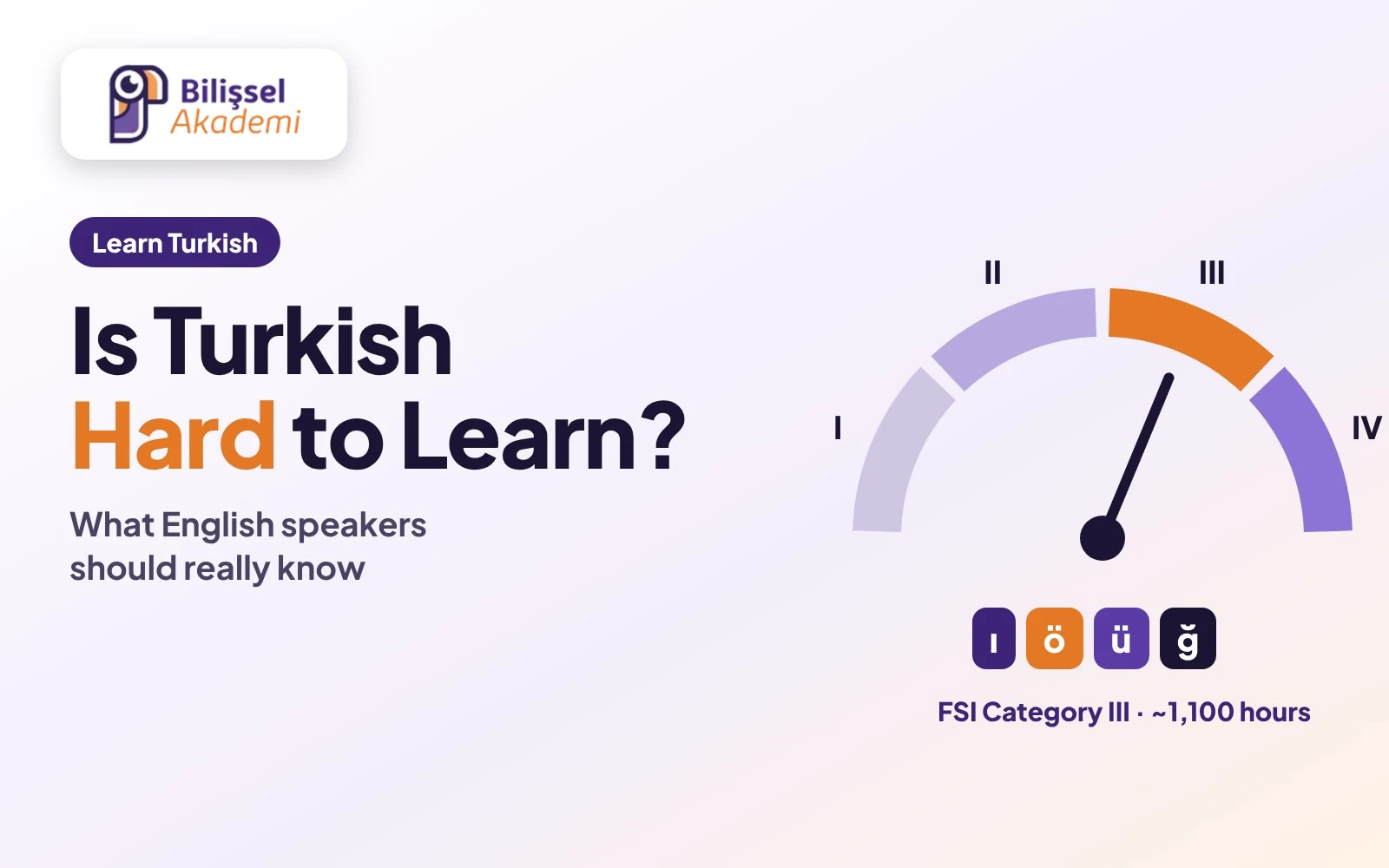
Turkish has a gift for beginners: it is written exactly as it is spoken. There are no silent e's, no “ough” with six pronunciations, no guessing. Learn 29 letters and you can read any Turkish word out loud, from çay to Afyonkarahisar. The catch is a handful of letters that look familiar but sound different, and a few that do not exist in English at all.
This guide walks you through the Turkish alphabet with audio for every letter, focuses on the sounds English speakers find tricky (ı, ö, ü, ğ and friends), tests your ear with minimal pairs like kır / kir, and lets you read words into your microphone for an instant check.
The Turkish alphabet at a glance
29
letters in the Turkish alphabet
8
vowels: a, e, ı, i, o, ö, u, ü
21
consonants, with no q, w or x
The modern Turkish alphabet was introduced in 1928, replacing the Arabic script. It uses the Latin alphabet with six extra letters: ç, ğ, ı, ö, ş, ü. Note that Turkish has two separate i's: dotted İ i and undotted I ı. They are different letters with different sounds, and the dot survives in capitals: İstanbul, not Istanbul.
Practical tip: On a phone keyboard, add the Turkish (Q) layout. Typing ı instead of i changes the word: sıcak (hot) is not sicak (not a word).
All 29 letters with audio
PCFET0NUWVBFIGh0bWw+PGh0bWwgbGFuZz0idHIiPjxoZWFkPjxtZXRhIGNoYXJzZXQ9InV0Zi04Ij48bWV0YSBuYW1lPSJ2aWV3cG9ydCIgY29udGVudD0id2lkdGg9ZGV2aWNlLXdpZHRoLGluaXRpYWwtc2NhbGU9MSI+PHRpdGxlPlR1cmtpc2ggYWxwaGFiZXQgd2l0aCBhdWRpbyBhbmQgbWljcm9waG9uZSBjaGVjazwvdGl0bGU+PHN0eWxlPip7Ym94LXNpemluZzpib3JkZXItYm94fWh0bWwsYm9keXttYXJnaW46MDtiYWNrZ3JvdW5kOnRyYW5zcGFyZW50fWh0bWwuZW1iZWQsaHRtbC5lbWJlZCBib2R5e292ZXJmbG93OmhpZGRlbn0KOnJvb3R7LS1hOiMzQzI0Nzg7LS1hMjojNUIzQkE2Oy0tYjojRTQ3ODI0Oy0tYjI6I0YyOUE0RTstLXNvZnQ6I0YzRUVGQjstLW9zb2Z0OiNGRkYxRTU7LS1saW5lOiNFN0UxRjI7LS1pbms6IzFCMTQzMzstLW11dDojNUM1NDc0Oy0tb2s6IzE2ODM0QTstLW9rYmc6I0U5RjhFRjstLW5vOiNDNjI4Mjg7LS1ub2JnOiNGREVDRUM7LS13YXJuOiM5QTVBMDA7LS13YXJuYmc6I0ZGRjRFMjstLXBhbGU6I0ZBRjhGRH0KYm9keXtmb250LWZhbWlseToiUGx1cyBKYWthcnRhIFNhbnMiLHN5c3RlbS11aSwtYXBwbGUtc3lzdGVtLCJTZWdvZSBVSSIsUm9ib3RvLEFyaWFsLHNhbnMtc2VyaWY7Y29sb3I6dmFyKC0taW5rKTtmb250LXNpemU6MTZweDtsaW5lLWhlaWdodDoxLjU7LXdlYmtpdC10ZXh0LXNpemUtYWRqdXN0OjEwMCV9CiNhcHB7cGFkZGluZzoycHh9aHRtbDpub3QoLmVtYmVkKSAjYXBwe21heC13aWR0aDo3ODBweDttYXJnaW46MCBhdXRvO3BhZGRpbmc6MjBweCAxNnB4fQouYm94e2JhY2tncm91bmQ6I2ZmZjtib3JkZXI6MnB4IHNvbGlkIHZhcigtLWxpbmUpO2JvcmRlci1yYWRpdXM6MjJweDtvdmVyZmxvdzpoaWRkZW59LmJveCsuYm94e21hcmdpbi10b3A6MTZweH0KLmhlYWR7YmFja2dyb3VuZDpsaW5lYXItZ3JhZGllbnQoMTIwZGVnLHZhcigtLWEpLHZhcigtLWEyKSk7Y29sb3I6I2ZmZjtwYWRkaW5nOjE0cHggMThweDtkaXNwbGF5OmZsZXg7anVzdGlmeS1jb250ZW50OnNwYWNlLWJldHdlZW47YWxpZ24taXRlbXM6Y2VudGVyO2dhcDo2cHggMTJweDtmbGV4LXdyYXA6d3JhcDtib3JkZXItYm90dG9tOjRweCBzb2xpZCB2YXIoLS1iKX0KLmhlYWQgYntmb250LXNpemU6MThweDtsaW5lLWhlaWdodDoxLjI1fS5oZWFkIHNwYW57Zm9udC1zaXplOjEzLjVweDtjb2xvcjpyZ2JhKDI1NSwyNTUsMjU1LC44Nil9Ci5ib2R5e3BhZGRpbmc6MTZweCAxOHB4IDE4cHh9Ci5pbnRyb3tjb2xvcjp2YXIoLS1tdXQpO2ZvbnQtc2l6ZToxNC41cHg7bWFyZ2luOjAgMCAxNHB4fQpidXR0b257Zm9udDppbmhlcml0O2NvbG9yOmluaGVyaXQ7Y3Vyc29yOnBvaW50ZXI7LXdlYmtpdC10YXAtaGlnaGxpZ2h0LWNvbG9yOnRyYW5zcGFyZW50fQppbnB1dCxzZWxlY3R7Zm9udDppbmhlcml0O2NvbG9yOmluaGVyaXR9Ci5idG57Ym9yZGVyOjA7Ym9yZGVyLXJhZGl1czoxMnB4O3BhZGRpbmc6MTBweCAxNnB4O2ZvbnQtd2VpZ2h0OjgwMDtmb250LXNpemU6MTVweDtiYWNrZ3JvdW5kOnZhcigtLWEpO2NvbG9yOiNmZmY7bWluLWhlaWdodDo0NHB4fQouYnRuLm97YmFja2dyb3VuZDp2YXIoLS1iKX0uYnRuLmdob3N0e2JhY2tncm91bmQ6I0YyRUZGODtjb2xvcjp2YXIoLS1pbmspfS5idG46ZGlzYWJsZWR7b3BhY2l0eTouNDU7Y3Vyc29yOmRlZmF1bHR9Ci5idG5ze2Rpc3BsYXk6ZmxleDtmbGV4LXdyYXA6d3JhcDtnYXA6OHB4O21hcmdpbi10b3A6MTBweH0KLnNwa3tkaXNwbGF5OmlubGluZS1mbGV4O2FsaWduLWl0ZW1zOmNlbnRlcjtqdXN0aWZ5LWNvbnRlbnQ6Y2VudGVyO2dhcDo2cHg7Ym9yZGVyOjEuNXB4IHNvbGlkIHZhcigtLWxpbmUpO2JhY2tncm91bmQ6I2ZmZjtib3JkZXItcmFkaXVzOjk5OXB4O21pbi13aWR0aDo0MHB4O2hlaWdodDo0MHB4O3BhZGRpbmc6MCAxMnB4O2NvbG9yOnZhcigtLWEpO2ZvbnQtd2VpZ2h0OjgwMDtmb250LXNpemU6MTMuNXB4O3ZlcnRpY2FsLWFsaWduOm1pZGRsZTtmbGV4Om5vbmU7bGluZS1oZWlnaHQ6MX0KLnNwayBzdmd7d2lkdGg6MThweDtoZWlnaHQ6MThweDtmbGV4Om5vbmV9LnNwazpob3Zlcntib3JkZXItY29sb3I6dmFyKC0tYil9Ci5zcGsub257YmFja2dyb3VuZDp2YXIoLS1vc29mdCk7Ym9yZGVyLWNvbG9yOnZhcigtLWIpO2FuaW1hdGlvbjpiYS1wdWxzZSAxcyBpbmZpbml0ZX0KLnNway5iaWd7aGVpZ2h0OjQ2cHg7cGFkZGluZzowIDE4cHg7Zm9udC1zaXplOjE1cHg7YmFja2dyb3VuZDp2YXIoLS1iKTtjb2xvcjojZmZmO2JvcmRlci1jb2xvcjp2YXIoLS1iKX0uc3BrLmJpZy5vbntiYWNrZ3JvdW5kOnZhcigtLWEpO2JvcmRlci1jb2xvcjp2YXIoLS1hKTtjb2xvcjojZmZmfQpAa2V5ZnJhbWVzIGJhLXB1bHNlezUwJXtib3gtc2hhZG93OjAgMCAwIDZweCByZ2JhKDIyOCwxMjAsMzYsLjE4KX19Ci50cntjb2xvcjp2YXIoLS1tdXQpO2ZvbnQtc2l6ZToxNHB4fQoudG9wbGluZXtkaXNwbGF5OmZsZXg7anVzdGlmeS1jb250ZW50OnNwYWNlLWJldHdlZW47YWxpZ24taXRlbXM6Y2VudGVyO2dhcDo4cHg7ZmxleC13cmFwOndyYXB9Ci5jbnR7Zm9udC1zaXplOjEzcHg7Y29sb3I6dmFyKC0tbXV0KTtmb250LXdlaWdodDo4MDB9Ci5wcm9ne2hlaWdodDo4cHg7YmFja2dyb3VuZDojRUZFQUY3O2JvcmRlci1yYWRpdXM6OTlweDtvdmVyZmxvdzpoaWRkZW47bWFyZ2luOjZweCAwIDE0cHh9LnByb2cgaXtkaXNwbGF5OmJsb2NrO2hlaWdodDoxMDAlO3dpZHRoOjA7YmFja2dyb3VuZDpsaW5lYXItZ3JhZGllbnQoOTBkZWcsdmFyKC0tYSksdmFyKC0tYikpO3RyYW5zaXRpb246d2lkdGggLjNzfQoucXtib3JkZXI6MS41cHggc29saWQgdmFyKC0tbGluZSk7Ym9yZGVyLXJhZGl1czoxNnB4O3BhZGRpbmc6MTRweDttYXJnaW4tYm90dG9tOjEycHh9Ci5xbntmb250LXNpemU6MTJweDtmb250LXdlaWdodDo4MDA7Y29sb3I6dmFyKC0tYik7bGV0dGVyLXNwYWNpbmc6LjA1ZW07dGV4dC10cmFuc2Zvcm06dXBwZXJjYXNlfQoucXR7Zm9udC13ZWlnaHQ6NzAwO21hcmdpbjo0cHggMCAxMHB4O2Rpc3BsYXk6ZmxleDtnYXA6MTBweDthbGlnbi1pdGVtczpmbGV4LXN0YXJ0O2p1c3RpZnktY29udGVudDpzcGFjZS1iZXR3ZWVufQouY3R4e2JhY2tncm91bmQ6dmFyKC0tcGFsZSk7Ym9yZGVyLXJhZGl1czoxMHB4O3BhZGRpbmc6OXB4IDEycHg7bWFyZ2luOjAgMCAxMHB4O2ZvbnQtc2l6ZToxNS41cHh9Ci5saXN0ZW57ZGlzcGxheTpmbGV4O2dhcDo4cHg7ZmxleC13cmFwOndyYXA7bWFyZ2luOjJweCAwIDEycHh9Ci5vcHRze2Rpc3BsYXk6Z3JpZDtnYXA6OHB4fS5vcHRzLnJvd3tncmlkLXRlbXBsYXRlLWNvbHVtbnM6cmVwZWF0KGF1dG8tZmlsbCxtaW5tYXgoMTE4cHgsMWZyKSl9Ci5vcHR7Ym9yZGVyOjEuNXB4IHNvbGlkIHZhcigtLWxpbmUpO2JhY2tncm91bmQ6I2ZmZjtib3JkZXItcmFkaXVzOjEycHg7cGFkZGluZzoxMHB4IDEycHg7dGV4dC1hbGlnbjpsZWZ0O2ZvbnQtd2VpZ2h0OjYwMDttaW4taGVpZ2h0OjQ0cHh9Ci5vcHQ6aG92ZXI6bm90KDpkaXNhYmxlZCl7Ym9yZGVyLWNvbG9yOnZhcigtLWIpfS5vcHQ6ZGlzYWJsZWR7Y3Vyc29yOmRlZmF1bHR9Ci5va3tib3JkZXItY29sb3I6dmFyKC0tb2spIWltcG9ydGFudDtiYWNrZ3JvdW5kOnZhcigtLW9rYmcpIWltcG9ydGFudDtjb2xvcjojMEU1QTMxIWltcG9ydGFudH0KLm5ve2JvcmRlci1jb2xvcjp2YXIoLS1ubykhaW1wb3J0YW50O2JhY2tncm91bmQ6dmFyKC0tbm9iZykhaW1wb3J0YW50O2NvbG9yOiM4RTFCMUIhaW1wb3J0YW50fQoud2h5e2Rpc3BsYXk6bm9uZTttYXJnaW4tdG9wOjEwcHg7Zm9udC1zaXplOjE0LjVweDtwYWRkaW5nOjEwcHggMTJweDtib3JkZXItcmFkaXVzOjEycHg7YmFja2dyb3VuZDp2YXIoLS1wYWxlKX0ud2h5LnNob3d7ZGlzcGxheTpibG9ja30KLnJlc3tkaXNwbGF5Om5vbmU7Ym9yZGVyLXJhZGl1czoxNnB4O3BhZGRpbmc6MTZweDtiYWNrZ3JvdW5kOnZhcigtLXNvZnQpO21hcmdpbi10b3A6NnB4fS5yZXMuc2hvd3tkaXNwbGF5OmJsb2NrfQoucmVzIC5iaWd7Zm9udC1zaXplOjMwcHg7Zm9udC13ZWlnaHQ6ODAwO2NvbG9yOnZhcigtLWEpO2xpbmUtaGVpZ2h0OjEuMX0ucmVzIGg0e21hcmdpbjo0cHggMCA0cHg7Zm9udC1zaXplOjE4cHh9LnJlcyBwe21hcmdpbjowfQouY3Rhe2Rpc3BsYXk6ZmxleDtmbGV4LXdyYXA6d3JhcDtnYXA6OHB4O21hcmdpbi10b3A6MTJweH0KLmN0YSBhe2ZsZXg6MSAxIDE3MHB4O3RleHQtYWxpZ246Y2VudGVyO2JvcmRlci1yYWRpdXM6MTJweDtwYWRkaW5nOjExcHggMTRweDtmb250LXdlaWdodDo4MDA7dGV4dC1kZWNvcmF0aW9uOm5vbmU7Zm9udC1zaXplOjE1cHh9Ci5jdGEgLnB7YmFja2dyb3VuZDp2YXIoLS1iKTtjb2xvcjojZmZmfS5jdGEgLnd7YmFja2dyb3VuZDojRTdGOEVFO2NvbG9yOiMxMjZCMzV9LmN0YSAuZ3tiYWNrZ3JvdW5kOiNGMkVGRjg7Y29sb3I6dmFyKC0taW5rKX0KLm5vdGV7Zm9udC1zaXplOjEyLjVweDtjb2xvcjp2YXIoLS1tdXQpO21hcmdpbi10b3A6MTBweH0KLnRvYXN0e2Rpc3BsYXk6bm9uZTttYXJnaW4tdG9wOjEwcHg7Zm9udC1zaXplOjEzLjVweDtiYWNrZ3JvdW5kOnZhcigtLXdhcm5iZyk7Ym9yZGVyOjFweCBzb2xpZCAjRjVEOUE2O2NvbG9yOiM3QTRBMDA7Ym9yZGVyLXJhZGl1czoxMHB4O3BhZGRpbmc6OHB4IDEwcHh9LnRvYXN0LnNob3d7ZGlzcGxheTpibG9ja30KLmNoaXB7ZGlzcGxheTppbmxpbmUtZmxleDthbGlnbi1pdGVtczpjZW50ZXI7Z2FwOjZweDtib3JkZXI6MS41cHggc29saWQgdmFyKC0tbGluZSk7YmFja2dyb3VuZDojZmZmO2JvcmRlci1yYWRpdXM6MTJweDtwYWRkaW5nOjhweCAxMnB4O2ZvbnQtd2VpZ2h0OjcwMDttYXJnaW46NHB4O2ZvbnQtc2l6ZToxNXB4O21pbi1oZWlnaHQ6NDRweH0KLmNoaXAuc2Vse2JvcmRlci1jb2xvcjp2YXIoLS1hKTtiYWNrZ3JvdW5kOnZhcigtLXNvZnQpO2NvbG9yOnZhcigtLWEpfQouaW5we21pbi13aWR0aDowO2JvcmRlcjoxLjVweCBzb2xpZCB2YXIoLS1saW5lKTtib3JkZXItcmFkaXVzOjEwcHg7cGFkZGluZzo4cHggMTBweDtmb250LXNpemU6MTZweDtiYWNrZ3JvdW5kOiNmZmY7d2lkdGg6MTAwJX0KLmlucDpmb2N1c3tvdXRsaW5lOm5vbmU7Ym9yZGVyLWNvbG9yOnZhcigtLWIpfQoudGFne2Rpc3BsYXk6aW5saW5lLWJsb2NrO2ZvbnQtc2l6ZToxMS41cHg7Zm9udC13ZWlnaHQ6ODAwO2JvcmRlci1yYWRpdXM6OTk5cHg7cGFkZGluZzozcHggOXB4O2JhY2tncm91bmQ6dmFyKC0tc29mdCk7Y29sb3I6dmFyKC0tYSl9Ci5tdXRlZHtjb2xvcjp2YXIoLS1tdXQpfQouYmFkZ2V7ZGlzcGxheTppbmxpbmUtZmxleDthbGlnbi1pdGVtczpjZW50ZXI7Z2FwOjZweDtib3JkZXItcmFkaXVzOjk5OXB4O3BhZGRpbmc6NXB4IDEycHg7Zm9udC13ZWlnaHQ6ODAwO2ZvbnQtc2l6ZToxNHB4fQouYi1va3tiYWNrZ3JvdW5kOnZhcigtLW9rYmcpO2NvbG9yOiMwRTVBMzF9LmItbm97YmFja2dyb3VuZDp2YXIoLS1ub2JnKTtjb2xvcjojOEUxQjFCfS5iLXdhcm57YmFja2dyb3VuZDp2YXIoLS13YXJuYmcpO2NvbG9yOnZhcigtLXdhcm4pfS5iLWluZm97YmFja2dyb3VuZDp2YXIoLS1zb2Z0KTtjb2xvcjp2YXIoLS1hKX0KLnBhbmVse2JvcmRlci1yYWRpdXM6MTZweDtwYWRkaW5nOjE0cHggMTZweDttYXJnaW4tdG9wOjEycHg7YmFja2dyb3VuZDp2YXIoLS1wYWxlKTtib3JkZXI6MS41cHggc29saWQgdmFyKC0tbGluZSl9Ci5wYW5lbCBoNHttYXJnaW46MCAwIDZweDtmb250LXNpemU6MTdweH0ucGFuZWwgcHttYXJnaW46NHB4IDB9Ci5zdGF0e2Rpc3BsYXk6Z3JpZDtncmlkLXRlbXBsYXRlLWNvbHVtbnM6cmVwZWF0KGF1dG8tZml0LG1pbm1heCgxMzBweCwxZnIpKTtnYXA6OHB4O21hcmdpbjoxMHB4IDB9Ci5zdGF0IGRpdntiYWNrZ3JvdW5kOiNmZmY7Ym9yZGVyOjEuNXB4IHNvbGlkIHZhcigtLWxpbmUpO2JvcmRlci1yYWRpdXM6MTRweDtwYWRkaW5nOjEwcHggMTJweH0KLnN0YXQgc21hbGx7ZGlzcGxheTpibG9jaztmb250LXNpemU6MTJweDtmb250LXdlaWdodDo4MDA7Y29sb3I6dmFyKC0tbXV0KTt0ZXh0LXRyYW5zZm9ybTp1cHBlcmNhc2U7bGV0dGVyLXNwYWNpbmc6LjA0ZW19LnN0YXQgYntmb250LXNpemU6MjJweDtjb2xvcjp2YXIoLS1hKX0KLnNlZ3tkaXNwbGF5OmZsZXg7ZmxleC13cmFwOndyYXA7Z2FwOjZweH0uc2VnIGJ1dHRvbntib3JkZXI6MS41cHggc29saWQgdmFyKC0tbGluZSk7YmFja2dyb3VuZDojZmZmO2JvcmRlci1yYWRpdXM6OTk5cHg7cGFkZGluZzo4cHggMTRweDtmb250LXdlaWdodDo3MDA7bWluLWhlaWdodDo0MnB4fS5zZWcgYnV0dG9uLnNlbHtiYWNrZ3JvdW5kOnZhcigtLWEpO2JvcmRlci1jb2xvcjp2YXIoLS1hKTtjb2xvcjojZmZmfQoucmFuZ2V7d2lkdGg6MTAwJTthY2NlbnQtY29sb3I6dmFyKC0tYik7aGVpZ2h0OjI4cHh9CkBtZWRpYSAobWF4LXdpZHRoOjQ4MHB4KXsuYm9keXtwYWRkaW5nOjE0cHggMTJweCAxNnB4fS5oZWFke3BhZGRpbmc6MTJweCAxNHB4fS5oZWFkIGJ7Zm9udC1zaXplOjE2LjVweH0uc3RhdCBie2ZvbnQtc2l6ZToxOXB4fX0KCltsYW5nPWFyXSwuYXJ7Zm9udC1mYW1pbHk6Ik5vdG8gTmFza2ggQXJhYmljIiwiQW1pcmkiLCJHZWV6YSBQcm8iLCJUcmFkaXRpb25hbCBBcmFiaWMiLCJTZWdvZSBVSSIsIlRhaG9tYSIsQXJpYWwsc2Fucy1zZXJpZjtkaXJlY3Rpb246cnRsO3VuaWNvZGUtYmlkaTppc29sYXRlO2ZvbnQtc2l6ZToxLjI4ZW07bGluZS1oZWlnaHQ6MS43NTtmb250LXdlaWdodDo2MDB9Ci50cmx7Zm9udC1zdHlsZTppdGFsaWM7Y29sb3I6dmFyKC0tbXV0KTtmb250LXNpemU6MTRweH0KPC9zdHlsZT48L2hlYWQ+PGJvZHk+PGRpdiBpZD0iYXBwIj48L2Rpdj48c2NyaXB0PihmdW5jdGlvbigpeyJ1c2Ugc3RyaWN0IjsKdmFyIEQ9ZG9jdW1lbnQsVz13aW5kb3csQkE9Vy5CQT17Yzp7fSxsYW5nOiJ0ci1UUiJ9OwpmdW5jdGlvbiBlc2Mocyl7cmV0dXJuIFN0cmluZyhzPT1udWxsPyIiOnMpLnJlcGxhY2UoL1smPD4iXS9nLGZ1bmN0aW9uKGMpe3JldHVybnsiJiI6IiZhbXA7IiwiPCI6IiZsdDsiLCI+IjoiJmd0OyIsJyInOiImcXVvdDsifVtjXX0pO30KQkEuZXNjPWVzYzsKQkEuZm10PWZ1bmN0aW9uKHgsZCl7aWYoeD09bnVsbHx8aXNOYU4oeCkpcmV0dXJuIuKAkyI7dmFyIHM9KCt4KS50b0ZpeGVkKGQ9PW51bGw/MjpkKTtyZXR1cm4gcy5yZXBsYWNlKCIuIiwiLCIpO307CnZhciBJQ09OPSc8c3ZnIHZpZXdCb3g9IjAgMCAyNCAyNCIgYXJpYS1oaWRkZW49InRydWUiPjxwYXRoIGZpbGw9ImN1cnJlbnRDb2xvciIgZD0iTTMgOS41djVoMy42TDExIDE4LjV2LTEzTDYuNiA5LjVIM3ptMTIuMyAyLjVhMy42IDMuNiAwIDAgMC0yLjEtMy4zdjYuNmEzLjYgMy42IDAgMCAwIDIuMS0zLjN6TTEzLjIgNC4zdjJhNiA2IDAgMCAxIDAgMTEuNHYyYTggOCAwIDAgMCAwLTE1LjR6Ii8+PC9zdmc+JzsKQkEuaWNvbj1JQ09OOwpCQS5zcGs9ZnVuY3Rpb24odCxsYWJlbCxjbHMscmF0ZSxsYW5nKXtyZXR1cm4gJzxidXR0b24gdHlwZT0iYnV0dG9uIiBjbGFzcz0ic3BrJysoY2xzPyIgIitjbHM6IiIpKyciIGRhdGEtc2F5PSInK2VzYyh0KSsnIicrKHJhdGU/JyBkYXRhLXJhdGU9IicrcmF0ZSsnIic6IiIpKyhsYW5nPycgZGF0YS1sYW5nPSInK2xhbmcrJyInOiIiKSsnIGFyaWEtbGFiZWw9IkRpbmxlJysobGFiZWw/IiAoIitlc2MobGFiZWwpKyIpIjoiIikrJyI+JytJQ09OKyhsYWJlbD8iPHNwYW4+IitsYWJlbCsiPC9zcGFuPiI6IiIpKyI8L2J1dHRvbj4iO307CkJBLnNodWZmbGU9ZnVuY3Rpb24oYSl7dmFyIGI9YS5zbGljZSgpLGs9MDtkb3tmb3IodmFyIGk9Yi5sZW5ndGgtMTtpPjA7aS0tKXt2YXIgaj1NYXRoLmZsb29yKE1hdGgucmFuZG9tKCkqKGkrMSkpLHQ9YltpXTtiW2ldPWJbal07YltqXT10O31rKys7fXdoaWxlKGIubGVuZ3RoPjEmJms8OCYmYi5qb2luKCJcdTAwMDEiKT09PWEuam9pbigiXHUwMDAxIikpO3JldHVybiBiO307CkJBLm5vVm9pY2U9ZnVuY3Rpb24oTE4pe2lmKEJBLnVpPT09ImVuIil7dmFyIHVhMD1uYXZpZ2F0b3IudXNlckFnZW50fHwiIix3MD0vV2luZG93cy8udGVzdCh1YTApLGUwPS9FZGdcLy8udGVzdCh1YTApLG0wPS9BbmRyb2lkfGlQaG9uZXxpUGFkfE1vYmlsZS8udGVzdCh1YTApLHQwPSJObyBUdXJraXNoIHZvaWNlIHdhcyBmb3VuZCBvbiB0aGlzIGRldmljZSwgc28geW91IG1heSBub3QgaGVhciB0aGUgYXVkaW8uICI7aWYodzAmJiFlMCl0MCs9Ik9uIFdpbmRvd3MgdGhlIGVhc2llc3QgZml4IGlzIHRvIG9wZW4gdGhpcyBwYWdlIGluIE1pY3Jvc29mdCBFZGdlLiBUbyBzdGF5IGluIENocm9tZSwgYWRkIGEgVHVya2lzaCB2b2ljZSBpbiBXaW5kb3dzIFNldHRpbmdzID4gVGltZSAmIGxhbmd1YWdlID4gU3BlZWNoIGFuZCByZXN0YXJ0IENocm9tZS4iO2Vsc2UgaWYodzApdDArPSJBZGQgYSBUdXJraXNoIHZvaWNlIGluIFdpbmRvd3MgU2V0dGluZ3MgPiBUaW1lICYgbGFuZ3VhZ2UgPiBTcGVlY2ggYW5kIHJlc3RhcnQgdGhlIGJyb3dzZXIuIjtlbHNlIGlmKG0wKXQwKz0iWW91IGNhbiBhZGQgYSBUdXJraXNoIHZvaWNlIGluIHlvdXIgcGhvbmUncyB0ZXh0LXRvLXNwZWVjaCBzZXR0aW5ncy4iO2Vsc2UgdDArPSJBZGQgYSBUdXJraXNoIHRleHQtdG8tc3BlZWNoIHZvaWNlIGluIHlvdXIgZGV2aWNlIHNldHRpbmdzIGFuZCByZXN0YXJ0IHRoZSBicm93c2VyLiI7cmV0dXJuIHQwO312YXIgdWE9bmF2aWdhdG9yLnVzZXJBZ2VudHx8IiIsd2luPS9XaW5kb3dzLy50ZXN0KHVhKSxlZGdlPS9FZGdcLy8udGVzdCh1YSksbW9iPS9BbmRyb2lkfGlQaG9uZXxpUGFkfE1vYmlsZS8udGVzdCh1YSksbT0iQnUgY2loYXpkYSAiK0xOKyIgc2VzIGJ1bHVuYW1hZMSxLCBidSB5w7x6ZGVuIG9rdW51xZ8gZHV5dWxtYXlhYmlsaXIuICI7aWYod2luJiYhZWRnZSltKz0iV2luZG93cyd0YSBlbiBrb2xheSDDp8O2esO8bSBzYXlmYXnEsSBNaWNyb3NvZnQgRWRnZSBpbGUgYcOnbWFrLiBDaHJvbWUnZGEga2FsbWFrIGlzdGVyc2VuaXogV2luZG93cyBBeWFybGFyID4gU2FhdCB2ZSBkaWwgPiBLb251xZ9tYSBiw7Zsw7xtw7xuZGVuICIrTE4rIiBzZXMgZWtsZXlpcCBDaHJvbWUndSB5ZW5pZGVuIGJhxZ9sYXTEsW4uIjtlbHNlIGlmKHdpbiltKz0iV2luZG93cyBBeWFybGFyID4gU2FhdCB2ZSBkaWwgPiBLb251xZ9tYSBiw7Zsw7xtw7xuZGVuICIrTE4rIiBzZXMgZWtsZXlpcCB0YXJhecSxY8SxecSxIHllbmlkZW4gYmHFn2xhdMSxbi4iO2Vsc2UgaWYobW9iKW0rPSJUZWxlZm9uIGF5YXJsYXLEsW5kYWtpIG1ldGluIG9rdW1hICh5YXrEsWRhbiBrb251xZ9tYXlhKSBiw7Zsw7xtw7xuZGVuICIrTE4rIiBzZXNpIGVrbGV5ZWJpbGlyc2luaXouIjtlbHNlIG0rPSJDaWhhesSxbiBheWFybGFyxLFuZGFuICIrTE4rIiBtZXRpbiBva3VtYSBzZXNpIGVrbGV5aXAgdGFyYXnEsWPEsXnEsSB5ZW5pZGVuIGJhxZ9sYXTEsW4uIjtyZXR1cm4gbTt9OwovKiAtLS0tLS0tLS0tIHNwZWVjaCAobGFuZ3VhZ2UtYXdhcmUpIC0tLS0tLS0tLS0gKi8KdmFyIFRUUz1CQS50dHM9e3Y6bnVsbCwKcGljazpmdW5jdGlvbigpe2lmKCEoInNwZWVjaFN5bnRoZXNpcyIgaW4gVykpcmV0dXJuO3ZhciBMPUJBLmxhbmcsYmFzZT1MLnNwbGl0KCItIilbMF0udG9Mb3dlckNhc2UoKSx2cz1XLnNwZWVjaFN5bnRoZXNpcy5nZXRWb2ljZXMoKXx8W10sCm09dnMuZmlsdGVyKGZ1bmN0aW9uKHYpe3JldHVybiB2LmxhbmcmJnYubGFuZy5yZXBsYWNlKCJfIiwiLSIpLnRvTG93ZXJDYXNlKCkuaW5kZXhPZihiYXNlKT09PTA7fSk7CnZhciBleD1tLmZpbHRlcihmdW5jdGlvbih2KXtyZXR1cm4gdi5sYW5nLnJlcGxhY2UoIl8iLCItIikudG9Mb3dlckNhc2UoKT09PUwudG9Mb3dlckNhc2UoKTt9KTt0aGlzLnY9ZXguZmlsdGVyKGZ1bmN0aW9uKHYpe3JldHVybiAvZ29vZ2xlL2kudGVzdCh2Lm5hbWUpO30pWzBdfHxtLmZpbHRlcihmdW5jdGlvbih2KXtyZXR1cm4gL2dvb2dsZS9pLnRlc3Qodi5uYW1lKTt9KVswXXx8ZXguZmlsdGVyKGZ1bmN0aW9uKHYpe3JldHVybiAvbmF0dXJhbHxvbmxpbmV8bmV1cmFsL2kudGVzdCh2Lm5hbWUpO30pWzBdfHxtLmZpbHRlcihmdW5jdGlvbih2KXtyZXR1cm4gL25hdHVyYWx8b25saW5lfG5ldXJhbC9pLnRlc3Qodi5uYW1lKTt9KVswXXx8bS5maWx0ZXIoZnVuY3Rpb24odil7cmV0dXJuIHYubGFuZy5yZXBsYWNlKCJfIiwiLSIpLnRvTG93ZXJDYXNlKCk9PT1MLnRvTG93ZXJDYXNlKCk7fSlbMF18fG1bMF18fG51bGw7fSwKdm9pY2VGb3I6ZnVuY3Rpb24oTCl7aWYoISgic3BlZWNoU3ludGhlc2lzIiBpbiBXKSlyZXR1cm4gbnVsbDt2YXIgdnM9Vy5zcGVlY2hTeW50aGVzaXMuZ2V0Vm9pY2VzKCl8fFtdLGw9TC50b0xvd2VyQ2FzZSgpLGJhc2U9bC5zcGxpdCgiLSIpWzBdLG5tPWZ1bmN0aW9uKHYpe3JldHVybiAodi5sYW5nfHwiIikucmVwbGFjZSgiXyIsIi0iKS50b0xvd2VyQ2FzZSgpO307CnZhciBleD12cy5maWx0ZXIoZnVuY3Rpb24odil7cmV0dXJuIG5tKHYpPT09bDt9KSxtPXZzLmZpbHRlcihmdW5jdGlvbih2KXtyZXR1cm4gbm0odikuaW5kZXhPZihiYXNlKT09PTA7fSk7dmFyIHByZWY9ZnVuY3Rpb24oYSl7cmV0dXJuIGEuZmlsdGVyKGZ1bmN0aW9uKHYpe3JldHVybiAvZ29vZ2xlL2kudGVzdCh2Lm5hbWUpO30pWzBdfHxhLmZpbHRlcihmdW5jdGlvbih2KXtyZXR1cm4gL25hdHVyYWx8b25saW5lfG5ldXJhbC9pLnRlc3Qodi5uYW1lKTt9KVswXXx8YVswXXx8bnVsbDt9OwpyZXR1cm4ge3Y6cHJlZihleCl8fHByZWYobSksZXhhY3Q6ZXgubGVuZ3RoPjB9O30sCnNheTpmdW5jdGlvbih0LHJhdGUsYnRuLGxhbmcpe2lmKCEoInNwZWVjaFN5bnRoZXNpcyIgaW4gVyl8fCFXLlNwZWVjaFN5bnRoZXNpc1V0dGVyYW5jZSl7QkEudG9hc3QoQkEudWk9PT0iZW4iPyJZb3VyIGJyb3dzZXIgZG9lcyBub3Qgc3VwcG9ydCBzcGVlY2guIFRyeSBDaHJvbWUsIEVkZ2Ugb3IgU2FmYXJpLiI6IlRhcmF5xLFjxLFuxLF6IHNlc2xpIG9rdW1hecSxIGRlc3Rla2xlbWl5b3IuIENocm9tZSwgRWRnZSB2ZXlhIFNhZmFyaSBpbGUgZGVuZXlpbi4iKTtyZXR1cm47fQp2YXIgUz1XLnNwZWVjaFN5bnRoZXNpcztTLmNhbmNlbCgpO2lmKCF0aGlzLnYpdGhpcy5waWNrKCk7CnZhciB1PW5ldyBXLlNwZWVjaFN5bnRoZXNpc1V0dGVyYW5jZSh0KTt1Lmxhbmc9QkEubGFuZztpZih0aGlzLnYpdS52b2ljZT10aGlzLnY7aWYobGFuZyYmbGFuZyE9PUJBLmxhbmcpe3UubGFuZz1sYW5nO3ZhciB2Zj10aGlzLnZvaWNlRm9yKGxhbmcpO2lmKHZmJiZ2Zi52KXUudm9pY2U9dmYudjt9dS5yYXRlPXJhdGV8fDAuOTU7dS5waXRjaD0xOwpELnF1ZXJ5U2VsZWN0b3JBbGwoIi5zcGsub24iKS5mb3JFYWNoKGZ1bmN0aW9uKGIpe2IuY2xhc3NMaXN0LnJlbW92ZSgib24iKTt9KTsKaWYoYnRuKXtidG4uY2xhc3NMaXN0LmFkZCgib24iKTt2YXIgb2ZmPWZ1bmN0aW9uKCl7YnRuLmNsYXNzTGlzdC5yZW1vdmUoIm9uIik7fTt1Lm9uZW5kPW9mZjt1Lm9uZXJyb3I9b2ZmO3NldFRpbWVvdXQob2ZmLE1hdGgubWF4KDI1MDAsdC5sZW5ndGgqMTIwLyhyYXRlfHwwLjk1KSkpO30KUy5zcGVhayh1KTsKaWYoIXRoaXMudiYmIXRoaXMud2FybmVkKXt2YXIgc2VsZj10aGlzO3NldFRpbWVvdXQoZnVuY3Rpb24oKXtzZWxmLnBpY2soKTtpZighc2VsZi52KXtzZWxmLndhcm5lZD0xO3ZhciBMTj17dHI6IlTDvHJrw6dlIixkZToiQWxtYW5jYSAoRGV1dHNjaCkiLGVuOiLEsG5naWxpemNlIixmcjoiRnJhbnPEsXpjYSIsaXQ6IsSwdGFseWFuY2EiLGFyOiJBcmFww6dhIn1bQkEubGFuZy5zcGxpdCgiLSIpWzBdXXx8ImJ1IGRpbCI7QkEudG9hc3QoQkEubm9Wb2ljZShMTikpO319LDcwMCk7fQp9fTsKaWYoInNwZWVjaFN5bnRoZXNpcyIgaW4gVyl7VFRTLnBpY2soKTt0cnl7Vy5zcGVlY2hTeW50aGVzaXMuYWRkRXZlbnRMaXN0ZW5lcigidm9pY2VzY2hhbmdlZCIsZnVuY3Rpb24oKXtUVFMucGljaygpO30pO31jYXRjaChlKXtXLnNwZWVjaFN5bnRoZXNpcy5vbnZvaWNlc2NoYW5nZWQ9ZnVuY3Rpb24oKXtUVFMucGljaygpO307fX0KRC5hZGRFdmVudExpc3RlbmVyKCJjbGljayIsZnVuY3Rpb24oZSl7dmFyIGI9ZS50YXJnZXQuY2xvc2VzdCYmZS50YXJnZXQuY2xvc2VzdCgiW2RhdGEtc2F5XSIpO2lmKCFiKXJldHVybjtlLnByZXZlbnREZWZhdWx0KCk7VFRTLnNheShiLmdldEF0dHJpYnV0ZSgiZGF0YS1zYXkiKSxiLmdldEF0dHJpYnV0ZSgiZGF0YS1yYXRlIik/K2IuZ2V0QXR0cmlidXRlKCJkYXRhLXJhdGUiKTowLGIsYi5nZXRBdHRyaWJ1dGUoImRhdGEtbGFuZyIpKTt9KTsKLyogLS0tLS0tLS0tLSBsYXlvdXQgaGVscGVycyAtLS0tLS0tLS0tICovCkJBLnRvYXN0PWZ1bmN0aW9uKG1zZyl7dmFyIHQ9RC5xdWVyeVNlbGVjdG9yKCIjYmEtdG9hc3QiKTtpZighdClyZXR1cm47dC50ZXh0Q29udGVudD1tc2c7dC5jbGFzc0xpc3QuYWRkKCJzaG93Iik7QkEucG9zdCgpO307CkJBLmJveD1mdW5jdGlvbihiKXt2YXIgcz1ELmNyZWF0ZUVsZW1lbnQoInNlY3Rpb24iKTtzLmNsYXNzTmFtZT0iYm94IjtzLmlubmVySFRNTD0nPGRpdiBjbGFzcz0iaGVhZCI+PGI+JysoYi50aXRsZXx8IiIpKyI8L2I+IisoYi5zdWI/IjxzcGFuPiIrYi5zdWIrIjwvc3Bhbj4iOiIiKSsnPC9kaXY+PGRpdiBjbGFzcz0iYm9keSI+JysoYi5pbnRybz8nPHAgY2xhc3M9ImludHJvIj4nK2IuaW50cm8rIjwvcD4iOiIiKSsnPGRpdiBjbGFzcz0iaW5uZXIiPjwvZGl2PjwvZGl2Pic7cmV0dXJuIHM7fTsKQkEuY291bnRlcj1mdW5jdGlvbihyb290LG4sbGFiZWwpe3ZhciB3PUQuY3JlYXRlRWxlbWVudCgiZGl2Iik7dy5pbm5lckhUTUw9JzxkaXYgY2xhc3M9InRvcGxpbmUiPjxzcGFuIGNsYXNzPSJjbnQiPjAgLyAnK24rIiAiKyhsYWJlbHx8InlhbsSxdCIpKyc8L3NwYW4+PHNwYW4gY2xhc3M9ImNudCBzYyI+PC9zcGFuPjwvZGl2PjxkaXYgY2xhc3M9InByb2ciPjxpPjwvaT48L2Rpdj4nO3Jvb3QuYXBwZW5kQ2hpbGQodyk7CnJldHVybntzZXQ6ZnVuY3Rpb24oZCxzKXt3LnF1ZXJ5U2VsZWN0b3IoIi5jbnQiKS50ZXh0Q29udGVudD1kKyIgLyAiK24rIiAiKyhsYWJlbHx8InlhbsSxdCIpO3cucXVlcnlTZWxlY3RvcigiLnByb2cgaSIpLnN0eWxlLndpZHRoPSgxMDAqZC9uKSsiJSI7dy5xdWVyeVNlbGVjdG9yKCIuc2MiKS50ZXh0Q29udGVudD1kPygiRG/En3J1OiAiK3MpOiIiO319O307CkJBLmN0YUh0bWw9ZnVuY3Rpb24oYyl7aWYoIWMpcmV0dXJuIiI7cmV0dXJuIChjLnRleHQ/JzxwIHN0eWxlPSJtYXJnaW4tdG9wOjEwcHgiPicrYy50ZXh0KyI8L3A+IjoiIikrJzxkaXYgY2xhc3M9ImN0YSI+JytjLmxpbmtzLm1hcChmdW5jdGlvbihsKXtyZXR1cm4gJzxhIGNsYXNzPSInKyhsLmN8fCJwIikrJyIgaHJlZj0iJytlc2MobC5ocmVmKSsnIiB0YXJnZXQ9Il90b3AiIHJlbD0ibm9vcGVuZXIiPicrbC5sKyI8L2E+Ijt9KS5qb2luKCIiKSsiPC9kaXY+Ijt9OwpCQS5yZXN1bHQ9ZnVuY3Rpb24oY2ZnLHNjb3JlLG4pe3ZhciBiYW5kcz1jZmcuYmFuZHN8fFt7bWluOjEsdDoiS3VzdXJzdXohIixkOiJCdSBrb251eXUgb3R1cnRtdcWfc3VuLiBCaXIgc29ucmFraSBrb251eWEgZ2XDp2ViaWxpcnNpbi4ifSx7bWluOjAuNix0OiLDh29rIGl5aSBnaWRpeW9yc3VuIixkOiJZYW5sxLHFnyB5YXB0xLHEn8SxbiBzb3J1bGFyxLFuIGHDp8Sxa2xhbWFsYXLEsW7EsSBiaXIga2V6IGRhaGEgb2t1LiJ9LHttaW46MCx0OiJUZWtyYXIgemFtYW7EsSIsZDoiWXVrYXLEsWRha2kgYW5sYXTEsW1hIGTDtm7DvHAgw7ZybmVrbGVyaSB5ZW5pZGVuIMOnw7Z6LCBzb25yYSB0ZXN0aSBiYcWfdGFuIGRlbmUuIn1dOwp2YXIgcj1zY29yZS9uLGI9YmFuZHNbYmFuZHMubGVuZ3RoLTFdO2Zvcih2YXIgaT0wO2k8YmFuZHMubGVuZ3RoO2krKyl7aWYocj49YmFuZHNbaV0ubWluKXtiPWJhbmRzW2ldO2JyZWFrO319CnJldHVybiAnPGRpdiBjbGFzcz0iYmlnIj4nK3Njb3JlKyIgLyAiK24rIjwvZGl2PjxoND4iK2IudCsiPC9oND48cD4iK2IuZCsiPC9wPiIrQkEuY3RhSHRtbChjZmcuY3RhKSsnPGRpdiBjbGFzcz0iYnRucyI+PGJ1dHRvbiB0eXBlPSJidXR0b24iIGNsYXNzPSJidG4gZ2hvc3QgcmVkbyI+QmHFn3RhbiDDp8O2ejwvYnV0dG9uPjwvZGl2Pic7fTsKLyogLS0tLS0tLS0tLSBoZWlnaHQgbWVzc2FnaW5nIGZvciB0aGUgc2l0ZSdzIGJhLWVtYmVkIGxvYWRlciAtLS0tLS0tLS0tICovCnZhciBpbkZyYW1lPWZhbHNlO3RyeXtpbkZyYW1lPVcuc2VsZiE9PVcudG9wO31jYXRjaChlKXtpbkZyYW1lPXRydWU7fQppZihpbkZyYW1lKUQuZG9jdW1lbnRFbGVtZW50LmNsYXNzTGlzdC5hZGQoImVtYmVkIik7CnZhciBsYXN0SD0wLHRtPTA7CkJBLnBvc3Q9ZnVuY3Rpb24oKXtjbGVhclRpbWVvdXQodG0pO3RtPXNldFRpbWVvdXQoZnVuY3Rpb24oKXt2YXIgYT1ELmdldEVsZW1lbnRCeUlkKCJhcHAiKTtpZighYSlyZXR1cm47dmFyIGg9TWF0aC5jZWlsKGEuZ2V0Qm91bmRpbmdDbGllbnRSZWN0KCkuaGVpZ2h0KSs2O2lmKE1hdGguYWJzKGgtbGFzdEgpPjEpe2xhc3RIPWg7dHJ5e1cucGFyZW50LnBvc3RNZXNzYWdlKHtiYUVtYmVkSGVpZ2h0Omh9LCIqIik7fWNhdGNoKGUpe319fSwzMCk7fTsKLyogLS0tLS0tLS0tLSBVSSBsYW5ndWFnZSAoY2ZnLnVpPSJlbiIpIC0tLS0tLS0tLS0gKi8KQkEuRU49W1siRGlubGUgdmUgZG/En3J1IGNldmFixLEgc2XDpy4iLCJMaXN0ZW4gYW5kIGNob29zZSB0aGUgcmlnaHQgYW5zd2VyLiJdLFsiw4fDtnrDvG3DvCBkaW5sZSIsIkxpc3RlbiB0byB0aGUgZXhwbGFuYXRpb24iXSxbIuKckyBEb8SfcnUuIiwi4pyTIENvcnJlY3QuIl0sWyLinJcgRG/En3J1IGNldmFwOiAiLCLinJcgQW5zd2VyOiAiXSxbIkJhxZ90YW4gw6fDtnoiLCJUcnkgYWdhaW4iXSxbIkhhdGFzxLF6IGXFn2xlxZ90aXJkaW4hIiwiTm8gbWlzdGFrZXMhIl0sWyIgaGF0YWzEsSBkZW5lbWVuIG9sZHUuICIsIiB3cm9uZyB0cmllcy4gIl0sWyJIYXRhbMSxIGRlbmVtZTogIiwiV3JvbmcgdHJpZXM6ICJdLFsiS2FyxLHFn3TEsXIsIHllbmlkZW4gb3luYSIsIlNodWZmbGUgYW5kIHBsYXkgYWdhaW4iXSxbIlRhbWFtbGFuZMSxIiwiRG9uZSJdLFsiIGXFn2xlxZ9tZSIsIiBtYXRjaGVkIl0sWyJEb8SfcnU6ICIsIkNvcnJlY3Q6ICJdLFsiIHlhbsSxdCIsIiBhbnN3ZXJlZCJdLFsiU29ydSAiLCJRdWVzdGlvbiAiXSxbIllhdmHFnyIsIlNsb3ciXSxbIlNlc2luaSBrYXlkZXQiLCJSZWNvcmQgeW91cnNlbGYiXSxbIktheWTEsSBkdXJkdXIiLCJTdG9wIHJlY29yZGluZyJdLFsiTWlrcm9mb24gaXpuaSB2ZXJpbG1lZGkuIEFkcmVzIMOndWJ1xJ91bmRha2kgbWlrcm9mb24gc2ltZ2VzaW5kZW4gaXppbiB2ZXJlYmlsaXJzaW4uIiwiTWljcm9waG9uZSBwZXJtaXNzaW9uIHdhcyBub3QgZ2l2ZW4uIFlvdSBjYW4gYWxsb3cgaXQgZnJvbSB0aGUgbWljcm9waG9uZSBpY29uIGluIHRoZSBhZGRyZXNzIGJhci4iXSxbIlRhcmF5xLFjxLFuIHNlcyBrYXlkxLFuxLEgZGVzdGVrbGVtaXlvci4gVGVsZWZvbnVudW4gc2VzIGtheWRlZGljaXNpeWxlIGRlIMOnYWzEscWfYWJpbGlyc2luLiIsIllvdXIgYnJvd3NlciBjYW5ub3QgcmVjb3JkIGF1ZGlvLiBZb3UgY2FuIHVzZSB5b3VyIHBob25lJ3Mgdm9pY2UgcmVjb3JkZXIgaW5zdGVhZC4iXSxbIkRpbmxlIiwiTGlzdGVuIl1dOwpCQS5pMThuPWZ1bmN0aW9uKHJvb3Qpe2Z1bmN0aW9uIGZpeChuKXt2YXIgcD1uLnBhcmVudE5vZGU7d2hpbGUocCYmcCE9PXJvb3Qpe2lmKHAuZ2V0QXR0cmlidXRlJiZwLmdldEF0dHJpYnV0ZSgibGFuZyIpPT09InRyIilyZXR1cm47cD1wLnBhcmVudE5vZGU7fXZhciB0PW4ubm9kZVZhbHVlLG89dDtCQS5FTi5mb3JFYWNoKGZ1bmN0aW9uKHIpe2lmKHQuaW5kZXhPZihyWzBdKT4tMSl0PXQuc3BsaXQoclswXSkuam9pbihyWzFdKTt9KTtpZih0IT09byluLm5vZGVWYWx1ZT10O30KZnVuY3Rpb24gd2FsayhlbCl7aWYoZWwubm9kZVR5cGU9PT0zKXtmaXgoZWwpO3JldHVybjt9aWYoZWwubm9kZVR5cGUhPT0xfHxlbC50YWdOYW1lPT09IlNDUklQVCJ8fGVsLnRhZ05hbWU9PT0iU1RZTEUiKXJldHVybjtpZihlbC5nZXRBdHRyaWJ1dGUoImxhbmciKT09PSJ0ciIpcmV0dXJuO2Zvcih2YXIgYz1lbC5maXJzdENoaWxkO2M7Yz1jLm5leHRTaWJsaW5nKXdhbGsoYyk7fQp3YWxrKHJvb3QpO2lmKFcuTXV0YXRpb25PYnNlcnZlcil7bmV3IE11dGF0aW9uT2JzZXJ2ZXIoZnVuY3Rpb24obXMpe21zLmZvckVhY2goZnVuY3Rpb24obSl7aWYobS50eXBlPT09ImNoYXJhY3RlckRhdGEiKWZpeChtLnRhcmdldCk7ZWxzZSBtLmFkZGVkTm9kZXMuZm9yRWFjaCh3YWxrKTt9KTt9KS5vYnNlcnZlKHJvb3Qse2NoaWxkTGlzdDp0cnVlLHN1YnRyZWU6dHJ1ZSxjaGFyYWN0ZXJEYXRhOnRydWV9KTt9fTsKLyogLS0tLS0tLS0tLSBydW5uZXIgLS0tLS0tLS0tLSAqLwpCQS5ydW49ZnVuY3Rpb24oY2ZnKXt2YXIgYXBwPUQuZ2V0RWxlbWVudEJ5SWQoImFwcCIpO2lmKGNmZy5sYW5nKUJBLmxhbmc9Y2ZnLmxhbmc7aWYoY2ZnLnVpKXtCQS51aT1jZmcudWk7RC5kb2N1bWVudEVsZW1lbnQubGFuZz1jZmcudWk7fWlmKGNmZy50aGVtZSl7Zm9yKHZhciBrIGluIGNmZy50aGVtZSlELmRvY3VtZW50RWxlbWVudC5zdHlsZS5zZXRQcm9wZXJ0eSgiLS0iK2ssY2ZnLnRoZW1lW2tdKTt9CnZhciBibG9ja3M9Y2ZnLmJsb2Nrc3x8W2NmZ107YmxvY2tzLmZvckVhY2goZnVuY3Rpb24oYil7dmFyIGJveD1CQS5ib3goYik7YXBwLmFwcGVuZENoaWxkKGJveCk7dmFyIGlubmVyPWJveC5xdWVyeVNlbGVjdG9yKCIuaW5uZXIiKTt0cnl7QkEuY1tiLnR5cGVdKGIsaW5uZXIpO31jYXRjaChlcnIpe2lubmVyLmlubmVySFRNTD0nPHAgY2xhc3M9Im11dGVkIj5CdSBldGtpbmxpayB5w7xrbGVuZW1lZGkuPC9wPic7aWYoVy5jb25zb2xlKWNvbnNvbGUuZXJyb3IoZXJyKTt9fSk7CmlmKGNmZy5mb290KXt2YXIgZj1ELmNyZWF0ZUVsZW1lbnQoInAiKTtmLmNsYXNzTmFtZT0ibm90ZSI7Zi5pbm5lckhUTUw9Y2ZnLmZvb3Q7YXBwLmFwcGVuZENoaWxkKGYpO30KaWYoQkEudWk9PT0iZW4iKUJBLmkxOG4oYXBwKTt2YXIgdD1ELmNyZWF0ZUVsZW1lbnQoImRpdiIpO3QuaWQ9ImJhLXRvYXN0Ijt0LmNsYXNzTmFtZT0idG9hc3QiO3Quc2V0QXR0cmlidXRlKCJyb2xlIiwic3RhdHVzIik7YXBwLmFwcGVuZENoaWxkKHQpOwppZihXLlJlc2l6ZU9ic2VydmVyKXtuZXcgUmVzaXplT2JzZXJ2ZXIoQkEucG9zdCkub2JzZXJ2ZShhcHApO31XLmFkZEV2ZW50TGlzdGVuZXIoImxvYWQiLEJBLnBvc3QpO1cuYWRkRXZlbnRMaXN0ZW5lcigicmVzaXplIixCQS5wb3N0KTtCQS5wb3N0KCk7c2V0VGltZW91dChCQS5wb3N0LDQwMCk7c2V0VGltZW91dChCQS5wb3N0LDE1MDApO307Cn0pKCk7CkJBLnJlY1N0eWxlPWZ1bmN0aW9uKCl7aWYoZG9jdW1lbnQuZ2V0RWxlbWVudEJ5SWQoInJlYy1zdCIpKXJldHVybjt2YXIgc3Q9ZG9jdW1lbnQuY3JlYXRlRWxlbWVudCgic3R5bGUiKTtzdC5pZD0icmVjLXN0IjtzdC50ZXh0Q29udGVudD0iLnJlY3tkaXNwbGF5OmZsZXg7ZmxleC13cmFwOndyYXA7Z2FwOjhweDthbGlnbi1pdGVtczpjZW50ZXJ9LnJlYyAucmJ7ZGlzcGxheTppbmxpbmUtZmxleDthbGlnbi1pdGVtczpjZW50ZXI7Z2FwOjhweDtib3JkZXI6MDtib3JkZXItcmFkaXVzOjk5OXB4O3BhZGRpbmc6MCAxNnB4O2hlaWdodDo0NHB4O2ZvbnQtd2VpZ2h0OjgwMDtiYWNrZ3JvdW5kOiNGREVDRUM7Y29sb3I6I0IzMjYxRX0ucmVjIC5yYiBpe3dpZHRoOjEycHg7aGVpZ2h0OjEycHg7Ym9yZGVyLXJhZGl1czo1MCU7YmFja2dyb3VuZDojQzYyODI4O2Rpc3BsYXk6aW5saW5lLWJsb2NrfS5yZWMgLnJiLm9ue2JhY2tncm91bmQ6I0M2MjgyODtjb2xvcjojZmZmfS5yZWMgLnJiLm9uIGl7YmFja2dyb3VuZDojZmZmO2FuaW1hdGlvbjpiYS1wdWxzZSAxcyBpbmZpbml0ZX0ucmVjIGF1ZGlve2hlaWdodDo0MHB4O21heC13aWR0aDoxMDAlfS5yZWMgLnJ0e2ZvbnQtc2l6ZToxM3B4O2NvbG9yOnZhcigtLW11dCk7Zm9udC13ZWlnaHQ6NzAwfS50eHttYXJnaW4tdG9wOjEwcHg7YmFja2dyb3VuZDojZmZmO2JvcmRlcjoxLjVweCBkYXNoZWQgdmFyKC0tbGluZSk7Ym9yZGVyLXJhZGl1czoxMnB4O3BhZGRpbmc6MTBweCAxMnB4O2ZvbnQtc2l6ZToxNXB4fS50eCBie2NvbG9yOnZhcigtLWEpfSI7ZG9jdW1lbnQuaGVhZC5hcHBlbmRDaGlsZChzdCk7fTsKLyogcmVjb3JkZXIgd2l0aCBvcHRpb25hbCBsaXZlIHRyYW5zY3JpcHQ7IG9wdHMub25UZXh0KHRleHQsZmluYWwpICovCkJBLnJlY29yZGVyPWZ1bmN0aW9uKGhvc3Qsb3B0cyl7QkEucmVjU3R5bGUoKTtvcHRzPW9wdHN8fHt9O3ZhciB3PWRvY3VtZW50LmNyZWF0ZUVsZW1lbnQoImRpdiIpO3cuY2xhc3NOYW1lPSJyZWMiO3cuaW5uZXJIVE1MPSc8YnV0dG9uIHR5cGU9ImJ1dHRvbiIgY2xhc3M9InJiIj48aT48L2k+PHNwYW4+U2VzaW5pIGtheWRldDwvc3Bhbj48L2J1dHRvbj48c3BhbiBjbGFzcz0icnQiPjwvc3Bhbj4nO2hvc3QuYXBwZW5kQ2hpbGQodyk7CnZhciBiPXcucXVlcnlTZWxlY3RvcigiLnJiIikscnQ9dy5xdWVyeVNlbGVjdG9yKCIucnQiKSxtcj1udWxsLGNodW5rcz1bXSxzdHJlYW09bnVsbCx0MD0wLGl2PTAsc3I9bnVsbCx0eHQ9IiI7CmZ1bmN0aW9uIFNSKCl7cmV0dXJuIHdpbmRvdy5TcGVlY2hSZWNvZ25pdGlvbnx8d2luZG93LndlYmtpdFNwZWVjaFJlY29nbml0aW9uO30KZnVuY3Rpb24gc3RvcEFsbCgpe2lmKG1yJiZtci5zdGF0ZSE9PSJpbmFjdGl2ZSIpbXIuc3RvcCgpO2lmKHNyKXt0cnl7c3Iuc3RvcCgpO31jYXRjaChlKXt9fWNsZWFySW50ZXJ2YWwoaXYpO2IuY2xhc3NMaXN0LnJlbW92ZSgib24iKTtiLnF1ZXJ5U2VsZWN0b3IoInNwYW4iKS50ZXh0Q29udGVudD0iWWVuaWRlbiBrYXlkZXQiO30KYi5hZGRFdmVudExpc3RlbmVyKCJjbGljayIsZnVuY3Rpb24oKXtpZihiLmNsYXNzTGlzdC5jb250YWlucygib24iKSl7c3RvcEFsbCgpO3JldHVybjt9CmlmKCFuYXZpZ2F0b3IubWVkaWFEZXZpY2VzfHwhd2luZG93Lk1lZGlhUmVjb3JkZXIpe3J0LnRleHRDb250ZW50PSJUYXJhecSxY8SxbiBzZXMga2F5ZMSxbsSxIGRlc3Rla2xlbWl5b3IuIFRlbGVmb251bnVuIHNlcyBrYXlkZWRpY2lzaXlsZSBkZSDDp2FsxLHFn2FiaWxpcnNpbi4iO0JBLnBvc3QoKTtyZXR1cm47fQpuYXZpZ2F0b3IubWVkaWFEZXZpY2VzLmdldFVzZXJNZWRpYSh7YXVkaW86dHJ1ZX0pLnRoZW4oZnVuY3Rpb24ocyl7c3RyZWFtPXM7Y2h1bmtzPVtdO21yPW5ldyBNZWRpYVJlY29yZGVyKHMpO21yLm9uZGF0YWF2YWlsYWJsZT1mdW5jdGlvbihlKXtpZihlLmRhdGEuc2l6ZSljaHVua3MucHVzaChlLmRhdGEpO307Cm1yLm9uc3RvcD1mdW5jdGlvbigpe3MuZ2V0VHJhY2tzKCkuZm9yRWFjaChmdW5jdGlvbih0KXt0LnN0b3AoKTt9KTt2YXIgYT13LnF1ZXJ5U2VsZWN0b3IoImF1ZGlvIik7aWYoIWEpe2E9ZG9jdW1lbnQuY3JlYXRlRWxlbWVudCgiYXVkaW8iKTthLmNvbnRyb2xzPXRydWU7dy5hcHBlbmRDaGlsZChhKTt9YS5zcmM9VVJMLmNyZWF0ZU9iamVjdFVSTChuZXcgQmxvYihjaHVua3Mse3R5cGU6bXIubWltZVR5cGV8fCJhdWRpby93ZWJtIn0pKTtydC50ZXh0Q29udGVudD0iS2F5ZMSxbsSxIGRpbmxlOiB0dXR1a2x1ayBuZXJlZGUsIGhhbmdpIGthbMSxYsSxIGt1bGxhbmTEsW4/IjtpZihvcHRzLm9uU3RvcClvcHRzLm9uU3RvcCh0eHQpO0JBLnBvc3QoKTt9Owptci5zdGFydCgpO3QwPURhdGUubm93KCk7Yi5jbGFzc0xpc3QuYWRkKCJvbiIpO2IucXVlcnlTZWxlY3Rvcigic3BhbiIpLnRleHRDb250ZW50PSJLYXlkxLEgZHVyZHVyIjtydC50ZXh0Q29udGVudD0iMCBzbiI7aXY9c2V0SW50ZXJ2YWwoZnVuY3Rpb24oKXt2YXIgc2VjPU1hdGgucm91bmQoKERhdGUubm93KCktdDApLzEwMDApO3J0LnRleHRDb250ZW50PXNlYysiIHNuIjtpZihvcHRzLm1heCYmc2VjPj1vcHRzLm1heClzdG9wQWxsKCk7fSw1MDApOwppZihvcHRzLm9uVGV4dCYmU1IoKSl7dHJ5e3R4dD0iIjtzcj1uZXcgKFNSKCkpKCk7c3IubGFuZz1CQS5sYW5nO3NyLmNvbnRpbnVvdXM9dHJ1ZTtzci5pbnRlcmltUmVzdWx0cz10cnVlO3NyLm9ucmVzdWx0PWZ1bmN0aW9uKGV2KXt2YXIgZj0iIixpMj0iIjtmb3IodmFyIGk9MDtpPGV2LnJlc3VsdHMubGVuZ3RoO2krKyl7aWYoZXYucmVzdWx0c1tpXS5pc0ZpbmFsKWYrPWV2LnJlc3VsdHNbaV1bMF0udHJhbnNjcmlwdCsiICI7ZWxzZSBpMis9ZXYucmVzdWx0c1tpXVswXS50cmFuc2NyaXB0O310eHQ9ZitpMjtvcHRzLm9uVGV4dCh0eHQpO307c3Iub25lcnJvcj1mdW5jdGlvbigpe307c3Iuc3RhcnQoKTt9Y2F0Y2goZSl7fX0KQkEucG9zdCgpO30pLmNhdGNoKGZ1bmN0aW9uKCl7cnQudGV4dENvbnRlbnQ9Ik1pa3JvZm9uIGl6bmkgdmVyaWxtZWRpLiBBZHJlcyDDp3VidcSfdW5kYWtpIG1pa3JvZm9uIHNpbWdlc2luZGVuIGl6aW4gdmVyZWJpbGlyc2luLiI7QkEucG9zdCgpO30pO30pOwpyZXR1cm57c3RvcDpzdG9wQWxsfTt9OwovKiBUdXJraXNoIGFscGhhYmV0IChFbmdsaXNoIFVJKTogY2ZnLmxldHRlcnMgW1t1cHBlcixsb3dlcixuYW1lLHdvcmQsd29yZEVuLHNvdW5kLHRyaWNreV1dLCBjZmcucmVhZCBbW3dvcmQsZW5dXSBmb3IgbWljIHJlYWRpbmcgKi8KQkEuYy5hbGZhYmU9ZnVuY3Rpb24oY2ZnLHJvb3Qpewp2YXIgc3Q9ZG9jdW1lbnQuY3JlYXRlRWxlbWVudCgic3R5bGUiKTtzdC50ZXh0Q29udGVudD0iLmFiLWd7ZGlzcGxheTpncmlkO2dyaWQtdGVtcGxhdGUtY29sdW1uczpyZXBlYXQoYXV0by1maWxsLG1pbm1heCg5MnB4LDFmcikpO2dhcDo4cHh9LmFiLXR7Ym9yZGVyOjJweCBzb2xpZCB2YXIoLS1saW5lKTtiYWNrZ3JvdW5kOiNmZmY7Ym9yZGVyLXJhZGl1czoxNHB4O3BhZGRpbmc6OHB4IDZweDt0ZXh0LWFsaWduOmNlbnRlcjttaW4taGVpZ2h0Ojg2cHg7cG9zaXRpb246cmVsYXRpdmV9LmFiLXQgYntkaXNwbGF5OmJsb2NrO2ZvbnQtc2l6ZToyNnB4O2NvbG9yOnZhcigtLWEpO2xpbmUtaGVpZ2h0OjEuMX0uYWItdCBzcGFue2ZvbnQtc2l6ZToxMi41cHg7Y29sb3I6dmFyKC0tbXV0KTtmb250LXdlaWdodDo3MDB9LmFiLXQudGt7Ym9yZGVyLWNvbG9yOnZhcigtLWIpO2JhY2tncm91bmQ6dmFyKC0tb3NvZnQpfS5hYi10LnRrOjphZnRlcntjb250ZW50OifimIUnO3Bvc2l0aW9uOmFic29sdXRlO3RvcDo0cHg7cmlnaHQ6N3B4O2NvbG9yOnZhcigtLWIpO2ZvbnQtc2l6ZToxMnB4fS5hYi10LnNlbHtib3gtc2hhZG93OjAgMCAwIDNweCB2YXIoLS1hKX0uYWItZHtib3JkZXI6MnB4IHNvbGlkIHZhcigtLWEpO2JvcmRlci1yYWRpdXM6MTZweDtwYWRkaW5nOjEycHggMTRweDttYXJnaW46MTJweCAwO2JhY2tncm91bmQ6dmFyKC0tcGFsZSl9LmFiLWQgLkx7Zm9udC1zaXplOjQwcHg7Zm9udC13ZWlnaHQ6ODAwO2NvbG9yOnZhcigtLWEpO2xpbmUtaGVpZ2h0OjF9LmFiLWQgcHttYXJnaW46NnB4IDA7Zm9udC1zaXplOjE1cHg7bGluZS1oZWlnaHQ6MS41NX0uYWItZntkaXNwbGF5OmZsZXg7Z2FwOjhweDtmbGV4LXdyYXA6d3JhcDttYXJnaW4tYm90dG9tOjEwcHh9LmFiLXJ7Ym9yZGVyOjJweCBkYXNoZWQgdmFyKC0tYik7Ym9yZGVyLXJhZGl1czoxNnB4O3BhZGRpbmc6MTJweCAxNHB4O21hcmdpbi10b3A6MTJweDtiYWNrZ3JvdW5kOnZhcigtLW9zb2Z0KX0uYWItciAud3tmb250LXNpemU6MjhweDtmb250LXdlaWdodDo4MDA7Y29sb3I6dmFyKC0tYSl9LmFiLXIgLmxie2ZvbnQtc2l6ZToxMi41cHg7Zm9udC13ZWlnaHQ6ODAwO3RleHQtdHJhbnNmb3JtOnVwcGVyY2FzZTtsZXR0ZXItc3BhY2luZzouMDVlbTtjb2xvcjojQTM1MDBGfS5hYi12e21hcmdpbi10b3A6OHB4O2ZvbnQtd2VpZ2h0OjgwMH0uYWItdi5va3tjb2xvcjp2YXIoLS1vayl9LmFiLXYubm97Y29sb3I6dmFyKC0td2Fybil9Ijtyb290LmFwcGVuZENoaWxkKHN0KTsKdmFyIEw9Y2ZnLmxldHRlcnMsUj1jZmcucmVhZHx8W10sc2VsPW51bGwsb25seT1mYWxzZSxyaT0wOwpmdW5jdGlvbiBUKHQpe3JldHVybic8c3BhbiBsYW5nPSJ0ciI+JytCQS5lc2ModCkrIjwvc3Bhbj4iO30KZnVuY3Rpb24gbm9ybShzKXtyZXR1cm4gU3RyaW5nKHN8fCIiKS50b0xvY2FsZUxvd2VyQ2FzZSgidHItVFIiKS5yZXBsYWNlKC9bXmEtesOnxJ/EscO2xZ/DvCBdL2csIiIpLnRyaW0oKTt9CmZ1bmN0aW9uIGRyYXcoKXt2YXIgaD0nPGRpdiBjbGFzcz0iYWItZiI+PGRpdiBjbGFzcz0ic2VnIiByb2xlPSJncm91cCI+PGJ1dHRvbiB0eXBlPSJidXR0b24iIGRhdGEtZj0iMCInKyhvbmx5PyIiOicgY2xhc3M9InNlbCInKSsnPkFsbCAyOSBsZXR0ZXJzPC9idXR0b24+PGJ1dHRvbiB0eXBlPSJidXR0b24iIGRhdGEtZj0iMSInKyhvbmx5PycgY2xhc3M9InNlbCInOiIiKSsnPuKYhSBUcmlja3kgZm9yIEVuZ2xpc2ggc3BlYWtlcnM8L2J1dHRvbj48L2Rpdj48L2Rpdj48ZGl2IGNsYXNzPSJhYi1nIj4nK0wubWFwKGZ1bmN0aW9uKGwsaSl7aWYob25seSYmIWxbNl0pcmV0dXJuIiI7cmV0dXJuJzxidXR0b24gdHlwZT0iYnV0dG9uIiBjbGFzcz0iYWItdCcrKGxbNl0/IiB0ayI6IiIpKyhpPT09c2VsPyIgc2VsIjoiIikrJyIgZGF0YS1pPSInK2krJyI+PGIgbGFuZz0idHIiPicrbFswXSsiICIrbFsxXSsnPC9iPjxzcGFuIGxhbmc9InRyIj4nK2xbM10rIjwvc3Bhbj48L2J1dHRvbj4iO30pLmpvaW4oIiIpKyI8L2Rpdj4iOwppZihzZWwhPT1udWxsKXt2YXIgbD1MW3NlbF07aCs9JzxkaXYgY2xhc3M9ImFiLWQiIGFyaWEtbGl2ZT0icG9saXRlIj48ZGl2IGNsYXNzPSJMIiBsYW5nPSJ0ciI+JytsWzBdKyIgIitsWzFdKyc8L2Rpdj48cD48Yj5Tb3VuZDo8L2I+ICcrbFs1XSsnPC9wPjxwPjxiPkV4YW1wbGU6PC9iPiAnK1QobFszXSkrIiA9ICIrbFs0XSsnPC9wPjxwPjxiPkxldHRlciBuYW1lOjwvYj4gJytUKGxbMl0pKyc8L3A+PGRpdiBjbGFzcz0iYnRucyI+JytCQS5zcGsobFszXSwiSGVhciB0aGUgd29yZCIsIiIsMC44KStCQS5zcGsobFszXSwiU2xvdyIsIiIsMC41KStCQS5zcGsobFsyXSwiSGVhciB0aGUgbGV0dGVyIG5hbWUiLCIiLDAuOCkrIjwvZGl2PjwvZGl2PiI7fQppZihSLmxlbmd0aCl7dmFyIHI9UltyaSVSLmxlbmd0aF07aCs9JzxkaXYgY2xhc3M9ImFiLXIiPjxkaXYgY2xhc3M9ImxiIj5SZWFkIGl0IGFsb3VkIMK3IG1pY3JvcGhvbmUgY2hlY2s8L2Rpdj48ZGl2IGNsYXNzPSJ3IiBsYW5nPSJ0ciI+JytCQS5lc2MoclswXSkrJzwvZGl2PjxkaXYgc3R5bGU9ImNvbG9yOnZhcigtLW11dCk7Zm9udC1zaXplOjE0cHg7bWFyZ2luLWJvdHRvbTo4cHgiPicrclsxXSsnPC9kaXY+PGRpdiBjbGFzcz0iYnRucyIgc3R5bGU9Im1hcmdpbi10b3A6MDttYXJnaW4tYm90dG9tOjhweCI+JytCQS5zcGsoclswXSwiTGlzdGVuIGZpcnN0IiwiIiwwLjgpKyc8YnV0dG9uIHR5cGU9ImJ1dHRvbiIgY2xhc3M9ImJ0biBnaG9zdCBhYm4iPk5leHQgd29yZCDihpI8L2J1dHRvbj48L2Rpdj48ZGl2IGNsYXNzPSJhYi1yZWMiPjwvZGl2PjxkaXYgY2xhc3M9ImFiLXYiIGFyaWEtbGl2ZT0icG9saXRlIj48L2Rpdj48cCBzdHlsZT0iZm9udC1zaXplOjEzcHg7Y29sb3I6dmFyKC0tbXV0KTttYXJnaW46OHB4IDAgMCI+U3BlZWNoIHJlY29nbml0aW9uIHdvcmtzIGJlc3QgaW4gQ2hyb21lIG9yIEVkZ2UgYW5kIG5lZWRzIG1pY3JvcGhvbmUgcGVybWlzc2lvbi4gWW91ciB2b2ljZSBzdGF5cyBpbiB5b3VyIGJyb3dzZXIuPC9wPjwvZGl2Pic7fQpyb290LnF1ZXJ5U2VsZWN0b3IoIi5hYi13IikuaW5uZXJIVE1MPWg7CmlmKFIubGVuZ3RoJiZCQS5yZWNvcmRlcil7dmFyIHRhcmdldD1ub3JtKFJbcmklUi5sZW5ndGhdWzBdKSxWPXJvb3QucXVlcnlTZWxlY3RvcigiLmFiLXYiKTtCQS5yZWNvcmRlcihyb290LnF1ZXJ5U2VsZWN0b3IoIi5hYi1yZWMiKSx7bWF4OjYsb25UZXh0OmZ1bmN0aW9uKHQsZmluKXt2YXIgbj1ub3JtKHQpO2lmKCFuKXJldHVybjtpZihuLmluZGV4T2YodGFyZ2V0KT4tMSl7Vi5jbGFzc05hbWU9ImFiLXYgb2siO1YudGV4dENvbnRlbnQ9IuKckyBSZWNvZ25pc2VkOiDigJwiK3QudHJpbSgpKyLigJ0g4oCUIHdlbGwgcmVhZCEiO31lbHNle1YuY2xhc3NOYW1lPSJhYi12IG5vIjtWLnRleHRDb250ZW50PSJIZWFyZDog4oCcIit0LnRyaW0oKSsi4oCdLiAiKyhmaW4/Ikxpc3RlbiBhZ2FpbiBhbmQgdHJ5IG9uY2UgbW9yZS4iOiIiKTt9QkEucG9zdCgpO319KTt9CkJBLnBvc3QoKTt9CnJvb3QuaW5zZXJ0QWRqYWNlbnRIVE1MKCJiZWZvcmVlbmQiLCc8ZGl2IGNsYXNzPSJhYi13Ij48L2Rpdj4nKTsKcm9vdC5hZGRFdmVudExpc3RlbmVyKCJjbGljayIsZnVuY3Rpb24oZSl7dmFyIGI7CmlmKChiPWUudGFyZ2V0LmNsb3Nlc3QoIltkYXRhLWZdIikpKXtvbmx5PWIuZ2V0QXR0cmlidXRlKCJkYXRhLWYiKT09PSIxIjtkcmF3KCk7cmV0dXJuO30KaWYoKGI9ZS50YXJnZXQuY2xvc2VzdCgiLmFiLXQiKSkpe3NlbD0rYi5nZXRBdHRyaWJ1dGUoImRhdGEtaSIpO2RyYXcoKTtpZihCQS50dHMpQkEudHRzLnNheShMW3NlbF1bM10sMC44KTtyZXR1cm47fQppZihlLnRhcmdldC5jbG9zZXN0KCIuYWJuIikpe3JpKys7ZHJhdygpO319KTsKZHJhdygpO307CgpCQS5ydW4oeyJ0eXBlIjogImFsZmFiZSIsICJsYW5nIjogInRyLVRSIiwgInVpIjogImVuIiwgInRpdGxlIjogIlRoZSBUdXJraXNoIGFscGhhYmV0IHdpdGggYXVkaW8iLCAic3ViIjogIjI5IGxldHRlcnMgwrcgdGFwIHRvIGxpc3RlbiDCtyBtaWMgY2hlY2siLCAiaW50cm8iOiAiVGFwIGFueSBsZXR0ZXIgdG8gaGVhciBhbiBleGFtcGxlIHdvcmQsIGl0cyBzbG93IHZlcnNpb24gYW5kIHRoZSBsZXR0ZXIncyBuYW1lLiBTdGFycmVkIGxldHRlcnMgYXJlIHRoZSBvbmVzIEVuZ2xpc2ggc3BlYWtlcnMgZmluZCB0cmlja3kuIEF0IHRoZSBib3R0b20sIHJlYWQgd29yZHMgYWxvdWQgYW5kIGxldCB5b3VyIGJyb3dzZXIncyBzcGVlY2ggcmVjb2duaXRpb24gY2hlY2sgeW91LiIsICJsZXR0ZXJzIjogW1siQSIsICJhIiwgImEiLCAiYW5uZSIsICJtb3RoZXIiLCAibGlrZSBhIGluIOKAnGZhdGhlcuKAnSwgYnV0IHNob3J0ZXIiLCAwXSwgWyJCIiwgImIiLCAiYmUiLCAiYmFiYSIsICJmYXRoZXIiLCAiYXMgaW4gRW5nbGlzaCIsIDBdLCBbIkMiLCAiYyIsICJjZSIsICJjYW0iLCAiZ2xhc3MiLCAibGlrZSBqIGluIOKAnGphbeKAnSDigJQgbmV2ZXIgbGlrZSBrIG9yIHMiLCAxXSwgWyLDhyIsICLDpyIsICLDp2UiLCAiw6dheSIsICJ0ZWEiLCAibGlrZSBjaCBpbiDigJxjaGFpcuKAnSIsIDFdLCBbIkQiLCAiZCIsICJkZSIsICJkZW5peiIsICJzZWEiLCAiYXMgaW4gRW5nbGlzaCIsIDBdLCBbIkUiLCAiZSIsICJlIiwgImV2IiwgImhvdXNlIiwgImxpa2UgZSBpbiDigJxiZWTigJ0iLCAwXSwgWyJGIiwgImYiLCAiZmUiLCAiZsSxcsSxbiIsICJiYWtlcnksIG92ZW4iLCAiYXMgaW4gRW5nbGlzaCIsIDBdLCBbIkciLCAiZyIsICJnZSIsICJnw7xsIiwgInJvc2UiLCAiYWx3YXlzIGhhcmQsIGFzIGluIOKAnGdv4oCdIiwgMF0sIFsixJ4iLCAixJ8iLCAieXVtdcWfYWsgZ2UiLCAiZGHEnyIsICJtb3VudGFpbiIsICJzaWxlbnQ6IGl0IGxlbmd0aGVucyB0aGUgdm93ZWwgYmVmb3JlIGl0IChkYcSfIOKJiCDigJxkYWHigJ0pIiwgMV0sIFsiSCIsICJoIiwgImhlIiwgImhhdmEiLCAiYWlyLCB3ZWF0aGVyIiwgImFzIGluIOKAnGhhdOKAnSwgYWx3YXlzIHByb25vdW5jZWQiLCAwXSwgWyJJIiwgIsSxIiwgIsSxIiwgImvEsXoiLCAiZ2lybCIsICJ1bmRvdHRlZCDEsTogbGlrZSB0aGUgdm93ZWwgaW4g4oCccm9zZXPigJ0gb3IgdGhlIGEgaW4g4oCcYWJvdXTigJ0iLCAxXSwgWyLEsCIsICJpIiwgImkiLCAiaWtpIiwgInR3byIsICJsaWtlIGVlIGluIOKAnHNlZeKAnSwgYnV0IHNob3J0IiwgMF0sIFsiSiIsICJqIiwgImplIiwgImppbGV0IiwgInJhem9yIGJsYWRlIiwgImxpa2UgcyBpbiDigJxtZWFzdXJl4oCdOyByYXJlLCBtb3N0bHkgaW4gRnJlbmNoIGxvYW53b3JkcyIsIDFdLCBbIksiLCAiayIsICJrZSIsICJrZWRpIiwgImNhdCIsICJhcyBpbiBFbmdsaXNoIiwgMF0sIFsiTCIsICJsIiwgImxlIiwgImxpbW9uIiwgImxlbW9uIiwgImFzIGluIEVuZ2xpc2giLCAwXSwgWyJNIiwgIm0iLCAibWUiLCAibWFzYSIsICJ0YWJsZSIsICJhcyBpbiBFbmdsaXNoIiwgMF0sIFsiTiIsICJuIiwgIm5lIiwgIm5hciIsICJwb21lZ3JhbmF0ZSIsICJhcyBpbiBFbmdsaXNoIiwgMF0sIFsiTyIsICJvIiwgIm8iLCAib2t1bCIsICJzY2hvb2wiLCAibGlrZSBvIGluIOKAnG1vcmXigJ0sIGJ1dCBzaG9ydCIsIDBdLCBbIsOWIiwgIsO2IiwgIsO2IiwgImfDtnoiLCAiZXllIiwgImxpa2UgR2VybWFuIMO2IG9yIEZyZW5jaCDigJxldeKAnTogc2F5IGUgd2l0aCByb3VuZGVkIGxpcHMiLCAxXSwgWyJQIiwgInAiLCAicGUiLCAicGFyYSIsICJtb25leSIsICJhcyBpbiBFbmdsaXNoIiwgMF0sIFsiUiIsICJyIiwgInJlIiwgInJhZHlvIiwgInJhZGlvIiwgImEgbGlnaHQgdGFwIG9mIHRoZSB0b25ndWU7IHNvZnRlciBhdCB0aGUgZW5kIG9mIGEgd29yZCIsIDBdLCBbIlMiLCAicyIsICJzZSIsICJzaW1pdCIsICJzZXNhbWUgYnJlYWQgcmluZyIsICJhbHdheXMgbGlrZSBzIGluIOKAnHN1buKAnSIsIDBdLCBbIsWeIiwgIsWfIiwgIsWfZSIsICLFn2VrZXIiLCAic3VnYXIiLCAibGlrZSBzaCBpbiDigJxzaG9w4oCdIiwgMV0sIFsiVCIsICJ0IiwgInRlIiwgInRha3NpIiwgInRheGkiLCAiYXMgaW4gRW5nbGlzaCIsIDBdLCBbIlUiLCAidSIsICJ1IiwgInXDp2FrIiwgInBsYW5lIiwgImxpa2Ugb28gaW4g4oCcYm9va+KAnSIsIDBdLCBbIsOcIiwgIsO8IiwgIsO8IiwgIsO8esO8bSIsICJncmFwZXMiLCAibGlrZSBHZXJtYW4gw7wgb3IgRnJlbmNoIHU6IHNheSBlZSB3aXRoIHJvdW5kZWQgbGlwcyIsIDFdLCBbIlYiLCAidiIsICJ2ZSIsICJ2YXB1ciIsICJmZXJyeSIsICJzb2Z0ZXIgdGhhbiBFbmdsaXNoIHYiLCAwXSwgWyJZIiwgInkiLCAieWUiLCAieW9sIiwgInJvYWQiLCAibGlrZSB5IGluIOKAnHllc+KAnTsgYWx3YXlzIGEgY29uc29uYW50IiwgMF0sIFsiWiIsICJ6IiwgInplIiwgInpleXRpbiIsICJvbGl2ZSIsICJhcyBpbiBFbmdsaXNoIiwgMF1dLCAicmVhZCI6IFtbIsOnacOnZWsiLCAiZmxvd2VyIl0sIFsiYcSfYcOnIiwgInRyZWUiXSwgWyLEsWzEsWsiLCAibHVrZXdhcm0iXSwgWyJnw7x6ZWwiLCAiYmVhdXRpZnVsIl0sIFsixZ9la2VyIiwgInN1Z2FyIl0sIFsiw7bEn3JldG1lbiIsICJ0ZWFjaGVyIl0sIFsidGXFn2Vra8O8cmxlciIsICJ0aGFua3MiXSwgWyJrxLFybcSxesSxIiwgInJlZCJdXX0pOzwvc2NyaXB0PjwvYm9keT48L2h0bWw+
Audio and speech recognition run in your browser. For the best Turkish voice and recognition, use Chrome or Microsoft Edge; recordings are not uploaded anywhere.
The tricky sounds, explained
| Letter | Sounds like | Example | Watch out |
|---|
| ı | the a in “about”; a relaxed, unrounded vowel | kız (girl) | Different from i: kır (countryside) vs kir (dirt) |
| ö | say “e” with rounded lips | göz (eye) | göl (lake) vs gol (goal) |
| ü | say “ee” with rounded lips | üzüm (grapes) | düş (dream) vs duş (shower) |
| ğ | silent; lengthens the vowel before it | dağ (mountain) ≈ “daa” | Never at the start of a word |
| c | j in “jam” | cam (glass) | Not k, not s: Cuma = “Juma” |
| ç | ch in “chair” | çay (tea) | çam (pine) vs cam (glass) |
| ş | sh in “shop” | şeker (sugar) | şiş (skewer) vs sis (fog) |
Minimal pairs: test your ear
PCFET0NUWVBFIGh0bWw+PGh0bWwgbGFuZz0idHIiPjxoZWFkPjxtZXRhIGNoYXJzZXQ9InV0Zi04Ij48bWV0YSBuYW1lPSJ2aWV3cG9ydCIgY29udGVudD0id2lkdGg9ZGV2aWNlLXdpZHRoLGluaXRpYWwtc2NhbGU9MSI+PHRpdGxlPlR1cmtpc2ggbWluaW1hbCBwYWlycyBsaXN0ZW5pbmcgdGVzdDwvdGl0bGU+PHN0eWxlPip7Ym94LXNpemluZzpib3JkZXItYm94fWh0bWwsYm9keXttYXJnaW46MDtiYWNrZ3JvdW5kOnRyYW5zcGFyZW50fWh0bWwuZW1iZWQsaHRtbC5lbWJlZCBib2R5e292ZXJmbG93OmhpZGRlbn0KOnJvb3R7LS1hOiMzQzI0Nzg7LS1hMjojNUIzQkE2Oy0tYjojRTQ3ODI0Oy0tYjI6I0YyOUE0RTstLXNvZnQ6I0YzRUVGQjstLW9zb2Z0OiNGRkYxRTU7LS1saW5lOiNFN0UxRjI7LS1pbms6IzFCMTQzMzstLW11dDojNUM1NDc0Oy0tb2s6IzE2ODM0QTstLW9rYmc6I0U5RjhFRjstLW5vOiNDNjI4Mjg7LS1ub2JnOiNGREVDRUM7LS13YXJuOiM5QTVBMDA7LS13YXJuYmc6I0ZGRjRFMjstLXBhbGU6I0ZBRjhGRH0KYm9keXtmb250LWZhbWlseToiUGx1cyBKYWthcnRhIFNhbnMiLHN5c3RlbS11aSwtYXBwbGUtc3lzdGVtLCJTZWdvZSBVSSIsUm9ib3RvLEFyaWFsLHNhbnMtc2VyaWY7Y29sb3I6dmFyKC0taW5rKTtmb250LXNpemU6MTZweDtsaW5lLWhlaWdodDoxLjU7LXdlYmtpdC10ZXh0LXNpemUtYWRqdXN0OjEwMCV9CiNhcHB7cGFkZGluZzoycHh9aHRtbDpub3QoLmVtYmVkKSAjYXBwe21heC13aWR0aDo3ODBweDttYXJnaW46MCBhdXRvO3BhZGRpbmc6MjBweCAxNnB4fQouYm94e2JhY2tncm91bmQ6I2ZmZjtib3JkZXI6MnB4IHNvbGlkIHZhcigtLWxpbmUpO2JvcmRlci1yYWRpdXM6MjJweDtvdmVyZmxvdzpoaWRkZW59LmJveCsuYm94e21hcmdpbi10b3A6MTZweH0KLmhlYWR7YmFja2dyb3VuZDpsaW5lYXItZ3JhZGllbnQoMTIwZGVnLHZhcigtLWEpLHZhcigtLWEyKSk7Y29sb3I6I2ZmZjtwYWRkaW5nOjE0cHggMThweDtkaXNwbGF5OmZsZXg7anVzdGlmeS1jb250ZW50OnNwYWNlLWJldHdlZW47YWxpZ24taXRlbXM6Y2VudGVyO2dhcDo2cHggMTJweDtmbGV4LXdyYXA6d3JhcDtib3JkZXItYm90dG9tOjRweCBzb2xpZCB2YXIoLS1iKX0KLmhlYWQgYntmb250LXNpemU6MThweDtsaW5lLWhlaWdodDoxLjI1fS5oZWFkIHNwYW57Zm9udC1zaXplOjEzLjVweDtjb2xvcjpyZ2JhKDI1NSwyNTUsMjU1LC44Nil9Ci5ib2R5e3BhZGRpbmc6MTZweCAxOHB4IDE4cHh9Ci5pbnRyb3tjb2xvcjp2YXIoLS1tdXQpO2ZvbnQtc2l6ZToxNC41cHg7bWFyZ2luOjAgMCAxNHB4fQpidXR0b257Zm9udDppbmhlcml0O2NvbG9yOmluaGVyaXQ7Y3Vyc29yOnBvaW50ZXI7LXdlYmtpdC10YXAtaGlnaGxpZ2h0LWNvbG9yOnRyYW5zcGFyZW50fQppbnB1dCxzZWxlY3R7Zm9udDppbmhlcml0O2NvbG9yOmluaGVyaXR9Ci5idG57Ym9yZGVyOjA7Ym9yZGVyLXJhZGl1czoxMnB4O3BhZGRpbmc6MTBweCAxNnB4O2ZvbnQtd2VpZ2h0OjgwMDtmb250LXNpemU6MTVweDtiYWNrZ3JvdW5kOnZhcigtLWEpO2NvbG9yOiNmZmY7bWluLWhlaWdodDo0NHB4fQouYnRuLm97YmFja2dyb3VuZDp2YXIoLS1iKX0uYnRuLmdob3N0e2JhY2tncm91bmQ6I0YyRUZGODtjb2xvcjp2YXIoLS1pbmspfS5idG46ZGlzYWJsZWR7b3BhY2l0eTouNDU7Y3Vyc29yOmRlZmF1bHR9Ci5idG5ze2Rpc3BsYXk6ZmxleDtmbGV4LXdyYXA6d3JhcDtnYXA6OHB4O21hcmdpbi10b3A6MTBweH0KLnNwa3tkaXNwbGF5OmlubGluZS1mbGV4O2FsaWduLWl0ZW1zOmNlbnRlcjtqdXN0aWZ5LWNvbnRlbnQ6Y2VudGVyO2dhcDo2cHg7Ym9yZGVyOjEuNXB4IHNvbGlkIHZhcigtLWxpbmUpO2JhY2tncm91bmQ6I2ZmZjtib3JkZXItcmFkaXVzOjk5OXB4O21pbi13aWR0aDo0MHB4O2hlaWdodDo0MHB4O3BhZGRpbmc6MCAxMnB4O2NvbG9yOnZhcigtLWEpO2ZvbnQtd2VpZ2h0OjgwMDtmb250LXNpemU6MTMuNXB4O3ZlcnRpY2FsLWFsaWduOm1pZGRsZTtmbGV4Om5vbmU7bGluZS1oZWlnaHQ6MX0KLnNwayBzdmd7d2lkdGg6MThweDtoZWlnaHQ6MThweDtmbGV4Om5vbmV9LnNwazpob3Zlcntib3JkZXItY29sb3I6dmFyKC0tYil9Ci5zcGsub257YmFja2dyb3VuZDp2YXIoLS1vc29mdCk7Ym9yZGVyLWNvbG9yOnZhcigtLWIpO2FuaW1hdGlvbjpiYS1wdWxzZSAxcyBpbmZpbml0ZX0KLnNway5iaWd7aGVpZ2h0OjQ2cHg7cGFkZGluZzowIDE4cHg7Zm9udC1zaXplOjE1cHg7YmFja2dyb3VuZDp2YXIoLS1iKTtjb2xvcjojZmZmO2JvcmRlci1jb2xvcjp2YXIoLS1iKX0uc3BrLmJpZy5vbntiYWNrZ3JvdW5kOnZhcigtLWEpO2JvcmRlci1jb2xvcjp2YXIoLS1hKTtjb2xvcjojZmZmfQpAa2V5ZnJhbWVzIGJhLXB1bHNlezUwJXtib3gtc2hhZG93OjAgMCAwIDZweCByZ2JhKDIyOCwxMjAsMzYsLjE4KX19Ci50cntjb2xvcjp2YXIoLS1tdXQpO2ZvbnQtc2l6ZToxNHB4fQoudG9wbGluZXtkaXNwbGF5OmZsZXg7anVzdGlmeS1jb250ZW50OnNwYWNlLWJldHdlZW47YWxpZ24taXRlbXM6Y2VudGVyO2dhcDo4cHg7ZmxleC13cmFwOndyYXB9Ci5jbnR7Zm9udC1zaXplOjEzcHg7Y29sb3I6dmFyKC0tbXV0KTtmb250LXdlaWdodDo4MDB9Ci5wcm9ne2hlaWdodDo4cHg7YmFja2dyb3VuZDojRUZFQUY3O2JvcmRlci1yYWRpdXM6OTlweDtvdmVyZmxvdzpoaWRkZW47bWFyZ2luOjZweCAwIDE0cHh9LnByb2cgaXtkaXNwbGF5OmJsb2NrO2hlaWdodDoxMDAlO3dpZHRoOjA7YmFja2dyb3VuZDpsaW5lYXItZ3JhZGllbnQoOTBkZWcsdmFyKC0tYSksdmFyKC0tYikpO3RyYW5zaXRpb246d2lkdGggLjNzfQoucXtib3JkZXI6MS41cHggc29saWQgdmFyKC0tbGluZSk7Ym9yZGVyLXJhZGl1czoxNnB4O3BhZGRpbmc6MTRweDttYXJnaW4tYm90dG9tOjEycHh9Ci5xbntmb250LXNpemU6MTJweDtmb250LXdlaWdodDo4MDA7Y29sb3I6dmFyKC0tYik7bGV0dGVyLXNwYWNpbmc6LjA1ZW07dGV4dC10cmFuc2Zvcm06dXBwZXJjYXNlfQoucXR7Zm9udC13ZWlnaHQ6NzAwO21hcmdpbjo0cHggMCAxMHB4O2Rpc3BsYXk6ZmxleDtnYXA6MTBweDthbGlnbi1pdGVtczpmbGV4LXN0YXJ0O2p1c3RpZnktY29udGVudDpzcGFjZS1iZXR3ZWVufQouY3R4e2JhY2tncm91bmQ6dmFyKC0tcGFsZSk7Ym9yZGVyLXJhZGl1czoxMHB4O3BhZGRpbmc6OXB4IDEycHg7bWFyZ2luOjAgMCAxMHB4O2ZvbnQtc2l6ZToxNS41cHh9Ci5saXN0ZW57ZGlzcGxheTpmbGV4O2dhcDo4cHg7ZmxleC13cmFwOndyYXA7bWFyZ2luOjJweCAwIDEycHh9Ci5vcHRze2Rpc3BsYXk6Z3JpZDtnYXA6OHB4fS5vcHRzLnJvd3tncmlkLXRlbXBsYXRlLWNvbHVtbnM6cmVwZWF0KGF1dG8tZmlsbCxtaW5tYXgoMTE4cHgsMWZyKSl9Ci5vcHR7Ym9yZGVyOjEuNXB4IHNvbGlkIHZhcigtLWxpbmUpO2JhY2tncm91bmQ6I2ZmZjtib3JkZXItcmFkaXVzOjEycHg7cGFkZGluZzoxMHB4IDEycHg7dGV4dC1hbGlnbjpsZWZ0O2ZvbnQtd2VpZ2h0OjYwMDttaW4taGVpZ2h0OjQ0cHh9Ci5vcHQ6aG92ZXI6bm90KDpkaXNhYmxlZCl7Ym9yZGVyLWNvbG9yOnZhcigtLWIpfS5vcHQ6ZGlzYWJsZWR7Y3Vyc29yOmRlZmF1bHR9Ci5va3tib3JkZXItY29sb3I6dmFyKC0tb2spIWltcG9ydGFudDtiYWNrZ3JvdW5kOnZhcigtLW9rYmcpIWltcG9ydGFudDtjb2xvcjojMEU1QTMxIWltcG9ydGFudH0KLm5ve2JvcmRlci1jb2xvcjp2YXIoLS1ubykhaW1wb3J0YW50O2JhY2tncm91bmQ6dmFyKC0tbm9iZykhaW1wb3J0YW50O2NvbG9yOiM4RTFCMUIhaW1wb3J0YW50fQoud2h5e2Rpc3BsYXk6bm9uZTttYXJnaW4tdG9wOjEwcHg7Zm9udC1zaXplOjE0LjVweDtwYWRkaW5nOjEwcHggMTJweDtib3JkZXItcmFkaXVzOjEycHg7YmFja2dyb3VuZDp2YXIoLS1wYWxlKX0ud2h5LnNob3d7ZGlzcGxheTpibG9ja30KLnJlc3tkaXNwbGF5Om5vbmU7Ym9yZGVyLXJhZGl1czoxNnB4O3BhZGRpbmc6MTZweDtiYWNrZ3JvdW5kOnZhcigtLXNvZnQpO21hcmdpbi10b3A6NnB4fS5yZXMuc2hvd3tkaXNwbGF5OmJsb2NrfQoucmVzIC5iaWd7Zm9udC1zaXplOjMwcHg7Zm9udC13ZWlnaHQ6ODAwO2NvbG9yOnZhcigtLWEpO2xpbmUtaGVpZ2h0OjEuMX0ucmVzIGg0e21hcmdpbjo0cHggMCA0cHg7Zm9udC1zaXplOjE4cHh9LnJlcyBwe21hcmdpbjowfQouY3Rhe2Rpc3BsYXk6ZmxleDtmbGV4LXdyYXA6d3JhcDtnYXA6OHB4O21hcmdpbi10b3A6MTJweH0KLmN0YSBhe2ZsZXg6MSAxIDE3MHB4O3RleHQtYWxpZ246Y2VudGVyO2JvcmRlci1yYWRpdXM6MTJweDtwYWRkaW5nOjExcHggMTRweDtmb250LXdlaWdodDo4MDA7dGV4dC1kZWNvcmF0aW9uOm5vbmU7Zm9udC1zaXplOjE1cHh9Ci5jdGEgLnB7YmFja2dyb3VuZDp2YXIoLS1iKTtjb2xvcjojZmZmfS5jdGEgLnd7YmFja2dyb3VuZDojRTdGOEVFO2NvbG9yOiMxMjZCMzV9LmN0YSAuZ3tiYWNrZ3JvdW5kOiNGMkVGRjg7Y29sb3I6dmFyKC0taW5rKX0KLm5vdGV7Zm9udC1zaXplOjEyLjVweDtjb2xvcjp2YXIoLS1tdXQpO21hcmdpbi10b3A6MTBweH0KLnRvYXN0e2Rpc3BsYXk6bm9uZTttYXJnaW4tdG9wOjEwcHg7Zm9udC1zaXplOjEzLjVweDtiYWNrZ3JvdW5kOnZhcigtLXdhcm5iZyk7Ym9yZGVyOjFweCBzb2xpZCAjRjVEOUE2O2NvbG9yOiM3QTRBMDA7Ym9yZGVyLXJhZGl1czoxMHB4O3BhZGRpbmc6OHB4IDEwcHh9LnRvYXN0LnNob3d7ZGlzcGxheTpibG9ja30KLmNoaXB7ZGlzcGxheTppbmxpbmUtZmxleDthbGlnbi1pdGVtczpjZW50ZXI7Z2FwOjZweDtib3JkZXI6MS41cHggc29saWQgdmFyKC0tbGluZSk7YmFja2dyb3VuZDojZmZmO2JvcmRlci1yYWRpdXM6MTJweDtwYWRkaW5nOjhweCAxMnB4O2ZvbnQtd2VpZ2h0OjcwMDttYXJnaW46NHB4O2ZvbnQtc2l6ZToxNXB4O21pbi1oZWlnaHQ6NDRweH0KLmNoaXAuc2Vse2JvcmRlci1jb2xvcjp2YXIoLS1hKTtiYWNrZ3JvdW5kOnZhcigtLXNvZnQpO2NvbG9yOnZhcigtLWEpfQouaW5we21pbi13aWR0aDowO2JvcmRlcjoxLjVweCBzb2xpZCB2YXIoLS1saW5lKTtib3JkZXItcmFkaXVzOjEwcHg7cGFkZGluZzo4cHggMTBweDtmb250LXNpemU6MTZweDtiYWNrZ3JvdW5kOiNmZmY7d2lkdGg6MTAwJX0KLmlucDpmb2N1c3tvdXRsaW5lOm5vbmU7Ym9yZGVyLWNvbG9yOnZhcigtLWIpfQoudGFne2Rpc3BsYXk6aW5saW5lLWJsb2NrO2ZvbnQtc2l6ZToxMS41cHg7Zm9udC13ZWlnaHQ6ODAwO2JvcmRlci1yYWRpdXM6OTk5cHg7cGFkZGluZzozcHggOXB4O2JhY2tncm91bmQ6dmFyKC0tc29mdCk7Y29sb3I6dmFyKC0tYSl9Ci5tdXRlZHtjb2xvcjp2YXIoLS1tdXQpfQouYmFkZ2V7ZGlzcGxheTppbmxpbmUtZmxleDthbGlnbi1pdGVtczpjZW50ZXI7Z2FwOjZweDtib3JkZXItcmFkaXVzOjk5OXB4O3BhZGRpbmc6NXB4IDEycHg7Zm9udC13ZWlnaHQ6ODAwO2ZvbnQtc2l6ZToxNHB4fQouYi1va3tiYWNrZ3JvdW5kOnZhcigtLW9rYmcpO2NvbG9yOiMwRTVBMzF9LmItbm97YmFja2dyb3VuZDp2YXIoLS1ub2JnKTtjb2xvcjojOEUxQjFCfS5iLXdhcm57YmFja2dyb3VuZDp2YXIoLS13YXJuYmcpO2NvbG9yOnZhcigtLXdhcm4pfS5iLWluZm97YmFja2dyb3VuZDp2YXIoLS1zb2Z0KTtjb2xvcjp2YXIoLS1hKX0KLnBhbmVse2JvcmRlci1yYWRpdXM6MTZweDtwYWRkaW5nOjE0cHggMTZweDttYXJnaW4tdG9wOjEycHg7YmFja2dyb3VuZDp2YXIoLS1wYWxlKTtib3JkZXI6MS41cHggc29saWQgdmFyKC0tbGluZSl9Ci5wYW5lbCBoNHttYXJnaW46MCAwIDZweDtmb250LXNpemU6MTdweH0ucGFuZWwgcHttYXJnaW46NHB4IDB9Ci5zdGF0e2Rpc3BsYXk6Z3JpZDtncmlkLXRlbXBsYXRlLWNvbHVtbnM6cmVwZWF0KGF1dG8tZml0LG1pbm1heCgxMzBweCwxZnIpKTtnYXA6OHB4O21hcmdpbjoxMHB4IDB9Ci5zdGF0IGRpdntiYWNrZ3JvdW5kOiNmZmY7Ym9yZGVyOjEuNXB4IHNvbGlkIHZhcigtLWxpbmUpO2JvcmRlci1yYWRpdXM6MTRweDtwYWRkaW5nOjEwcHggMTJweH0KLnN0YXQgc21hbGx7ZGlzcGxheTpibG9jaztmb250LXNpemU6MTJweDtmb250LXdlaWdodDo4MDA7Y29sb3I6dmFyKC0tbXV0KTt0ZXh0LXRyYW5zZm9ybTp1cHBlcmNhc2U7bGV0dGVyLXNwYWNpbmc6LjA0ZW19LnN0YXQgYntmb250LXNpemU6MjJweDtjb2xvcjp2YXIoLS1hKX0KLnNlZ3tkaXNwbGF5OmZsZXg7ZmxleC13cmFwOndyYXA7Z2FwOjZweH0uc2VnIGJ1dHRvbntib3JkZXI6MS41cHggc29saWQgdmFyKC0tbGluZSk7YmFja2dyb3VuZDojZmZmO2JvcmRlci1yYWRpdXM6OTk5cHg7cGFkZGluZzo4cHggMTRweDtmb250LXdlaWdodDo3MDA7bWluLWhlaWdodDo0MnB4fS5zZWcgYnV0dG9uLnNlbHtiYWNrZ3JvdW5kOnZhcigtLWEpO2JvcmRlci1jb2xvcjp2YXIoLS1hKTtjb2xvcjojZmZmfQoucmFuZ2V7d2lkdGg6MTAwJTthY2NlbnQtY29sb3I6dmFyKC0tYik7aGVpZ2h0OjI4cHh9CkBtZWRpYSAobWF4LXdpZHRoOjQ4MHB4KXsuYm9keXtwYWRkaW5nOjE0cHggMTJweCAxNnB4fS5oZWFke3BhZGRpbmc6MTJweCAxNHB4fS5oZWFkIGJ7Zm9udC1zaXplOjE2LjVweH0uc3RhdCBie2ZvbnQtc2l6ZToxOXB4fX0KCltsYW5nPWFyXSwuYXJ7Zm9udC1mYW1pbHk6Ik5vdG8gTmFza2ggQXJhYmljIiwiQW1pcmkiLCJHZWV6YSBQcm8iLCJUcmFkaXRpb25hbCBBcmFiaWMiLCJTZWdvZSBVSSIsIlRhaG9tYSIsQXJpYWwsc2Fucy1zZXJpZjtkaXJlY3Rpb246cnRsO3VuaWNvZGUtYmlkaTppc29sYXRlO2ZvbnQtc2l6ZToxLjI4ZW07bGluZS1oZWlnaHQ6MS43NTtmb250LXdlaWdodDo2MDB9Ci50cmx7Zm9udC1zdHlsZTppdGFsaWM7Y29sb3I6dmFyKC0tbXV0KTtmb250LXNpemU6MTRweH0KPC9zdHlsZT48L2hlYWQ+PGJvZHk+PGRpdiBpZD0iYXBwIj48L2Rpdj48c2NyaXB0PihmdW5jdGlvbigpeyJ1c2Ugc3RyaWN0IjsKdmFyIEQ9ZG9jdW1lbnQsVz13aW5kb3csQkE9Vy5CQT17Yzp7fSxsYW5nOiJ0ci1UUiJ9OwpmdW5jdGlvbiBlc2Mocyl7cmV0dXJuIFN0cmluZyhzPT1udWxsPyIiOnMpLnJlcGxhY2UoL1smPD4iXS9nLGZ1bmN0aW9uKGMpe3JldHVybnsiJiI6IiZhbXA7IiwiPCI6IiZsdDsiLCI+IjoiJmd0OyIsJyInOiImcXVvdDsifVtjXX0pO30KQkEuZXNjPWVzYzsKQkEuZm10PWZ1bmN0aW9uKHgsZCl7aWYoeD09bnVsbHx8aXNOYU4oeCkpcmV0dXJuIuKAkyI7dmFyIHM9KCt4KS50b0ZpeGVkKGQ9PW51bGw/MjpkKTtyZXR1cm4gcy5yZXBsYWNlKCIuIiwiLCIpO307CnZhciBJQ09OPSc8c3ZnIHZpZXdCb3g9IjAgMCAyNCAyNCIgYXJpYS1oaWRkZW49InRydWUiPjxwYXRoIGZpbGw9ImN1cnJlbnRDb2xvciIgZD0iTTMgOS41djVoMy42TDExIDE4LjV2LTEzTDYuNiA5LjVIM3ptMTIuMyAyLjVhMy42IDMuNiAwIDAgMC0yLjEtMy4zdjYuNmEzLjYgMy42IDAgMCAwIDIuMS0zLjN6TTEzLjIgNC4zdjJhNiA2IDAgMCAxIDAgMTEuNHYyYTggOCAwIDAgMCAwLTE1LjR6Ii8+PC9zdmc+JzsKQkEuaWNvbj1JQ09OOwpCQS5zcGs9ZnVuY3Rpb24odCxsYWJlbCxjbHMscmF0ZSxsYW5nKXtyZXR1cm4gJzxidXR0b24gdHlwZT0iYnV0dG9uIiBjbGFzcz0ic3BrJysoY2xzPyIgIitjbHM6IiIpKyciIGRhdGEtc2F5PSInK2VzYyh0KSsnIicrKHJhdGU/JyBkYXRhLXJhdGU9IicrcmF0ZSsnIic6IiIpKyhsYW5nPycgZGF0YS1sYW5nPSInK2xhbmcrJyInOiIiKSsnIGFyaWEtbGFiZWw9IkRpbmxlJysobGFiZWw/IiAoIitlc2MobGFiZWwpKyIpIjoiIikrJyI+JytJQ09OKyhsYWJlbD8iPHNwYW4+IitsYWJlbCsiPC9zcGFuPiI6IiIpKyI8L2J1dHRvbj4iO307CkJBLnNodWZmbGU9ZnVuY3Rpb24oYSl7dmFyIGI9YS5zbGljZSgpLGs9MDtkb3tmb3IodmFyIGk9Yi5sZW5ndGgtMTtpPjA7aS0tKXt2YXIgaj1NYXRoLmZsb29yKE1hdGgucmFuZG9tKCkqKGkrMSkpLHQ9YltpXTtiW2ldPWJbal07YltqXT10O31rKys7fXdoaWxlKGIubGVuZ3RoPjEmJms8OCYmYi5qb2luKCJcdTAwMDEiKT09PWEuam9pbigiXHUwMDAxIikpO3JldHVybiBiO307CkJBLm5vVm9pY2U9ZnVuY3Rpb24oTE4pe2lmKEJBLnVpPT09ImVuIil7dmFyIHVhMD1uYXZpZ2F0b3IudXNlckFnZW50fHwiIix3MD0vV2luZG93cy8udGVzdCh1YTApLGUwPS9FZGdcLy8udGVzdCh1YTApLG0wPS9BbmRyb2lkfGlQaG9uZXxpUGFkfE1vYmlsZS8udGVzdCh1YTApLHQwPSJObyBUdXJraXNoIHZvaWNlIHdhcyBmb3VuZCBvbiB0aGlzIGRldmljZSwgc28geW91IG1heSBub3QgaGVhciB0aGUgYXVkaW8uICI7aWYodzAmJiFlMCl0MCs9Ik9uIFdpbmRvd3MgdGhlIGVhc2llc3QgZml4IGlzIHRvIG9wZW4gdGhpcyBwYWdlIGluIE1pY3Jvc29mdCBFZGdlLiBUbyBzdGF5IGluIENocm9tZSwgYWRkIGEgVHVya2lzaCB2b2ljZSBpbiBXaW5kb3dzIFNldHRpbmdzID4gVGltZSAmIGxhbmd1YWdlID4gU3BlZWNoIGFuZCByZXN0YXJ0IENocm9tZS4iO2Vsc2UgaWYodzApdDArPSJBZGQgYSBUdXJraXNoIHZvaWNlIGluIFdpbmRvd3MgU2V0dGluZ3MgPiBUaW1lICYgbGFuZ3VhZ2UgPiBTcGVlY2ggYW5kIHJlc3RhcnQgdGhlIGJyb3dzZXIuIjtlbHNlIGlmKG0wKXQwKz0iWW91IGNhbiBhZGQgYSBUdXJraXNoIHZvaWNlIGluIHlvdXIgcGhvbmUncyB0ZXh0LXRvLXNwZWVjaCBzZXR0aW5ncy4iO2Vsc2UgdDArPSJBZGQgYSBUdXJraXNoIHRleHQtdG8tc3BlZWNoIHZvaWNlIGluIHlvdXIgZGV2aWNlIHNldHRpbmdzIGFuZCByZXN0YXJ0IHRoZSBicm93c2VyLiI7cmV0dXJuIHQwO312YXIgdWE9bmF2aWdhdG9yLnVzZXJBZ2VudHx8IiIsd2luPS9XaW5kb3dzLy50ZXN0KHVhKSxlZGdlPS9FZGdcLy8udGVzdCh1YSksbW9iPS9BbmRyb2lkfGlQaG9uZXxpUGFkfE1vYmlsZS8udGVzdCh1YSksbT0iQnUgY2loYXpkYSAiK0xOKyIgc2VzIGJ1bHVuYW1hZMSxLCBidSB5w7x6ZGVuIG9rdW51xZ8gZHV5dWxtYXlhYmlsaXIuICI7aWYod2luJiYhZWRnZSltKz0iV2luZG93cyd0YSBlbiBrb2xheSDDp8O2esO8bSBzYXlmYXnEsSBNaWNyb3NvZnQgRWRnZSBpbGUgYcOnbWFrLiBDaHJvbWUnZGEga2FsbWFrIGlzdGVyc2VuaXogV2luZG93cyBBeWFybGFyID4gU2FhdCB2ZSBkaWwgPiBLb251xZ9tYSBiw7Zsw7xtw7xuZGVuICIrTE4rIiBzZXMgZWtsZXlpcCBDaHJvbWUndSB5ZW5pZGVuIGJhxZ9sYXTEsW4uIjtlbHNlIGlmKHdpbiltKz0iV2luZG93cyBBeWFybGFyID4gU2FhdCB2ZSBkaWwgPiBLb251xZ9tYSBiw7Zsw7xtw7xuZGVuICIrTE4rIiBzZXMgZWtsZXlpcCB0YXJhecSxY8SxecSxIHllbmlkZW4gYmHFn2xhdMSxbi4iO2Vsc2UgaWYobW9iKW0rPSJUZWxlZm9uIGF5YXJsYXLEsW5kYWtpIG1ldGluIG9rdW1hICh5YXrEsWRhbiBrb251xZ9tYXlhKSBiw7Zsw7xtw7xuZGVuICIrTE4rIiBzZXNpIGVrbGV5ZWJpbGlyc2luaXouIjtlbHNlIG0rPSJDaWhhesSxbiBheWFybGFyxLFuZGFuICIrTE4rIiBtZXRpbiBva3VtYSBzZXNpIGVrbGV5aXAgdGFyYXnEsWPEsXnEsSB5ZW5pZGVuIGJhxZ9sYXTEsW4uIjtyZXR1cm4gbTt9OwovKiAtLS0tLS0tLS0tIHNwZWVjaCAobGFuZ3VhZ2UtYXdhcmUpIC0tLS0tLS0tLS0gKi8KdmFyIFRUUz1CQS50dHM9e3Y6bnVsbCwKcGljazpmdW5jdGlvbigpe2lmKCEoInNwZWVjaFN5bnRoZXNpcyIgaW4gVykpcmV0dXJuO3ZhciBMPUJBLmxhbmcsYmFzZT1MLnNwbGl0KCItIilbMF0udG9Mb3dlckNhc2UoKSx2cz1XLnNwZWVjaFN5bnRoZXNpcy5nZXRWb2ljZXMoKXx8W10sCm09dnMuZmlsdGVyKGZ1bmN0aW9uKHYpe3JldHVybiB2LmxhbmcmJnYubGFuZy5yZXBsYWNlKCJfIiwiLSIpLnRvTG93ZXJDYXNlKCkuaW5kZXhPZihiYXNlKT09PTA7fSk7CnZhciBleD1tLmZpbHRlcihmdW5jdGlvbih2KXtyZXR1cm4gdi5sYW5nLnJlcGxhY2UoIl8iLCItIikudG9Mb3dlckNhc2UoKT09PUwudG9Mb3dlckNhc2UoKTt9KTt0aGlzLnY9ZXguZmlsdGVyKGZ1bmN0aW9uKHYpe3JldHVybiAvZ29vZ2xlL2kudGVzdCh2Lm5hbWUpO30pWzBdfHxtLmZpbHRlcihmdW5jdGlvbih2KXtyZXR1cm4gL2dvb2dsZS9pLnRlc3Qodi5uYW1lKTt9KVswXXx8ZXguZmlsdGVyKGZ1bmN0aW9uKHYpe3JldHVybiAvbmF0dXJhbHxvbmxpbmV8bmV1cmFsL2kudGVzdCh2Lm5hbWUpO30pWzBdfHxtLmZpbHRlcihmdW5jdGlvbih2KXtyZXR1cm4gL25hdHVyYWx8b25saW5lfG5ldXJhbC9pLnRlc3Qodi5uYW1lKTt9KVswXXx8bS5maWx0ZXIoZnVuY3Rpb24odil7cmV0dXJuIHYubGFuZy5yZXBsYWNlKCJfIiwiLSIpLnRvTG93ZXJDYXNlKCk9PT1MLnRvTG93ZXJDYXNlKCk7fSlbMF18fG1bMF18fG51bGw7fSwKdm9pY2VGb3I6ZnVuY3Rpb24oTCl7aWYoISgic3BlZWNoU3ludGhlc2lzIiBpbiBXKSlyZXR1cm4gbnVsbDt2YXIgdnM9Vy5zcGVlY2hTeW50aGVzaXMuZ2V0Vm9pY2VzKCl8fFtdLGw9TC50b0xvd2VyQ2FzZSgpLGJhc2U9bC5zcGxpdCgiLSIpWzBdLG5tPWZ1bmN0aW9uKHYpe3JldHVybiAodi5sYW5nfHwiIikucmVwbGFjZSgiXyIsIi0iKS50b0xvd2VyQ2FzZSgpO307CnZhciBleD12cy5maWx0ZXIoZnVuY3Rpb24odil7cmV0dXJuIG5tKHYpPT09bDt9KSxtPXZzLmZpbHRlcihmdW5jdGlvbih2KXtyZXR1cm4gbm0odikuaW5kZXhPZihiYXNlKT09PTA7fSk7dmFyIHByZWY9ZnVuY3Rpb24oYSl7cmV0dXJuIGEuZmlsdGVyKGZ1bmN0aW9uKHYpe3JldHVybiAvZ29vZ2xlL2kudGVzdCh2Lm5hbWUpO30pWzBdfHxhLmZpbHRlcihmdW5jdGlvbih2KXtyZXR1cm4gL25hdHVyYWx8b25saW5lfG5ldXJhbC9pLnRlc3Qodi5uYW1lKTt9KVswXXx8YVswXXx8bnVsbDt9OwpyZXR1cm4ge3Y6cHJlZihleCl8fHByZWYobSksZXhhY3Q6ZXgubGVuZ3RoPjB9O30sCnNheTpmdW5jdGlvbih0LHJhdGUsYnRuLGxhbmcpe2lmKCEoInNwZWVjaFN5bnRoZXNpcyIgaW4gVyl8fCFXLlNwZWVjaFN5bnRoZXNpc1V0dGVyYW5jZSl7QkEudG9hc3QoQkEudWk9PT0iZW4iPyJZb3VyIGJyb3dzZXIgZG9lcyBub3Qgc3VwcG9ydCBzcGVlY2guIFRyeSBDaHJvbWUsIEVkZ2Ugb3IgU2FmYXJpLiI6IlRhcmF5xLFjxLFuxLF6IHNlc2xpIG9rdW1hecSxIGRlc3Rla2xlbWl5b3IuIENocm9tZSwgRWRnZSB2ZXlhIFNhZmFyaSBpbGUgZGVuZXlpbi4iKTtyZXR1cm47fQp2YXIgUz1XLnNwZWVjaFN5bnRoZXNpcztTLmNhbmNlbCgpO2lmKCF0aGlzLnYpdGhpcy5waWNrKCk7CnZhciB1PW5ldyBXLlNwZWVjaFN5bnRoZXNpc1V0dGVyYW5jZSh0KTt1Lmxhbmc9QkEubGFuZztpZih0aGlzLnYpdS52b2ljZT10aGlzLnY7aWYobGFuZyYmbGFuZyE9PUJBLmxhbmcpe3UubGFuZz1sYW5nO3ZhciB2Zj10aGlzLnZvaWNlRm9yKGxhbmcpO2lmKHZmJiZ2Zi52KXUudm9pY2U9dmYudjt9dS5yYXRlPXJhdGV8fDAuOTU7dS5waXRjaD0xOwpELnF1ZXJ5U2VsZWN0b3JBbGwoIi5zcGsub24iKS5mb3JFYWNoKGZ1bmN0aW9uKGIpe2IuY2xhc3NMaXN0LnJlbW92ZSgib24iKTt9KTsKaWYoYnRuKXtidG4uY2xhc3NMaXN0LmFkZCgib24iKTt2YXIgb2ZmPWZ1bmN0aW9uKCl7YnRuLmNsYXNzTGlzdC5yZW1vdmUoIm9uIik7fTt1Lm9uZW5kPW9mZjt1Lm9uZXJyb3I9b2ZmO3NldFRpbWVvdXQob2ZmLE1hdGgubWF4KDI1MDAsdC5sZW5ndGgqMTIwLyhyYXRlfHwwLjk1KSkpO30KUy5zcGVhayh1KTsKaWYoIXRoaXMudiYmIXRoaXMud2FybmVkKXt2YXIgc2VsZj10aGlzO3NldFRpbWVvdXQoZnVuY3Rpb24oKXtzZWxmLnBpY2soKTtpZighc2VsZi52KXtzZWxmLndhcm5lZD0xO3ZhciBMTj17dHI6IlTDvHJrw6dlIixkZToiQWxtYW5jYSAoRGV1dHNjaCkiLGVuOiLEsG5naWxpemNlIixmcjoiRnJhbnPEsXpjYSIsaXQ6IsSwdGFseWFuY2EiLGFyOiJBcmFww6dhIn1bQkEubGFuZy5zcGxpdCgiLSIpWzBdXXx8ImJ1IGRpbCI7QkEudG9hc3QoQkEubm9Wb2ljZShMTikpO319LDcwMCk7fQp9fTsKaWYoInNwZWVjaFN5bnRoZXNpcyIgaW4gVyl7VFRTLnBpY2soKTt0cnl7Vy5zcGVlY2hTeW50aGVzaXMuYWRkRXZlbnRMaXN0ZW5lcigidm9pY2VzY2hhbmdlZCIsZnVuY3Rpb24oKXtUVFMucGljaygpO30pO31jYXRjaChlKXtXLnNwZWVjaFN5bnRoZXNpcy5vbnZvaWNlc2NoYW5nZWQ9ZnVuY3Rpb24oKXtUVFMucGljaygpO307fX0KRC5hZGRFdmVudExpc3RlbmVyKCJjbGljayIsZnVuY3Rpb24oZSl7dmFyIGI9ZS50YXJnZXQuY2xvc2VzdCYmZS50YXJnZXQuY2xvc2VzdCgiW2RhdGEtc2F5XSIpO2lmKCFiKXJldHVybjtlLnByZXZlbnREZWZhdWx0KCk7VFRTLnNheShiLmdldEF0dHJpYnV0ZSgiZGF0YS1zYXkiKSxiLmdldEF0dHJpYnV0ZSgiZGF0YS1yYXRlIik/K2IuZ2V0QXR0cmlidXRlKCJkYXRhLXJhdGUiKTowLGIsYi5nZXRBdHRyaWJ1dGUoImRhdGEtbGFuZyIpKTt9KTsKLyogLS0tLS0tLS0tLSBsYXlvdXQgaGVscGVycyAtLS0tLS0tLS0tICovCkJBLnRvYXN0PWZ1bmN0aW9uKG1zZyl7dmFyIHQ9RC5xdWVyeVNlbGVjdG9yKCIjYmEtdG9hc3QiKTtpZighdClyZXR1cm47dC50ZXh0Q29udGVudD1tc2c7dC5jbGFzc0xpc3QuYWRkKCJzaG93Iik7QkEucG9zdCgpO307CkJBLmJveD1mdW5jdGlvbihiKXt2YXIgcz1ELmNyZWF0ZUVsZW1lbnQoInNlY3Rpb24iKTtzLmNsYXNzTmFtZT0iYm94IjtzLmlubmVySFRNTD0nPGRpdiBjbGFzcz0iaGVhZCI+PGI+JysoYi50aXRsZXx8IiIpKyI8L2I+IisoYi5zdWI/IjxzcGFuPiIrYi5zdWIrIjwvc3Bhbj4iOiIiKSsnPC9kaXY+PGRpdiBjbGFzcz0iYm9keSI+JysoYi5pbnRybz8nPHAgY2xhc3M9ImludHJvIj4nK2IuaW50cm8rIjwvcD4iOiIiKSsnPGRpdiBjbGFzcz0iaW5uZXIiPjwvZGl2PjwvZGl2Pic7cmV0dXJuIHM7fTsKQkEuY291bnRlcj1mdW5jdGlvbihyb290LG4sbGFiZWwpe3ZhciB3PUQuY3JlYXRlRWxlbWVudCgiZGl2Iik7dy5pbm5lckhUTUw9JzxkaXYgY2xhc3M9InRvcGxpbmUiPjxzcGFuIGNsYXNzPSJjbnQiPjAgLyAnK24rIiAiKyhsYWJlbHx8InlhbsSxdCIpKyc8L3NwYW4+PHNwYW4gY2xhc3M9ImNudCBzYyI+PC9zcGFuPjwvZGl2PjxkaXYgY2xhc3M9InByb2ciPjxpPjwvaT48L2Rpdj4nO3Jvb3QuYXBwZW5kQ2hpbGQodyk7CnJldHVybntzZXQ6ZnVuY3Rpb24oZCxzKXt3LnF1ZXJ5U2VsZWN0b3IoIi5jbnQiKS50ZXh0Q29udGVudD1kKyIgLyAiK24rIiAiKyhsYWJlbHx8InlhbsSxdCIpO3cucXVlcnlTZWxlY3RvcigiLnByb2cgaSIpLnN0eWxlLndpZHRoPSgxMDAqZC9uKSsiJSI7dy5xdWVyeVNlbGVjdG9yKCIuc2MiKS50ZXh0Q29udGVudD1kPygiRG/En3J1OiAiK3MpOiIiO319O307CkJBLmN0YUh0bWw9ZnVuY3Rpb24oYyl7aWYoIWMpcmV0dXJuIiI7cmV0dXJuIChjLnRleHQ/JzxwIHN0eWxlPSJtYXJnaW4tdG9wOjEwcHgiPicrYy50ZXh0KyI8L3A+IjoiIikrJzxkaXYgY2xhc3M9ImN0YSI+JytjLmxpbmtzLm1hcChmdW5jdGlvbihsKXtyZXR1cm4gJzxhIGNsYXNzPSInKyhsLmN8fCJwIikrJyIgaHJlZj0iJytlc2MobC5ocmVmKSsnIiB0YXJnZXQ9Il90b3AiIHJlbD0ibm9vcGVuZXIiPicrbC5sKyI8L2E+Ijt9KS5qb2luKCIiKSsiPC9kaXY+Ijt9OwpCQS5yZXN1bHQ9ZnVuY3Rpb24oY2ZnLHNjb3JlLG4pe3ZhciBiYW5kcz1jZmcuYmFuZHN8fFt7bWluOjEsdDoiS3VzdXJzdXohIixkOiJCdSBrb251eXUgb3R1cnRtdcWfc3VuLiBCaXIgc29ucmFraSBrb251eWEgZ2XDp2ViaWxpcnNpbi4ifSx7bWluOjAuNix0OiLDh29rIGl5aSBnaWRpeW9yc3VuIixkOiJZYW5sxLHFnyB5YXB0xLHEn8SxbiBzb3J1bGFyxLFuIGHDp8Sxa2xhbWFsYXLEsW7EsSBiaXIga2V6IGRhaGEgb2t1LiJ9LHttaW46MCx0OiJUZWtyYXIgemFtYW7EsSIsZDoiWXVrYXLEsWRha2kgYW5sYXTEsW1hIGTDtm7DvHAgw7ZybmVrbGVyaSB5ZW5pZGVuIMOnw7Z6LCBzb25yYSB0ZXN0aSBiYcWfdGFuIGRlbmUuIn1dOwp2YXIgcj1zY29yZS9uLGI9YmFuZHNbYmFuZHMubGVuZ3RoLTFdO2Zvcih2YXIgaT0wO2k8YmFuZHMubGVuZ3RoO2krKyl7aWYocj49YmFuZHNbaV0ubWluKXtiPWJhbmRzW2ldO2JyZWFrO319CnJldHVybiAnPGRpdiBjbGFzcz0iYmlnIj4nK3Njb3JlKyIgLyAiK24rIjwvZGl2PjxoND4iK2IudCsiPC9oND48cD4iK2IuZCsiPC9wPiIrQkEuY3RhSHRtbChjZmcuY3RhKSsnPGRpdiBjbGFzcz0iYnRucyI+PGJ1dHRvbiB0eXBlPSJidXR0b24iIGNsYXNzPSJidG4gZ2hvc3QgcmVkbyI+QmHFn3RhbiDDp8O2ejwvYnV0dG9uPjwvZGl2Pic7fTsKLyogLS0tLS0tLS0tLSBoZWlnaHQgbWVzc2FnaW5nIGZvciB0aGUgc2l0ZSdzIGJhLWVtYmVkIGxvYWRlciAtLS0tLS0tLS0tICovCnZhciBpbkZyYW1lPWZhbHNlO3RyeXtpbkZyYW1lPVcuc2VsZiE9PVcudG9wO31jYXRjaChlKXtpbkZyYW1lPXRydWU7fQppZihpbkZyYW1lKUQuZG9jdW1lbnRFbGVtZW50LmNsYXNzTGlzdC5hZGQoImVtYmVkIik7CnZhciBsYXN0SD0wLHRtPTA7CkJBLnBvc3Q9ZnVuY3Rpb24oKXtjbGVhclRpbWVvdXQodG0pO3RtPXNldFRpbWVvdXQoZnVuY3Rpb24oKXt2YXIgYT1ELmdldEVsZW1lbnRCeUlkKCJhcHAiKTtpZighYSlyZXR1cm47dmFyIGg9TWF0aC5jZWlsKGEuZ2V0Qm91bmRpbmdDbGllbnRSZWN0KCkuaGVpZ2h0KSs2O2lmKE1hdGguYWJzKGgtbGFzdEgpPjEpe2xhc3RIPWg7dHJ5e1cucGFyZW50LnBvc3RNZXNzYWdlKHtiYUVtYmVkSGVpZ2h0Omh9LCIqIik7fWNhdGNoKGUpe319fSwzMCk7fTsKLyogLS0tLS0tLS0tLSBVSSBsYW5ndWFnZSAoY2ZnLnVpPSJlbiIpIC0tLS0tLS0tLS0gKi8KQkEuRU49W1siRGlubGUgdmUgZG/En3J1IGNldmFixLEgc2XDpy4iLCJMaXN0ZW4gYW5kIGNob29zZSB0aGUgcmlnaHQgYW5zd2VyLiJdLFsiw4fDtnrDvG3DvCBkaW5sZSIsIkxpc3RlbiB0byB0aGUgZXhwbGFuYXRpb24iXSxbIuKckyBEb8SfcnUuIiwi4pyTIENvcnJlY3QuIl0sWyLinJcgRG/En3J1IGNldmFwOiAiLCLinJcgQW5zd2VyOiAiXSxbIkJhxZ90YW4gw6fDtnoiLCJUcnkgYWdhaW4iXSxbIkhhdGFzxLF6IGXFn2xlxZ90aXJkaW4hIiwiTm8gbWlzdGFrZXMhIl0sWyIgaGF0YWzEsSBkZW5lbWVuIG9sZHUuICIsIiB3cm9uZyB0cmllcy4gIl0sWyJIYXRhbMSxIGRlbmVtZTogIiwiV3JvbmcgdHJpZXM6ICJdLFsiS2FyxLHFn3TEsXIsIHllbmlkZW4gb3luYSIsIlNodWZmbGUgYW5kIHBsYXkgYWdhaW4iXSxbIlRhbWFtbGFuZMSxIiwiRG9uZSJdLFsiIGXFn2xlxZ9tZSIsIiBtYXRjaGVkIl0sWyJEb8SfcnU6ICIsIkNvcnJlY3Q6ICJdLFsiIHlhbsSxdCIsIiBhbnN3ZXJlZCJdLFsiU29ydSAiLCJRdWVzdGlvbiAiXSxbIllhdmHFnyIsIlNsb3ciXSxbIlNlc2luaSBrYXlkZXQiLCJSZWNvcmQgeW91cnNlbGYiXSxbIktheWTEsSBkdXJkdXIiLCJTdG9wIHJlY29yZGluZyJdLFsiTWlrcm9mb24gaXpuaSB2ZXJpbG1lZGkuIEFkcmVzIMOndWJ1xJ91bmRha2kgbWlrcm9mb24gc2ltZ2VzaW5kZW4gaXppbiB2ZXJlYmlsaXJzaW4uIiwiTWljcm9waG9uZSBwZXJtaXNzaW9uIHdhcyBub3QgZ2l2ZW4uIFlvdSBjYW4gYWxsb3cgaXQgZnJvbSB0aGUgbWljcm9waG9uZSBpY29uIGluIHRoZSBhZGRyZXNzIGJhci4iXSxbIlRhcmF5xLFjxLFuIHNlcyBrYXlkxLFuxLEgZGVzdGVrbGVtaXlvci4gVGVsZWZvbnVudW4gc2VzIGtheWRlZGljaXNpeWxlIGRlIMOnYWzEscWfYWJpbGlyc2luLiIsIllvdXIgYnJvd3NlciBjYW5ub3QgcmVjb3JkIGF1ZGlvLiBZb3UgY2FuIHVzZSB5b3VyIHBob25lJ3Mgdm9pY2UgcmVjb3JkZXIgaW5zdGVhZC4iXSxbIkRpbmxlIiwiTGlzdGVuIl1dOwpCQS5pMThuPWZ1bmN0aW9uKHJvb3Qpe2Z1bmN0aW9uIGZpeChuKXt2YXIgcD1uLnBhcmVudE5vZGU7d2hpbGUocCYmcCE9PXJvb3Qpe2lmKHAuZ2V0QXR0cmlidXRlJiZwLmdldEF0dHJpYnV0ZSgibGFuZyIpPT09InRyIilyZXR1cm47cD1wLnBhcmVudE5vZGU7fXZhciB0PW4ubm9kZVZhbHVlLG89dDtCQS5FTi5mb3JFYWNoKGZ1bmN0aW9uKHIpe2lmKHQuaW5kZXhPZihyWzBdKT4tMSl0PXQuc3BsaXQoclswXSkuam9pbihyWzFdKTt9KTtpZih0IT09byluLm5vZGVWYWx1ZT10O30KZnVuY3Rpb24gd2FsayhlbCl7aWYoZWwubm9kZVR5cGU9PT0zKXtmaXgoZWwpO3JldHVybjt9aWYoZWwubm9kZVR5cGUhPT0xfHxlbC50YWdOYW1lPT09IlNDUklQVCJ8fGVsLnRhZ05hbWU9PT0iU1RZTEUiKXJldHVybjtpZihlbC5nZXRBdHRyaWJ1dGUoImxhbmciKT09PSJ0ciIpcmV0dXJuO2Zvcih2YXIgYz1lbC5maXJzdENoaWxkO2M7Yz1jLm5leHRTaWJsaW5nKXdhbGsoYyk7fQp3YWxrKHJvb3QpO2lmKFcuTXV0YXRpb25PYnNlcnZlcil7bmV3IE11dGF0aW9uT2JzZXJ2ZXIoZnVuY3Rpb24obXMpe21zLmZvckVhY2goZnVuY3Rpb24obSl7aWYobS50eXBlPT09ImNoYXJhY3RlckRhdGEiKWZpeChtLnRhcmdldCk7ZWxzZSBtLmFkZGVkTm9kZXMuZm9yRWFjaCh3YWxrKTt9KTt9KS5vYnNlcnZlKHJvb3Qse2NoaWxkTGlzdDp0cnVlLHN1YnRyZWU6dHJ1ZSxjaGFyYWN0ZXJEYXRhOnRydWV9KTt9fTsKLyogLS0tLS0tLS0tLSBydW5uZXIgLS0tLS0tLS0tLSAqLwpCQS5ydW49ZnVuY3Rpb24oY2ZnKXt2YXIgYXBwPUQuZ2V0RWxlbWVudEJ5SWQoImFwcCIpO2lmKGNmZy5sYW5nKUJBLmxhbmc9Y2ZnLmxhbmc7aWYoY2ZnLnVpKXtCQS51aT1jZmcudWk7RC5kb2N1bWVudEVsZW1lbnQubGFuZz1jZmcudWk7fWlmKGNmZy50aGVtZSl7Zm9yKHZhciBrIGluIGNmZy50aGVtZSlELmRvY3VtZW50RWxlbWVudC5zdHlsZS5zZXRQcm9wZXJ0eSgiLS0iK2ssY2ZnLnRoZW1lW2tdKTt9CnZhciBibG9ja3M9Y2ZnLmJsb2Nrc3x8W2NmZ107YmxvY2tzLmZvckVhY2goZnVuY3Rpb24oYil7dmFyIGJveD1CQS5ib3goYik7YXBwLmFwcGVuZENoaWxkKGJveCk7dmFyIGlubmVyPWJveC5xdWVyeVNlbGVjdG9yKCIuaW5uZXIiKTt0cnl7QkEuY1tiLnR5cGVdKGIsaW5uZXIpO31jYXRjaChlcnIpe2lubmVyLmlubmVySFRNTD0nPHAgY2xhc3M9Im11dGVkIj5CdSBldGtpbmxpayB5w7xrbGVuZW1lZGkuPC9wPic7aWYoVy5jb25zb2xlKWNvbnNvbGUuZXJyb3IoZXJyKTt9fSk7CmlmKGNmZy5mb290KXt2YXIgZj1ELmNyZWF0ZUVsZW1lbnQoInAiKTtmLmNsYXNzTmFtZT0ibm90ZSI7Zi5pbm5lckhUTUw9Y2ZnLmZvb3Q7YXBwLmFwcGVuZENoaWxkKGYpO30KaWYoQkEudWk9PT0iZW4iKUJBLmkxOG4oYXBwKTt2YXIgdD1ELmNyZWF0ZUVsZW1lbnQoImRpdiIpO3QuaWQ9ImJhLXRvYXN0Ijt0LmNsYXNzTmFtZT0idG9hc3QiO3Quc2V0QXR0cmlidXRlKCJyb2xlIiwic3RhdHVzIik7YXBwLmFwcGVuZENoaWxkKHQpOwppZihXLlJlc2l6ZU9ic2VydmVyKXtuZXcgUmVzaXplT2JzZXJ2ZXIoQkEucG9zdCkub2JzZXJ2ZShhcHApO31XLmFkZEV2ZW50TGlzdGVuZXIoImxvYWQiLEJBLnBvc3QpO1cuYWRkRXZlbnRMaXN0ZW5lcigicmVzaXplIixCQS5wb3N0KTtCQS5wb3N0KCk7c2V0VGltZW91dChCQS5wb3N0LDQwMCk7c2V0VGltZW91dChCQS5wb3N0LDE1MDApO307Cn0pKCk7Ci8qIG1pbmltYWwtcGFpciBsaXN0ZW5pbmcgdGVzdCAoRW5nbGlzaCBVSSk6IGNmZy5wYWlycyBbW3cxLGVuMSx3MixlbjIsZm9jdXNdXSwgY2ZnLnJvdW5kcyAqLwpCQS5jLnNlcz1mdW5jdGlvbihjZmcscm9vdCl7CnZhciBzdD1kb2N1bWVudC5jcmVhdGVFbGVtZW50KCJzdHlsZSIpO3N0LnRleHRDb250ZW50PSIuc3MtcXt0ZXh0LWFsaWduOmNlbnRlcn0uc3MtcHtkaXNwbGF5OmdyaWQ7Z3JpZC10ZW1wbGF0ZS1jb2x1bW5zOjFmciAxZnI7Z2FwOjEwcHg7bWFyZ2luLXRvcDoxNHB4fS5zcy1wIGJ1dHRvbntib3JkZXI6MnB4IHNvbGlkIHZhcigtLWxpbmUpO2JhY2tncm91bmQ6I2ZmZjtib3JkZXItcmFkaXVzOjE2cHg7cGFkZGluZzoxNHB4IDEwcHg7bWluLWhlaWdodDo4NnB4fS5zcy1wIGJ1dHRvbiBie2Rpc3BsYXk6YmxvY2s7Zm9udC1zaXplOjI2cHg7Y29sb3I6dmFyKC0tYSl9LnNzLXAgYnV0dG9uIHNwYW57Zm9udC1zaXplOjEzLjVweDtjb2xvcjp2YXIoLS1tdXQpfS5zcy1wIGJ1dHRvbi5va3tib3JkZXItY29sb3I6dmFyKC0tb2spO2JhY2tncm91bmQ6dmFyKC0tb2tiZyl9LnNzLXAgYnV0dG9uLm5ve2JvcmRlci1jb2xvcjp2YXIoLS1ubyk7YmFja2dyb3VuZDp2YXIoLS1ub2JnKX0uc3MtZntkaXNwbGF5OmlubGluZS1ibG9jaztmb250LXNpemU6MTIuNXB4O2ZvbnQtd2VpZ2h0OjgwMDtiYWNrZ3JvdW5kOnZhcigtLXNvZnQpO2NvbG9yOnZhcigtLWEpO2JvcmRlci1yYWRpdXM6OTk5cHg7cGFkZGluZzozcHggMTBweDttYXJnaW4tdG9wOjZweH0uc3MtY21we2Rpc3BsYXk6ZmxleDtnYXA6OHB4O2p1c3RpZnktY29udGVudDpjZW50ZXI7ZmxleC13cmFwOndyYXA7bWFyZ2luLXRvcDo4cHh9Ijtyb290LmFwcGVuZENoaWxkKHN0KTsKdmFyIFA9Y2ZnLnBhaXJzLE49TWF0aC5taW4oY2ZnLnJvdW5kc3x8OCxQLmxlbmd0aCksUz17aTowLHNjOjAsTDpbXSxsb2NrOmZhbHNlLGN1cjpudWxsLHBpY2s6MH07CnJvb3QuaW5zZXJ0QWRqYWNlbnRIVE1MKCJiZWZvcmVlbmQiLCc8ZGl2IGNsYXNzPSJzcy1vIj48L2Rpdj4nKTt2YXIgTz1yb290LnF1ZXJ5U2VsZWN0b3IoIi5zcy1vIik7CmZ1bmN0aW9uIFQodCl7cmV0dXJuJzxzcGFuIGxhbmc9InRyIj4nK0JBLmVzYyh0KSsiPC9zcGFuPiI7fQpmdW5jdGlvbiBzdGFydCgpe1MuaT0wO1Muc2M9MDtTLkw9QkEuc2h1ZmZsZShQKS5zbGljZSgwLE4pO2FzaygpO30KZnVuY3Rpb24gYXNrKCl7Uy5sb2NrPWZhbHNlO2lmKFMuaT49Uy5MLmxlbmd0aCl7Ty5pbm5lckhUTUw9JzxkaXYgY2xhc3M9InJlcyBzaG93IHNzLXEiPjxkaXYgY2xhc3M9ImJpZyI+JytTLnNjKyIgLyAiK1MuTC5sZW5ndGgrIjwvZGl2PjxoND4iKyhTLnNjPT09Uy5MLmxlbmd0aD8iR3JlYXQgZWFyISI6Uy5zYz49Uy5MLmxlbmd0aCowLjY/Ik5lYXJseSB0aGVyZSI6IlRoZXNlIHNvdW5kcyBuZWVkIHByYWN0aWNlIikrIjwvaDQ+PHA+IisoUy5zYz09PVMuTC5sZW5ndGg/IllvdSBjYW4gaGVhciB0aGUgZGlmZmVyZW5jZSBiZXR3ZWVuIHRoZXNlIFR1cmtpc2ggc291bmRzLiBOb3cgdHJ5IHNheWluZyBib3RoIHdvcmRzIG91dCBsb3VkLiI6IlJlcGxheSB0aGUgcGFpcnMgeW91IG1pc3NlZCBhdCBzbG93IHNwZWVkIGFuZCBzYXkgdGhlbSB5b3Vyc2VsZi4gTW9zdCBsZWFybmVycyBuZWVkIGEgZmV3IGRheXMgYmVmb3JlIMSxL2kgYW5kIMO2L28gc291bmQgY2xlYXJseSBkaWZmZXJlbnQuIikrJzwvcD48ZGl2IGNsYXNzPSJidG5zIiBzdHlsZT0ianVzdGlmeS1jb250ZW50OmNlbnRlciI+PGJ1dHRvbiB0eXBlPSJidXR0b24iIGNsYXNzPSJidG4gc3NuIj5OZXcgcm91bmQ8L2J1dHRvbj48L2Rpdj48L2Rpdj4nO0JBLnBvc3QoKTtyZXR1cm47fQp2YXIgcD1TLkxbUy5pXTtTLnBpY2s9TWF0aC5yYW5kb20oKTwwLjU/MDoyO1MuY3VyPXA7dmFyIHc9cFtTLnBpY2tdOwpPLmlubmVySFRNTD0nPGRpdiBjbGFzcz0ic3MtcSI+PGRpdiBjbGFzcz0idG9wbGluZSI+PHNwYW4gY2xhc3M9ImNudCI+UGFpciAnKyhTLmkrMSkrIiAvICIrUy5MLmxlbmd0aCsnPC9zcGFuPjxzcGFuIGNsYXNzPSJjbnQiPkNvcnJlY3Q6ICcrUy5zYysnPC9zcGFuPjwvZGl2PjxkaXYgY2xhc3M9InByb2ciPjxpIHN0eWxlPSJ3aWR0aDonKygxMDAqUy5pL1MuTC5sZW5ndGgpKyclIj48L2k+PC9kaXY+PHAgc3R5bGU9ImZvbnQtd2VpZ2h0OjcwMDttYXJnaW46MTJweCAwIDZweCI+V2hpY2ggd29yZCBkbyB5b3UgaGVhcj88L3A+PGRpdiBjbGFzcz0ibGlzdGVuIiBzdHlsZT0ianVzdGlmeS1jb250ZW50OmNlbnRlciI+JytCQS5zcGsodywiTGlzdGVuIiwiYmlnIiwwLjgpK0JBLnNwayh3LCJTbG93IiwiIiwwLjU1KSsnPC9kaXY+PHNwYW4gY2xhc3M9InNzLWYiPkZvY3VzOiAnK3BbNF0rJzwvc3Bhbj48ZGl2IGNsYXNzPSJzcy1wIj48YnV0dG9uIHR5cGU9ImJ1dHRvbiIgZGF0YS1rPSIwIj48Yj4nK1QocFswXSkrIjwvYj48c3Bhbj4iK3BbMV0rJzwvc3Bhbj48L2J1dHRvbj48YnV0dG9uIHR5cGU9ImJ1dHRvbiIgZGF0YS1rPSIyIj48Yj4nK1QocFsyXSkrIjwvYj48c3Bhbj4iK3BbM10rJzwvc3Bhbj48L2J1dHRvbj48L2Rpdj48ZGl2IGNsYXNzPSJ3aHkgc3MtdyIgYXJpYS1saXZlPSJwb2xpdGUiPjwvZGl2PjwvZGl2Pic7QkEucG9zdCgpO30KTy5hZGRFdmVudExpc3RlbmVyKCJjbGljayIsZnVuY3Rpb24oZSl7dmFyIGI9ZS50YXJnZXQuY2xvc2VzdCgiLnNzLXAgYnV0dG9uIik7CmlmKGIpe2lmKFMubG9jaylyZXR1cm47Uy5sb2NrPXRydWU7dmFyIGs9K2IuZ2V0QXR0cmlidXRlKCJkYXRhLWsiKSxvaz1rPT09Uy5waWNrLHA9Uy5jdXI7aWYob2spUy5zYysrO08ucXVlcnlTZWxlY3RvckFsbCgiLnNzLXAgYnV0dG9uIikuZm9yRWFjaChmdW5jdGlvbih4KXt4LmNsYXNzTGlzdC5hZGQoK3guZ2V0QXR0cmlidXRlKCJkYXRhLWsiKT09PVMucGljaz8ib2siOih4PT09Yj8ibm8iOiJ6IikpO3guZGlzYWJsZWQ9dHJ1ZTt9KTsKdmFyIHc9Ty5xdWVyeVNlbGVjdG9yKCIuc3MtdyIpO3cuaW5uZXJIVE1MPShvaz8iPGI+4pyTIENvcnJlY3QuPC9iPiAiOiI8Yj7inJcgWW91IGhlYXJkPC9iPiAiKStUKHBbUy5waWNrXSkrIi4gQ29tcGFyZSBib3RoOiIrJzxkaXYgY2xhc3M9InNzLWNtcCI+JytCQS5zcGsocFswXSxwWzBdLCIiLDAuNykrQkEuc3BrKHBbMl0scFsyXSwiIiwwLjcpKyc8L2Rpdj48ZGl2IGNsYXNzPSJidG5zIiBzdHlsZT0ianVzdGlmeS1jb250ZW50OmNlbnRlciI+PGJ1dHRvbiB0eXBlPSJidXR0b24iIGNsYXNzPSJidG4gbyBzc3giPk5leHQg4oaSPC9idXR0b24+PC9kaXY+Jzt3LmNsYXNzTGlzdC5hZGQoInNob3ciKTtTLmkrKztCQS5wb3N0KCk7cmV0dXJuO30KaWYoZS50YXJnZXQuY2xvc2VzdCgiLnNzeCIpKXthc2soKTtyZXR1cm47fWlmKGUudGFyZ2V0LmNsb3Nlc3QoIi5zc24iKSl7c3RhcnQoKTt9fSk7CnN0YXJ0KCk7fTsKCkJBLnJ1bih7InR5cGUiOiAic2VzIiwgImxhbmciOiAidHItVFIiLCAidWkiOiAiZW4iLCAidGl0bGUiOiAiTWluaW1hbCBwYWlyczogY2FuIHlvdSBoZWFyIHRoZSBkaWZmZXJlbmNlPyIsICJzdWIiOiAiOCBwYWlycyDCtyBhdWRpbyIsICJyb3VuZHMiOiA4LCAiaW50cm8iOiAiRWFjaCBwYWlyIGNoYW5nZXMgb25lIHNvdW5kIGFuZCB0aGUgd2hvbGUgbWVhbmluZy4gTGlzdGVuIGFuZCBjaG9vc2UgdGhlIHdvcmQgeW91IGhlYXIuIiwgInBhaXJzIjogW1sia8SxciIsICJjb3VudHJ5c2lkZSIsICJraXIiLCAiZGlydCIsICLEsSB2cyBpIl0sIFsia8SxbCIsICJib2R5IGhhaXIiLCAia2lsIiwgImNsYXkiLCAixLEgdnMgaSJdLCBbImfDtmwiLCAibGFrZSIsICJnb2wiLCAiZ29hbCIsICLDtiB2cyBvIl0sIFsia8O8bCIsICJhc2giLCAia3VsIiwgInNlcnZhbnQiLCAiw7wgdnMgdSJdLCBbIsWfacWfIiwgInNrZXdlciIsICJzaXMiLCAiZm9nIiwgIsWfIHZzIHMiXSwgWyLDp2FtIiwgInBpbmUiLCAiY2FtIiwgImdsYXNzIiwgIsOnIHZzIGMiXSwgWyJkYcSfIiwgIm1vdW50YWluIiwgImRhIiwgImFsc28iLCAixJ8gbGVuZ3RoZW5zIHRoZSB2b3dlbCJdLCBbImTDvMWfIiwgImRyZWFtIiwgImR1xZ8iLCAic2hvd2VyIiwgIsO8IHZzIHUiXV19KTs8L3NjcmlwdD48L2JvZHk+PC9odG1sPg==
Turkish course in Ankara
Get your pronunciation right from day one
A teacher hears what you cannot. Structured Turkish lessons in Ankara or live online, with pronunciation practice built in.
Five Turkish pronunciation rules
1One letter, one sound
Every letter is pronounced, always the same way. Hava is “ha-va”, ekmek is “ek-mek”.
2Pronounce every vowel separately
Two vowels next to each other are two syllables: saat (hour, watch) is “sa-at”.
3Double consonants are held longer
Elli (fifty) has a longer l than eli (his hand).
4ğ is a lengthener, not a g
Dağ sounds like “daa”, öğretmen (teacher) like “öö-ret-men”.
5Keep r light
Tap the tongue once, like the tt in American “butter”. At the end of a word it becomes softer and breathier: bir, var.
Where does the stress go?
Most Turkish words are stressed on the last syllable: ki-TAP, o-KUL. When you add a suffix, the stress usually moves to the new end: ki-tap-LAR. There are exceptions worth knowing early:
- Many place names are stressed earlier: AN-ka-ra, is-TAN-bul.
- Some suffixes never take stress, such as the question particle mı and negative -me: GEL-me (don't come).
- Many adverbs and borrowed words have their own stress: ŞİM-di (now), lo-KAN-ta (restaurant).
Word stress in Turkish is gentle compared with English, so do not worry if it is not perfect at first. Clear vowels matter much more for being understood. Once your letters are solid, the next step is vowel harmony, which decides the vowels in every suffix.
Common pronunciation mistakes
✕ Reading c as k or s
✓ c = j in “jam”
Cami (mosque) is “ja-mi”, not “kami”.
✕ Ignoring the dot on i
✓ ı and i are different letters
Sıcak and kız need the undotted ı; switching changes or breaks the word.
✕ Pronouncing ğ as g
✓ Lengthen the vowel instead
Yağmur (rain) is “yaa-mur”.
✕ Swallowing final vowels
✓ Pronounce every letter
Anne is “an-ne”, two clear syllables with a held n.
✕ English diphthongs
✓ Keep vowels pure
Turkish o is short and pure, not the “oh-oo” of English “go”.
Frequently asked questions
How many letters are in the Turkish alphabet?
29: 8 vowels (a, e, ı, i, o, ö, u, ü) and 21 consonants. The letters q, w and x are not used.
Is Turkish pronunciation hard?
It is one of the easier parts of Turkish. Spelling is regular, so once you learn the 29 letters you can read any word. The main challenges are ı, ö, ü and ğ.
What is the difference between ı and i?
They are two separate letters. Dotted i sounds like a short “ee”; undotted ı is a relaxed vowel like the a in “about”. The difference changes meaning: kır (countryside) vs kir (dirt).
How do you pronounce ğ?
Ğ (yumuşak ge, “soft g”) is not pronounced as a consonant. It lengthens the vowel before it: dağ sounds like “daa”. It never starts a word.
How is c pronounced in Turkish?
Like the j in “jam”. Ç with a cedilla is like ch in “chair”.
When was the Turkish alphabet introduced?
The Latin-based Turkish alphabet was adopted in 1928, replacing the Arabic script used in Ottoman Turkish.
Turkish in Ankara
From letters to real conversations
Turkish lessons for adults in Ankara or online. Start with sounds and survival phrases, then build up level by level.
- Complete beginners welcome
- In class or live online
- Kızılay, Keçiören and Çayyolu branches